
 7 months ago
68
7 months ago
68


 Catrin Edwards
Parent Catrin Edwards believes smartphones play an important role in child safety
Parents have claimed there is mixed-messaging over a council's advice not to give smartphones to under-14s and to not allow under-16s to use social media.
Ceredigion council said the advice was based on research linking excessive smartphone use to anxiety, depression, sleep problems and reduced concentration.
The authority said it was supporting the Smartphone Free Childhood movement, which argues the devices have "changed the shape of childhoods" over the past 15 years.
But some parents were sceptical, because their children needed apps to access homework.
"I just feel like they can't have it both ways," said parent Leanne Hughes.
"They can't say that they're encouraging them not to be on their phones and then at the same time expect them to use them to access schoolwork."
Leanne, from Aberystwyth, has four children aged 11, 13, 18 and 19.
She waited until they were in secondary school before giving them mobile phones, but questioned how the initiative would work in practice.
With schools often expecting pupils to use apps to access timetables and homework, she said the move resulted in "mixed messaging".
Because of this, Leanne said she would not be signing a parent pledge and would instead use apps to set boundaries and monitor her children's online activity.
Another parent, Catrin Edwards, said she agreed children should stay off social media for as long as possible, but felt smartphones also played an important role in safety.
"These phones are not only for their own safety but for us to keep track of them and be able to get in touch if we need to," she said.
"I'd much rather spend an hour or two monitoring their devices and checking that things are age appropriate than worrying daily about their safety until they arrived home."
"We want to give children the best possible chance to thrive, free from the pressure of constant connectivity and potential harm," said Laurie Hughes, Ceredigion's senior advisory teacher for wellbeing.
"Mobile phones and social media have been a hot topic for some time, and we are starting to see shifts in attitudes and culture locally, nationally, and globally."
The initiative is also aimed at protecting young people from online risks, including cyberbullying and harmful content.
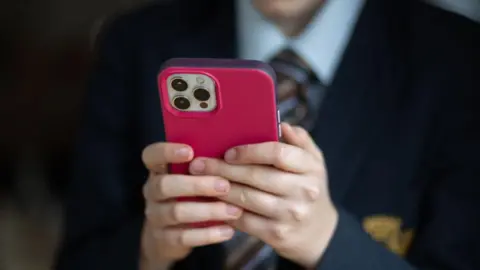 Matt Cardy/Getty Images
Ceredigion council is urging parents to delay giving smartphones to children under 14
Council officials vowed to work with schools and families across the county to encourage participation in the scheme.
In February 2024, the UK government issued guidance on smartphone use in schools, after which a number of schools introduced bans or restrictions during the school day.
However, in March 2025, a Senedd inquiry concluded that smartphones should not be banned outright from schools in Wales.
Instead, the Petitions Committee said schools should receive more support from the Welsh government to set their own restrictions.
A report said there was "plenty of evidence" that smartphones could cause harm, but also that they could play a role in supporting young people's welfare and safety.
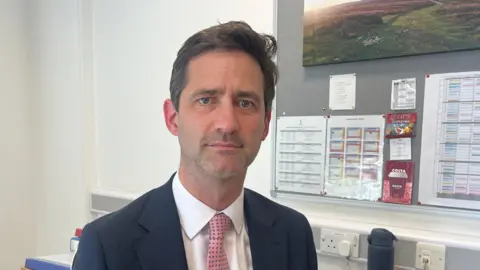
Hugo Hutchinson said he felt many parents were "grateful" schools were stepping in
According to communications regulator Ofcom, 90% of children in the UK own a mobile phone by the age of 11, including nearly a quarter of five to seven year olds.
"The evidence is clear that reducing early access to smartphones can support wellbeing, safety and positive social relationships," said Wyn Thomas, Ceredigion's cabinet member for schools.
"We are proud to work with families and schools across the county to create an environment where children can grow, learn and thrive without the unnecessary pressures of rapidly changing technology."
In 2025, Monmouthshire council said it believed it was the first county in the UK where all primary and secondary teachers in both state and private schools were advising against smartphones for children under 14.
"We've got reports of students who are online at two, three, four in the morning," Hugo Hutchinson, Monmouth Comprehensive headteacher, told the BBC last July.
"We get a lot of wellbeing issues, as do all schools, that come from social media activity online over the weekend or when they should be asleep."
He said while schools had introduced "robust" phone policies, much of children's time was spent outside school, where access to smartphones was harder to control.
What is Smartphone Free Childhood?
Smartphone Free Childhood was founded by two parents in February 2024 and began as a WhatsApp group that later went viral.
Co-founder Daisy Greenwell said it now had local groups in every UK county and thousands of school groups.
The organisation says more than 165,000 families have signed its Parent Pact in eight months, representing more than 40% of schools nationwide.
It argues smartphones have "changed the shape of childhood" over the past 15 years and that parents often feel torn between allowing phone access or risking social isolation for their children.
"Smartphone Free Childhood isn't about banning tech or turning back time, it's about giving children more of what really matters - time, connection, and freedom to be kids," the group said.
The campaign has been backed by well-known parents including Paloma Faith, Benedict Cumberbatch and Joe Wicks.
As part of its commitment, Ceredigion council has shared guidance with schools and provided practical resources to help families reduce screen time and support healthier digital habits.


