3 hours ago
5
3 hours ago
5

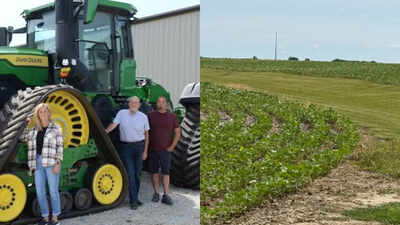
The Kellogg story is also one of persistence. He began farming at 14 after his father left agriculture to care for his ill wife. By his senior year of high school, Bill was managing 700 acres, much of it through relationships with older farmers in the community.
For Bill Kellogg, conservation did not begin with a government program, a sustainability label or a push for recognition. It began with gullies. Watching water repeatedly carve through his family’s rolling farmland convinced him that the way the ground was being worked had to change.
What followed was a decades-long effort to protect the soil while building a larger, more efficient and profitable farm. Scroll down to read the details.
From erosion control to precision farming
According to a report by Farm Progress, Kellogg’s original 700-acre operation has expanded to about 8,000 acres, with 1,800 acres owned and the remainder rented. Along the way, conservation evolved from grass waterways and water and sediment control basins into a much broader system.
Today, the Hardin County farm uses grid soil testing, no-till and strip-till practices, precision nutrient management, cover crops, buffer strips, subsurface drainage, pollinator habitat and about 60 acres of waterways.The shift toward precision agriculture accelerated when Bill’s son, Shane, became involved in the operation. Grid soil sampling began in 1999, giving the family a clearer picture of how nutrients were moving through their fields and how the soil responded to management decisions.
Strip-till eventually became a particularly visible part of the farm’s approach. Instead of broadcasting fertilizer across an entire field, the Kelloggs began banding nutrients where crops could access them more efficiently. The approach has helped reduce fertilizer use while maintaining or improving yields, states the online report.
Adapting instead of following a formula
The Kelloggs do not treat conservation as a one-size-fits-all system. Cover crops, for example, are used selectively, particularly on rolling ground where they can provide greater erosion protection.
The farm also is not strictly no-till. Tillage generally remains shallow, rarely going beyond two inches except when drainage or leveling work requires deeper disturbance, and that flexibility extends to fertilizer decisions.
With phosphate prices expected to rise above $900 per ton, the family is reconsidering chicken litter as a nutrient source, adds the Farm Progress report. The farm used the material 15 to 20 years ago and is now examining whether bringing it back could make economic sense.
A farm built through difficult times
The Kellogg story is also one of persistence. He began farming at 14 after his father left agriculture to care for his ill wife. By his senior year of high school, Bill was managing 700 acres, much of it through relationships with older farmers in the community. The farm survived the severe agricultural crisis of the early 1980s, when Bill faced foreclosure and sold possessions to keep the operation afloat. A combination of family help and a shrewd investment in payment-in-kind certificates helped him emerge from the debt crisis, states the report.
Those experiences shaped a straightforward financial philosophy: profitability matters alongside stewardship. And that principle remains central as Shane manages the farm’s day-to-day operations and works to expand what his father built.
Conservation as a family legacy
The Kelloggs’ conservation work gained a wider audience after they joined a Farm Bureau and Natural Resources Conservation Service demonstration project following the 2014 Toledo water crisis.
The family later became involved with H2Ohio and has opened its farm to thousands of visitors, including students, officials and journalists.Their efforts recently earned the family the Ohio Conservation Farm Family Award. The farm now involves multiple generations, with Bill, Shane, Jacinta Burd and their families contributing to its future.Images Courtesy: Farm Progress