1 hour ago
4
1 hour ago
4

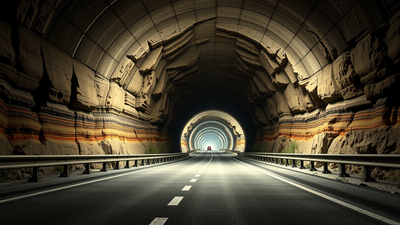
While most coverage of Norway's Rogfast tunnel focuses on the record it will hold, the world's longest and deepest undersea road tunnel, the real story engineers are dealing with sits underground, in rock that has spent millions of years being crushed, fractured and folded into some of the most unpredictable terrain along the entire Norwegian coast.
Stretching nearly 27 kilometres beneath the Boknafjord and reaching almost 400 metres below sea level, Rogfast is not just a длинный tunnel; it is a direct fight against unstable geology, constant saltwater pressure and a fjord shaped by forces engineers cannot always predict in advance.
Why the Boknafjord posed such a difficult engineering problem
Boknafjord is one of the largest fjords in Norway, stretching 45 kilometres inland and reaching depths of hundreds of metres, cutting straight through a region responsible for a large share of the country's fishing, oil and gas industries.
For decades, crossing this fjord meant relying on a patchwork of tunnels, bridges, ferries, and islands strung together in sequence, a route that grew increasingly inadequate as truck traffic through the area kept climbing well above the national average.
Rather than adding yet another ferry link, Norway chose to go straight through the rock beneath the fjord instead.
Drilling through fault zones and unstable rock
What makes Rogfast especially demanding is not just its length but what lies beneath it.
The tunnel route passes through several distinct bands of rock, and between them sit fault zones where millions of years of geological movement have left the ground crushed and fractured. Some sections, like the dense phyllite found at the southern end, are relatively straightforward to excavate. Other sections have proven far less predictable, forcing engineering teams to constantly adjust their approach as conditions shift metre by metre underground.
Fighting saltwater leaks nearly 300 metres down
Working this deep below the seabed brings a problem that has nothing to do with drilling itself: keeping saltwater out. According to Anne Brit Moen, a project manager working on Rogfast, crews reached roughly 300 metres below sea level and immediately began dealing with extensive saltwater leaks pushing into the tunnel system. To manage this, engineers have relied on specialised grouting and sealing methods designed specifically for deep marine geology, injecting material into the surrounding rock to seal off water before construction can safely continue.
As Norwegian Public Roads Administration project manager Oddvar Kaarmo explained to Euronews, Norwegian regulations require at least 50 metres of solid rock between the tunnel and the sea above, a safety margin engineers rely on for durability under this kind of pressure.
Building through solid bedrock instead of prefabricated sections
Unlike similar undersea crossings elsewhere in Europe, such as the Fehmarn Belt tunnel currently being built between Germany and Denmark using prefabricated modular sections, Rogfast is being drilled and blasted directly through solid bedrock.
This method takes longer and is considerably more demanding, but it is one Norway has refined over decades of tunnel construction, giving the country genuine world leading expertise in this specific type of underground engineering.
Construction is happening simultaneously from three separate access points, with teams working from the north, south and centre of the route at once to speed up an already lengthy project.
An underground roundabout unlike anything built before
Roughly halfway along the route, engineers are building something that has never been attempted in quite this way before, a junction connecting the main tunnel to a spur leading up to Kvitsøy, Norway's smallest municipality. This connection includes two roundabouts sitting around 260 metres below sea level, designed so traffic can keep flowing through one tunnel tube even if the other needs to close for maintenance or an emergency.
Getting this junction to work reliably at such depth, while still meeting strict safety standards, has required its own dedicated engineering solutions separate from the rest of the tunnel.
A project already reshaped once by its own complexity
Rogfast's difficulty has already left a mark on its history. Construction first began in 2018 but was halted in late 2019 after predicted cost overruns forced planners back to the drawing board, eventually pushing the total budget up by around eight billion Norwegian kroner. According to Norconsult, the engineering firm involved in the project's design, work resumed from 2021 with contracts for the tunnel's northern, southern and central sections signed between 2022 and 2024, giving the project a fresh, more realistic footing after its earlier setbacks.
What Rogfast means for the engineers who come after it
Norway still has dozens of fjord crossings left to complete along its wider E39 coastal highway, some of which present engineering problems that remain unsolved even on paper, including a proposed floating tunnel that would hang suspended just beneath the water's surface elsewhere along the route. Whatever solution eventually gets built there, it will likely be shaped by lessons learned on Rogfast first. For a country whose relationship with its coastline has always meant negotiating with difficult terrain rather than simply overcoming it, Rogfast stands as the latest and most technically demanding chapter in that long-running relationship between Norwegian engineers and the ground beneath their feet.