1 month ago
48
1 month ago
48

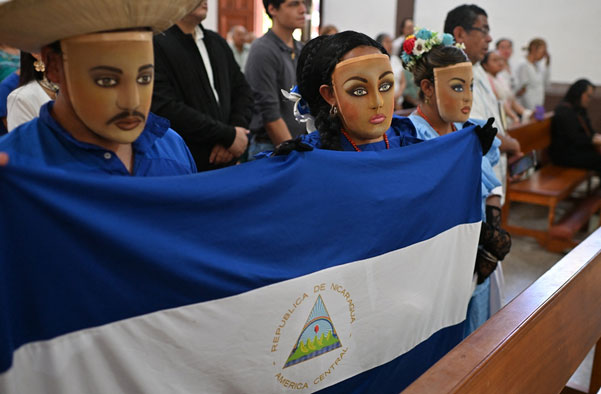 Exiled Nicaraguans hold a national flag in the Church of San Francisco in San José, Costa Rica, at a service held on 19 April 2026 to commemorate the anniversary of protests in 2018. Credit: Ezequiel Becerra/AFP
MONTEVIDEO, Uruguay, August 12 (IPS) - On 19 July, the 47th anniversary of the Sandinista revolution that first brought him to power, Nicaraguan President Daniel Ortega declared that his country would hold ‘no more elections’ so that the opposition could never again try to ‘seize power’. Just like that, he scrapped a presidential vote that had previously been pushed back to 2027, abandoning even the fiction of democratic legitimacy. The move changes little in practice, since no free vote had been possible for years. But it’s still revealing: a government that controls the army, the courts, the electoral machinery and the police, and will still not risk even a stage-managed ballot, is one that has lost confidence in its people.
Civil society dismantled
The abolition of elections is the political capstone of a longer-term project to eliminate every organised space beyond the ruling family’s control. A constitutional overhaul ratified in January 2025 extended Ortega’s term, elevated his wife, Rosario Murillo, from vice-president to ‘co-president’, and handed the couple control over every branch of the state, with their son, Laureano Ortega Murillo, positioned as monarchical heir apparent. Scrapping elections that had already been emptied of any meaning removes the last formal mechanism through which power in Nicaragua might, however unlikely, have changed hands.
Since 2018, the government has shut down over 5,500 civil society organisations, close to 80 per cent of what existed. Its net has encompassed trade unions, women’s groups, universities, independent media and religious bodies, with the Catholic Church a particular target. The legal profession is the latest victim. In early July, some 2,000 lawyers found their licences to practise revoked overnight, without notice or appeal, effectively leaving many Nicaraguans without legal defence.
The Group of Human Rights Experts on Nicaragua, mandated by the UN Human Rights Council, has concluded that the government has weaponised every arm of the state and its abuses amount to crimes against humanity committed as deliberate policy. It has documented chains of command linking the presidency to local officials, and named 54 officials responsible for the repression.
Repression beyond borders
Persecution has forced over 935,000 people, roughly one in eight Nicaraguans, into exile since mass protests in 2018, which security forces suppressed by killing more than 300 people. But exile offers no safety. A 2025 report by the Group of Human Rights Experts shows the regime runs an extensive transnational intelligence and surveillance network using the army, police, foreign service and informal agents to track critics abroad, monitor their communications and threaten their families back home.
For a growing number, surveillance leads to violence. In June 2025, Roberto Samcam, a retired army major turned prominent critic, was shot dead at his home in Costa Rica by an assassin posing as a delivery driver. He was one of at least four exiled opposition figures killed in Central America since 2022. Many more have survived attempts on their lives.
The regime has also stripped hundreds of critics of their nationality, including 222 political prisoners it expelled to the USA in 2023 and 135 it shipped to Guatemala in 2024, and made changes to the Penal Code to prosecute ‘crimes against the state’ committed abroad.
Aware that international bodies offer a route to accountability, the regime is moving to close it off. Having quit the Organization of American States in 2023, Nicaragua withdrew from the UN Human Rights Council and four other multilateral bodies in 2025. Yet some mechanisms do not need its consent. Two months after the government announced it was quitting, the Human Rights Council renewed the Group of Experts’ mandate for a further two years. An Argentine judge, acting under universal jurisdiction, has issued arrest warrants for Ortega, Murillo and other senior officials. The legal instruments exist, but the will to use them is often missing.
Democratic states have supplied little of that will. The USA does not recognise Ortega’s government, yet in September 2025 the Trump administration terminated Temporary Protected Status for Nicaraguans, asserting that the country was now safe for their return, a claim at odds with UN findings. This left thousands exposed to deportation.
Ortega has meanwhile leaned on autocratic friends, with China now his main source of funding and Russia supplying intelligence and security advice and training.
Long-term pressure needed
Ortega will have watched Venezuela closely. In 2024, Nicolás Maduro allowed the holding of an election he was sure he had won in advance, having stopped the main opposition candidate standing, only to see a little-known substitute become the catalyst for years of pent-up discontent. Scrapping elections spares Ortega that danger, at least in the short term.
Over the long term, pressure for the restoration of democracy will depend on the endurance of Nicaraguan civil society, at home and in exile, and on democratic states being willing to hold the regime to account. Neither can be taken for granted. The movement best able to sustain the fight has been driven abroad, where it also faces persecution, and the government best placed to shelter these exiles is busy sending them back home.
Inés M. Pousadela is CIVICUS Head of Research and Analysis, co-director and writer for CIVICUS Lens and co-author of the State of Civil Society Report. She is also a Professor of Comparative Politics at Universidad ORT Uruguay.
For interviews or more information, please contact [email protected]
© Inter Press Service (20260812085734) — All Rights Reserved. Original source: Inter Press Service