2 months ago
42
2 months ago
42


 Bethany Handley
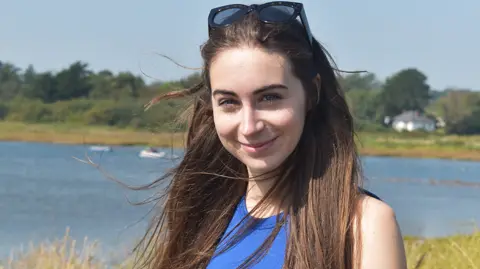
Bethany Handley grew up in nature but struggles to enjoy it in the same way now after illness left her unable to walk
Bethany Handley practically lived outdoors from the time she could toddle.
Growing up in rural Monmouthshire, she regularly got covered in mud and played for hours in the woods with her younger brother, damming rivers and making dens.
"All my early memories are of being a bit feral."
The family were keen hikers, climbing mountains like Sugarloaf and the Skirrid, trips to the beach led to bodyboarding and later surfing while closer to home they kayaked down the River Wye.
But it was not to stay that way.
Years of worsening health led to declining mobility and, three years ago, Bethany lost the use of her legs completely.
While she has dedicated herself to reclaiming the natural world for all people who feel shut out from it, she said: "I think it was more disabling than my medical conditions coming home and realising that I was literally padlocked out of all my favourite landscapes."
 Bethany Handley
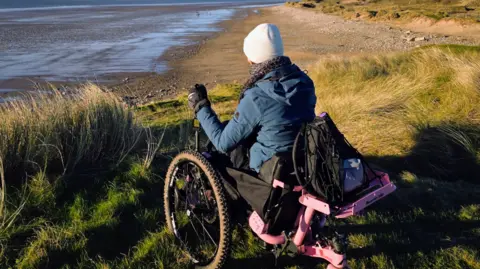
Bethany in her all-terrain trike at Sker Beach, Porthcawl. Some of her earliest memories were of being on a beach
Bethany, 26, was born with a visual impairment that made taking part in ball sports and anything needing depth perception difficult in school.
Her active lifestyle at home helped overcome feeling of not being sporty, despite always being "clumsy".
"All in all, an idyllic childhood in nature."
At the start of her GCSEs she developed glandular fever and "didn't really recover".
From there, she had more diagnoses, including endometriosis when she was 16.
Fatigue meant losing strength in her legs and she developed a condition that caused frequent fainting, while the underlying cause remained a mystery.
Despite this, she continued her connection with the natural world and took time after leaving school to work as an outdoor pursuits instructor before going to university in St Andrews.
But illness forced her to drop out and she eventually studied at Cardiff University so she could get more support.
Part of her course was creative writing - something she had always enjoyed from the days of "writing plays and being really bossy, directing my brother and making him act them out".
She also created poetry out of her teen experience of chronic illness, but it wasn't until she received encouragement from lecturers that she began "sending work out to the world".
However, her health continued to decline and she had just turned 22 when she climbed to the summit of her last mountain - Cader Idris in mid Wales.
That evening, she collapsed on a kitchen floor.
"I'd still been able to hike, I just had to rest a lot afterwards. I could still wild swim, just have rest days.
"It just suddenly got a lot worse and I had to use a wheelchair part time because I couldn't really walk very far and I was fainting all the time. I had concussions all the time. It was getting really dangerous."
Because she could still sometimes walk, she wasn't eligible for an NHS wheelchair, so she used her student loan to buy one from eBay, but it was made for a small woman.
"I'm 6ft. It was like riding a kid's bike."
 Bethany Handley
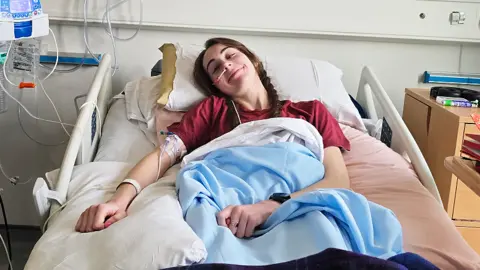
Bethany has had a number of long hospital stays and now needs to be fed by tube
Housemates pushed her around in the "awful" chair, where going over potholes or uneven ground would see her thrown out of it.
Despite that, she grew to love it.
"I heard all the time people saying, 'if you use a wheelchair, it's giving up', which is ridiculous when using a wheelchair in that situation is the bravest, most courageous thing you can do – live your life and still keep going out."
After a period of adjustment before seeing the chair as freedom, Bethany was able to go clubbing in her final year of university and get out into the parks of Cardiff.
But a year after her last trip up a mountain, while working in communications, she became so ill her parents had to rush her to hospital, where she realised she could not feel her legs.
After a long and debilitating stay in hospital, she became a full-time wheelchair user and could not return to her own step-fronted home or get accessible accommodation.
She had to live in her parents' front room, sleeping on a sofa, and had to shower at a nearby leisure centre for more than a year as she "had no access to a bathroom at all".
 Bethany Handley
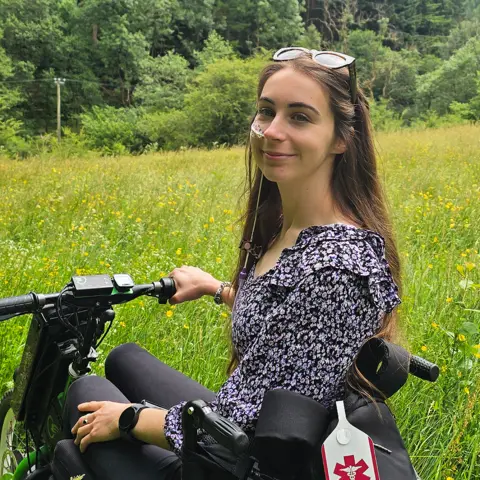
Bethany explores the parallels between physical disability and the degredation of the natural world in her book
Being removed from contact with the natural world was almost worse.
"I think it was more disabling than my medical conditions coming home and realising that I was literally padlocked out of all my favourite landscapes.
"From where I live now there are seven stiles within a mile of my home, so that's seven places I can't access."
Now in an NHS-issued wheelchair, it was too heavy to get to and around the places she wanted to return to so Bethany crowdfunded and applied for charity funding to get a lightweight chair, which made "such a difference".
"I can now return to most of the places I want to access".
Bethany talks about the social model of disability - it is not the person's condition but the societal and physical environment that hold them back - and while conversations around barriers in towns and cities have improved, that is not the case for the countryside.
"We understand that if you've got a step to access a coffee shop it might be hard but I don't think we talk enough about the barriers that exist to accessing nature.
"It's often not the landscape itself. It's not mud or grass or sand, if you're lucky enough to have the equipment. It's the barriers that we put in. We design people out of nature.
"We don't think who we're excluding when we put up some kind of boundary... padlocked gates, stiles or tiny kissing gates which are all barriers that don't need to exist."
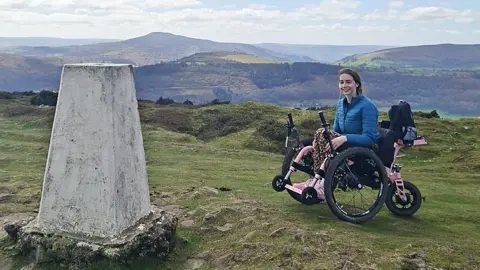 Bethany Handley
Bethany has recently returned to the tops of the Black Mountains after many years' absence
She has returned to many of the activities she loved as an able-bodied person, including kayaking and being in the sea, just in a different way.
"My brother adapted a surfboard for me – he put handles on a board so I'm surfing again, which I didn't think would be possible."
An all-terrain wheelchair allowed her to recently go up a ridge on the Black Mountains.
"It felt really defiant, because nobody expects to see a wheelchair user on top of a mountain ridge because we don't design access."
She borrowed money and built a "tiny, accessible" home next to her parents' and lives beside a meadow she is helping to rewild.
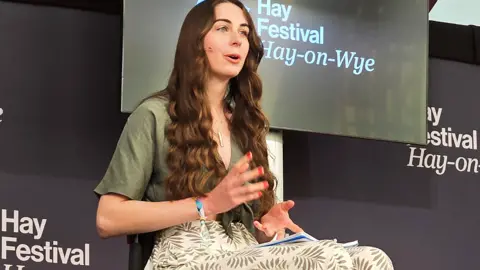 Bethany Handley
Bethany - who has had a pamphlet of poetry published and edited a collection of writing - has spoken at the Hay Festival in Powys
When she was in that hospital, Bethany felt like "I'd never access nature again".
After proving herself wrong, she has gone on to write a book partly about her experiences entitled My Body is a Meadow, about reclaiming the natural world for all who feel shut out from it.
"I also wanted to share the importance of finding joy. We don't talk enough about how grief and joy can co-exist and that it's OK to be angry at the barriers or discrimination you're facing.
"I just want other people who either have grown up disabled or have acquired an impairment to see role models and hear these stories.
"You can access landscapes again. There will be places that welcome your body and your way of moving. Our right to access nature is just as valid as that of a non-disabled person."
Although her own health continues to decline – a serious infection left her unable to eat and she has to be tube fed – she still looks for things which are "joyful", whether it is watching birds on a feeder or meeting loved ones, and is planning future writing projects.
Ironically, if it weren't for illness, she may never have become a writer at all.
"I was working in a nine-to-five job. And in some ways, having to start again and rebuild my life set me free in a strange way and gave me the courage and the support network to be able to start writing full time."