1 hour ago
5
1 hour ago
5

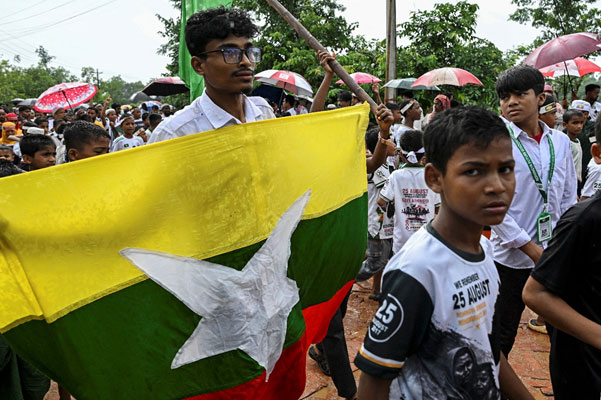 A Rohingya refugee carries Myanmar's national flag during a Genocide Remembrance Day rally marking the anniversary of their mass exodus at a refugee camp in Bangladesh on 25 August 2026. Credit: Abdul Goni/AFP
LONDON, September 25 (IPS) - On 15 September, Norwegian police and security services raided the headquarters of Telenor in Oslo. Authorities accuse the multinational telecoms company, majority owned by the Norwegian state, of aiding and abetting crimes against humanity in Myanmar and breaching sanctions.
Telenor sold its Myanmar subsidiary in March 2022, in the wake of the military coup that ousted the country’s democratically elected government in February 2021. An August 2025 Norwegian Broadcasting Corporation investigation reported that ahead of its exit, Telenor had complied with military requests to hand over customer data. It’s alleged that call log and location data may have helped the military track, capture and kill democracy activists, including campaigner Ko Jimmy, executed in July 2022.
Civil society warned of the dangers when Telenor prepared to sell its subsidiary to a joint venture between a Lebanese group and Thein Win Zaw, a Burmese entrepreneur accused of having close military ties. It has kept up the struggle for accountability. Justice for Myanmar, a covert activist group, worked with the International Commission of Jurists to collect documentary evidence on Telenor’s role and filed police complaints in December 2024 and October 2025.
Telenor is also subject to a lawsuit brought by a group of civil society organisations last October, alleging the company passed on data of over 1,200 people. In addition, the company has been found in breach of the Organisation for Economic Co-operation and Development’s Guidelines for Multinational Enterprises on Responsible Business Conduct.
International complicity
The Telenor case focuses attention on the wider networks of companies and states that are propping up the regime and keeping Myanmar’s civil war going.
Following the coup, almost all states refused to recognise Myanmar’s military rulers and continued to regard the exiled National Unity Government as the country’s legitimate representative. But several authoritarian states have since swung behind the junta. Russia leads the pack, with Vladimir Putin hosting junta leader Min Aung Hlaing for repeat visits in Moscow. China, India, Singapore and Thailand have joined Russia in supplying weapons.
Many Chinese companies collaborate with the regime, among them Geedge Networks, a tech company with close links to the Chinese state that specialises in online surveillance. The company is helping the military install a version of China’s ‘great firewall’ so it can systematically restrict internet use, access users’ data and identify and track down dissenters.
The junta made a concerted effort to gain international legitimacy with a sham election in December 2025 and January 2026. It extensively prepared the ground by replacing the civilian electoral commission with a military-controlled body, banning pro-democracy parties and prohibiting political rallies, ensuring a military puppet party faced only token opposition. A new election law enabled it to criminalise over 300 people for criticising the election. Authorities jailed some merely for liking social media posts and handed 37-year sentences to eight activists for taking part in a protest calling for a boycott. There were also reports of threats to withhold aid from displacement camps unless people voted.
After the military’s party duly won, Min Aung Hlaing transitioned from general to civilian and became president in April. That same month, a group of civil society organisations filed a complaint against him in Indonesia over his role in the 2017 genocide of Rohingya people. Despite this legal action and the election’s evident lack of credibility, an array of non-democratic states including Belarus, China and Russia were happy to endorse the result.
While the Association of Southeast Asian Nations (ASEAN) didn’t recognise the election, its most authoritarian members, Cambodia, Laos and Vietnam, backed it anyway, and the bloc has consistently stuck with its failed Five Point Consensus, a plan agreed with the junta in April 2021 that the military has never respected.
The US government has also shifted its position. In 2025, the Trump administration cut funding to independent Burmese media, lifted sanctions against junta-controlled businesses and arms dealers supplying the regime and removed protections from Burmese refugees living in the USA, citing governance improvements. It treated the junta as a legitimate counterpart by sending it a letter about tariffs. In May, it was revealed the junta gives Roger Stone, a long-time Donald Trump ally, US$50,000 a month to rebuild relations with the USA. Mineral deposits are likely in the Trump administration’s sights.
Civil war continues
The Telenor raid has momentarily brought Myanmar back into the headlines. Its civil war has otherwise gone on for almost five and a half years with little global attention. Sparked by the army’s violent suppression of democracy protests, it pits the military against armed pro-democracy forces, both backed by a variety of ethnic militia. The army controls the main population centres and has recently regained some territory, but there’s no end in sight.
The army has committed numerous crimes against humanity and war crimes. A September 2025 UN report painted a harrowing picture of airstrikes on schools and the destruction of villages. This year, the conflict has escalated across the Magway Region, with the army and associated militia mounting armed assaults on villages, burning homes and using drones to kill civilians, including children.
Recent escalations of conflict have driven further displacement. At the same time, monsoon rains across several regions in July and August caused floods that left villages isolated and increased disease risks. As needs have grown, the healthcare system is collapsing due to military attacks on facilities and workers, while humanitarian aid and vital health supplies are further constrained by military checkpoints, road closures and movement restrictions.
The Telenor case has the potential to challenge impunity. It should refocus the minds of democratic states and companies headquartered in them, offering a warning that they can be exposed for complicity in the junta’s atrocities. It should give fresh impetus to civil society’s efforts to hold states and companies to account. By standing with civil society, in Myanmar and around the world, democratic states can put themselves on the side of human rights and justice.
Andrew Firmin is CIVICUS Editor-in-Chief, co-director and writer for CIVICUS Lens and co-author of the State of Civil Society Report.
For interviews or more information, please contact [email protected]



© Inter Press Service (20260925144147) — All Rights Reserved. Original source: Inter Press Service