1 hour ago
3
1 hour ago
3

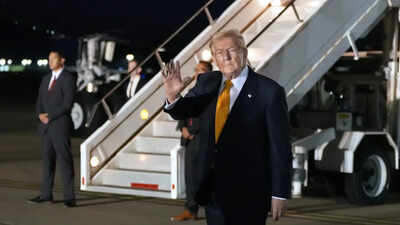
US President Donald Trump waves as he switches planes at US Air Force Base in England, on his way back to Washington from the Nato summit in Turkey
US President Donald Trump was secretly moved to a smaller military aircraft after a credible and imminent threat that a shoulder-fired missile could target his plane during his return from Turkey last month, according to people briefed on the matter cited by Reuters.The extraordinary security operation took place on July 8, the final day of Trump's visit to Ankara for the Nato summit, as tensions with Iran were running high.Trump and a small group of aides were moved from the presidential aircraft to a nondescript C-32A jet using a catering truck, while the larger aircraft continued its journey carrying senior administration officials, White House staff and journalists.The operation was kept secret to conceal the president's movements.
Secret Service acted on credible, imminent threat
According to a person briefed on the matter, the Secret Service determined that the threat was credible and imminent and had little time to prepare an alternative travel plan.A second source told Reuters that there was no clear operational plan by Trump's potential attackers, but there was an apparent intent to target him. That assessment allowed the aircraft to continue flying while additional precautions were taken.
The sources did not disclose where the intelligence about the threat came from.Trump confirmed on Tuesday that the Secret Service had ordered him to use a different aircraft, although he did not disclose details of the threat."It's only up to the Secret Service. I just follow what they'd like to do, so I go by Secret Service and the military," Trump told reporters.He added that the aircraft he ultimately travelled on may have been at greater risk because an attacker would have been more likely to target the plane believed to be carrying him."I think actually the plane that I flew on was at greater risk," Trump said. "I think it was at greater risk because that would be the plane I think that they'd be more likely to go for."
Air Force One used as a decoy
Trump had travelled to the Nato summit aboard a newer Boeing 747-8 aircraft gifted by Qatar and retrofitted for US use. For the return journey, however, he had publicly indicated that he would initially use the older Air Force One aircraft.Trump boarded the presidential aircraft in Ankara as expected. He was then secretly moved to a smaller C-32A, a modified Boeing 757 commonly used for senior US officials, through a catering truck.Meanwhile, the larger aircraft departed separately with Secretary of State Marco Rubio, Treasury Secretary Scott Bessent, White House staff and the travelling press corps.The operation was designed to make it appear that Trump was still aboard the presidential aircraft.Rubio was aware of the aircraft switch and the threat behind it. A senior US official told news agency AP that Bessent was likely aware of the situation, although the official could not confirm it.Trump's security arrangements were more extensive because of the specific threat to the president, the official said.
What kind of missile raised concern?
The nature of the reported threat has not been publicly confirmed by US officials.Douglas Birkey, executive director of the Mitchell Institute for Aerospace Studies, told Reuters that one possibility was a newer type of heat-seeking missile designed to home in on an aircraft's hot engines.Such weapons can be difficult to detect because they do not necessarily emit the radio signals associated with radar-guided systems.Birkey cited the Iranian SA-67 as one possible example, describing it as a weapon believed to have heat-seeking and laser-guidance capabilities. He also pointed to Russia's shoulder-launched 9K333 Verba system.However, there has been no public confirmation that either weapon was involved in the threat against Trump.
Journalists on board did not know Trump had left
The secrecy of the operation meant that journalists and some White House staff travelling on the larger aircraft were unaware that Trump had been moved to another plane.The Washington Post first reported details of the operation this week, more than a month after it took place. The New York Times subsequently reported that US intelligence officials had been concerned that Iranian operatives knew where Trump was staying in Ankara, including the floor of his hotel.Journalists aboard the aircraft were instructed to keep the window shades closed. The White House Correspondents' Association later said members of the travelling press noticed unusual security arrangements around the plane.Trump eventually flew to a refuelling stop in Britain without incident and later transferred back to the legacy presidential aircraft before continuing his journey to the US.
Questions over 'decoy' plane and passenger safety
The operation has raised questions about the safety of those who remained aboard the aircraft believed to be carrying the president.Among those passengers were senior members of Trump's Cabinet as well as journalists.Some commentators and lawmakers have questioned whether using the presidential aircraft as a decoy could have exposed those passengers to danger if an attack had occurred.The Reuters source said officials nevertheless determined that concealing Trump's movements was in his best interests given the heightened tensions with Iran.Presidential security is treated differently from that of even the most senior Cabinet officials.Under the US Constitution, the secretary of state and secretary of the treasury are among those in the presidential line of succession, but they do not receive the same level of protection as the president.
Trump had warned of Iran threat
The incident came against the backdrop of heightened US-Iran tensions and renewed American military action against Iran.Trump had previously said that he was a major target for Iran and acknowledged on Tuesday that he regularly receives threats."I guess there was a threat out there," Trump said, according to the BBC's earlier report. "I didn't really ask too much about it. I get a lot of threats."He added, "I have a lot of threats that you don't know about."US presidents have previously travelled secretly during high-risk trips, particularly during visits to war zones.But the Turkey operation was unusual because it involved creating the appearance that Trump remained aboard one aircraft while secretly moving him to another, with members of the travelling press corps unaware of the switch.