2 months ago
40
2 months ago
40


 PA Media
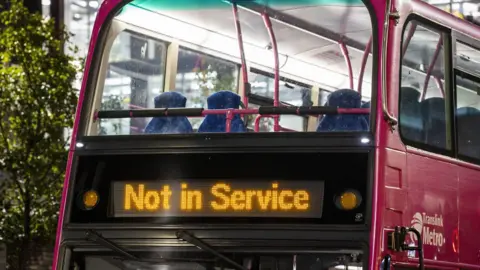
Cuts to services across Metro, Ulsterbus and NI Railways are being explored under Translink's proposals
The Infrastructure Minister Liz Kimmins has defended freezing bus and train fares across Northern Ireland, despite warnings from Translink that it could reduce public transport services and discounts.
Translink is publicly owned but operates at arm's length from Stormont's Department for Infrastructure (DfI).
Despite proposals to cut services, Kimmins said on Sunday that her decision last month to freeze fares for a second year running was the right move.
Kimmins said "for every decision there is a consequence and in this case I feel that the consequences of increasing fares would have been far more detrimental than freezing fares".
She said she would continue to work with Translink "so that we can find solutions and find a way forward".
Translink's Chief Executive Chris Conway previously told a Stormont committee that freezing fares has cost more than £20m of revenue over the past nine years.
However, speaking on Sunday, the minister said that putting fares up "at a time when people are struggling would act as a deterrent for people to use public transport, so we have to get the balance right".
She said there were challenges as there had been "consistent underfunding" for budgets, "which makes it difficult for me as minister and previous ministers to fund Translink and everything else that we are trying to do".
"People are really pinned to their collars here," she told the BBC News NI's Sunday Politics programme.
She said: "people are really under serious financial pressures" with the cost of fuel.
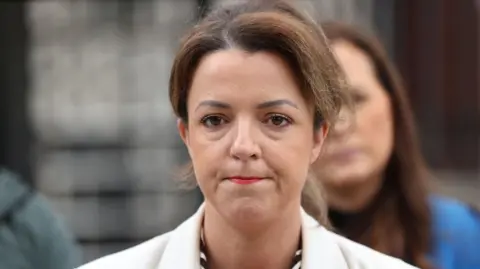 PA Media
Liz Kimmins said she would continue to work with Translink "so that we can find solutions and find a way forward"
Democratic Unionist Party (DUP) MLA Deborah Erskine said that "you can't put a freeze on fares" and then expect Translink to still provide the same services.
"You can't expect Translink to still turn up at all the stops that they have across Northern Ireland," she added.
She said services in her consistency will likely be affected.
"What it is going to mean for an area like Fermanagh and South Tyrone is services are going to be cut, services that are vital to connect communities and it is going to hurt homes right across Northern Ireland."
"That was the minister's decision, she can't blame the Brits for that decision, that was her decision, that she took."
Erskine said she did not "disagree with the financial situation that we are in" and that politicians were "making the case to Treasury that we need to be fairly funded".
"We should be expanding our public transport network right now," she said.
On Wednesday, Chris Conway acknowledged cuts to Translink services would be "very disappointing and concerning" for passengers, but said the measures were to "protect Translink from a financially unsustainable position".
A spokesperson for DfI said there is no agreed budget, and added that the department continues to work closely with Translink.
Conway also said previously that its public service agreement "has not been funded by DfI over the last couple of years" and subsidies per passenger were "well below other regions in the UK and Ireland".
Finance Minister John O'Dowd published a draft multi-year budget in January.
It is due to cover the three years from 2026 to 2029 but has not yet been agreed by all the executive parties.
This means government departments started the financial year in April without being certain how much they have to spend.
The Northern Ireland budget is largely dependent on the money provided by the Treasury through what is known as the block grant.
There was a large increase in spending after the first budget from Chancellor Rachel Reeves as she sought to give NHS funding an immediate boost.
However, spending growth is set to slow sharply over the next few years. That is exacerbated at Stormont due to the end of one-off funding provided when devolution was restored in February 2024.