58 minutes ago
2
58 minutes ago
2

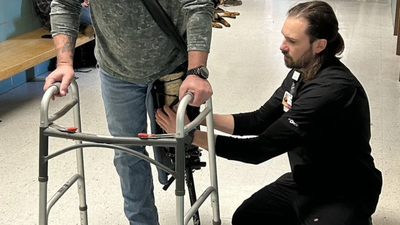
A Michigan man has been turning discarded bicycles into prosthetic legs while also teaching others how to make them, all for free. Ben Hogan, a former bike mechanic and prosthetist at Mary Free Bed Rehabilitation Hospital, founded Project Bike Leg, an initiative that makes prosthetics sourced almost entirely from repurposed bike parts.
He hopes his low-cost design can eventually help millions of amputees around the world, according to a report by PEOPLE's Toria Sheffield.Hogan worked at the Michigan State University Bikes Service Centre as a student 20 years ago, where he learned to repair bikes. Bike shop general manager Tim Potter trained Hogan. “When I think about it, you know, I mean, it sometimes will tear you up,” said Potter.Hogan revealed that it all began with a random encounter. “I had a chance encounter with an amputee that walked into a bike shop I was working at in Los Angeles in 2011,” he said to the outlet.
“He showed me his prosthesis unprompted, and it really informed me of how much a bike and a prosthesis had in common.” “After [later] shadowing some prosthetists at UCLA, I made the connection that it was my calling,” he added.Moreover, he shared that his desire to create something both functional and cost-efficient only grew after he learned how many amputees worldwide do not have access to the prosthetics they need.
Citing World Health Organisation estimates, Hogan said that a "staggering 85-90% of amputees worldwide lack access to a proper prosthesis." “As a former bike mechanic turned prosthetist, I was naturally drawn to take a bicycle and turn it into a prosthesis,” he said.
“A bike, after all, is a tool used to enhance human locomotion. The inherent design would allow for an adjustable, lightweight, structurally sound and functional prosthesis.”After seriously working and experimenting with the designs, Hogan crafted his first below-the-knee prosthesis model within a few weeks in 2013. However, he said he decided to put the project aside until he had developed his skillset more fully. “Due to the fact that I had not yet achieved a master's vantage point of the prosthetic arts, I decided to set the bike leg down until I could say that I honestly had the advanced prosthetic skillset to ‘reinvent the wheel’ of prosthetic care,” he explained.It was in the summer of 2024 that he decided he was finally ready to return to the initiative, at which point he officially founded Project Bike Leg. “I had been working at Mary Free Bed Rehabilitation Hospital for the past 8 years and had a patient who was up for the challenge. Using all of the rudimentary concepts of prosthetics that I had come to know in the previous decade, I crafted a new design of a BK [below-the-knee] bike leg that had an enhanced level of adjustability and functionality compared to the previous model.
”Andy Leedom, who lost his leg five years ago in a car accident, is one of Hogan’s bike-leg testers. Leedom is on his third prosthesis, which cost nearly $70,000. “I call myself the guinea pig,” Leedom said. “Ben’s been to enough places that he knows what is needed.”He went on to design an above-the-knee model in 2025 and decided he felt ready to share his designs on a larger scale. The prosthetic is made from over 95% bicycle parts.
The foot is formed from a bike seat, strips of wheel and tyre treads, held together with spokes. The seat post and frame add stability. “If you look at the back of the knee, there are two chains,” Hogan said. “These hold the knee stable and there are two of them.
”The cable used to shift gears runs around the bike-leg to hold it together. The socket is made of wicker, which local communities could make out of material they have access to.
“It’s actually a perfect application for a prosthesis, because it’s already built to take the weight of a human, so all I’ve done is reconfigure it in a different way to be a prosthesis,” Hogan said.He soon met with a physician in Ghana, where he eventually travelled to personally teach prosthetics students how to recreate his designs. He shared that by the end of his nine-day trip he and the students had successfully completed their work on building two fully-made prosthetics and given two amputees the ability to walk again.
“And now they can train others in the Ghana region on how to make bike legs,” Hogan said.“This was a phenomenal experience that I will never forget, and I cannot wait to see what the local clinicians might do with the bike legs moving forward,” he said of the experience.Moreover, he is training thousands more across the globe on how to make their own prosthetic legs with the help of his website. He shares instructional videos on how to make both above-the-knee and below-the-knee bike leg prosthetics, with pages of pictures and step-by-step instructions.In a recent conversation with InvestigateTV about the project, Hogan said he has no intention to patent the design or personally profit from it. “I don’t have any intention of financially benefiting from it or patenting these designs,” he told the outlet. “I want them to be available to all parties all over the world.”For Hogan, the next step is a pilot study with amputees in third-world countries wearing bike legs full time. He hopes his invention will eventually help some of the 30 to 40 million people worldwide who need prosthetic legs.“As my sister said, your career should be your greatest gift to the world,” he said, “and I do think this is my greatest gift to the world.”