1 month ago
42
1 month ago
42

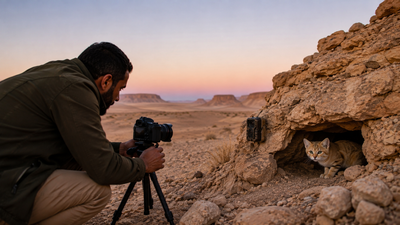
In 2017, Mohammed Almuntasir uploaded an 18-second YouTube video that appeared to show nothing more than a small sand cat sheltering beneath a desert shrub in Libya. The clip would later become the first documented evidence of the species in the country, prompting an eight-year effort to establish where the elusive animals were living.
Almuntasir was already familiar with sand cats, having seen them at night while photographing wildlife across Libya. But he had never managed to capture one clearly. “As soon as I saw the animal, I knew it was a sand cat because I had seen the species before at night,” Almuntasir told CNN via email. He added: “However, I had never been able to photograph it because I did not have a camera suitable for night photography, or camera traps.”
When zoologist Firas Hayder later saw the footage, he realised its significance: Libya’s sand cats had finally been documented.
Who is Mohammed Almuntasir, the Libyan Wildlife photographer
Almuntasir had encountered sand cats before the YouTube video, mostly during the night when the animals were active. His difficulty was getting a usable photograph. As he explained to CNN, he had never been able to properly photograph one because he did not have equipment suitable for night photography or camera traps.
The daytime encounter in 2017 therefore gave him something he had previously lacked: a clear record of an animal he already recognised.What surprised Almuntasir was the reaction to the footage. Big Cat Rescue reported that when he posted the video, “almost no one believed him” and that people told him the cat could not have been in Libya. Almuntasir continued to maintain that sand cats lived in several places near his home, including one location around 43 miles from Zintan.
Natural World Fund gives a similar account, quoting Almuntasir directly: “When I posted it, nobody believed it had been filmed in Libya.
” He said he kept insisting that the cats were present in several places.
How Firas Hayder and Mohammed Almuntasir began documenting Libya’s sand cats
The footage soon reached Firas Hayder, a zoologist specialising in small carnivores. When he contacted Almuntasir and learned that the animal had genuinely been filmed in the Al-Hamada Al-Hamra region, he realised that the seemingly ordinary encounter was important.
CNN quoted Hayder recalling his response: “I told him, ‘No!’” For Almuntasir, seeing a sand cat was familiar. For Hayder, it represented the first documented record.The two then began working together. Natural World Fund reports that Almuntasir agreed to collaborate on documenting the animal and registering it among Libyan wildlife species. In Hayder’s words, “He convinced me that we should collaborate on a study to document the return of this animal to Libya and register it among Libyan wildlife species.”
The project eventually moved well beyond the original video. Hayder taught Almuntasir how to record GPS coordinates and document sightings with photographs or video, while Almuntasir gathered information from local Tuareg communities familiar with the desert.The two then began working together. Natural World Fund reports that Almuntasir agreed to collaborate on documenting the animal and registering it among Libyan wildlife species.
In Hayder’s words, “He convinced me that we should collaborate on a study to document the return of this animal to Libya and register it among Libyan wildlife species.” The project eventually moved well beyond the original video. Hayder taught Almuntasir how to record GPS coordinates and document sightings with photographs or video, while Almuntasir gathered information from local Tuareg communities familiar with the desert.
Why documenting sand cats in Libya was so difficult
The practical work was demanding. Sand cats are mostly active at night, hide from extreme daytime heat and can travel over large areas. Their colouring makes them difficult to distinguish from the desert, while tracks can disappear quickly. CNN noted that wild sand cat kittens were only photographed for the first time in 2017, illustrating how little opportunity researchers have historically had to observe the species in the field.Almuntasir's familiarity with the landscape became important during the survey. Natural World Fund reports that he worked with local guides and followed tracks for days in some cases before locating burrows. He described how people in the area would tell him where they had seen sand cats, after which he would record the coordinates and plan trips to investigate those locations. “They would tell me about places where they had seen the sand cat and record the coordinates, and I would compile them all to plan a dedicated trip to visit each location,” he said.
According to the study published on ScienceDirect, titled ‘Rediscovering desert ghosts: new records and range extensions of the sand cat and Saharan striped polecat in Libya’, documented sand cats at 13 locations across the Libyan Sahara.
What Libya’s sand cat records mean for conservation
The records do not mean the sand cat has been newly classified as a threatened species. The species remains listed as “least concern” by the International Union for Conservation of Nature, although scientists have questioned whether that status adequately reflects pressures affecting populations living in fragile desert environments.
Hayder told CNN that small carnivores can also act as indicators of environmental conditions because they are sensitive to changes in temperature and habitat.
The Libyan records add information to a species whose distribution in the country had previously been poorly documented.There are also signs of direct human pressure. Sand cats are sometimes caught and sold as pets, while Natural World Fund says some animals were found being sold in local markets and others had been accidentally killed by hunters. The Natural World Fund article quotes Hayder making the wider conservation point: “All Libyans should be involved in conservation efforts.” He added that people need to feel that these species represent their environment and their country.
For Almuntasir, the story began with an 18-second recording. The research that followed has now provided a documented picture of sand cats living across parts of Libya, while leaving much of their desert habitat still to be explored.