2 months ago
52
2 months ago
52

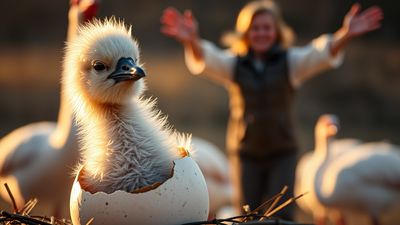
In 1976, ornithologist George Archibald began an unusual daily ritual, dancing beside a whooping crane named Tex in an attempt to save one of the rarest birds on the planet. Tex had been raised in captivity and had imprinted on humans rather than other cranes, meaning she showed no interest in mating with her own species.
Archibald, co-founder of the International Crane Foundation, spent years mimicking crane courtship behaviour beside her enclosure, hoping to trigger the hormonal changes needed for her to lay a viable egg. After seven years of dancing and several failed attempts, Tex finally produced a fertile egg in 1982. The resulting chick, named Gee Whiz, went on to father generations of whooping cranes and remains one of conservation's most remarkable success stories.
Why George Archibald danced with a whooping crane named Tex
According to the International Crane Foundation, Tex had been hand-raised at the San Antonio Zoo, which caused her to imprint on humans and reject other whooping cranes as potential mates. Since whooping cranes rely on elaborate courtship dances, involving wing flapping, bowing and jumping, to prepare physically for breeding, Archibald realised that only a human willing to perform this same ritual might be able to bring Tex into breeding condition.
Archibald moved into a small shack beside Tex's enclosure for extended periods each spring, spending countless hours dancing, calling and building nests alongside her in an effort to form what he described as a pair bond. Because whooping cranes were down to only around 100 individuals left in the world at the time, every genetically distinct bird like Tex represented an important part of the species' survival.
How artificial insemination finally produced a fertile egg
The courtship ritual alone was not enough to produce offspring, since Tex still needed to be artificially inseminated using semen collected from a male whooping crane.
Early attempts failed repeatedly. Tex laid her first egg at age ten, but it proved infertile. A fertile egg followed the next year, but the chick died just before hatching, and a later attempt produced only a soft-shelled egg that broke before it could develop.It was not until 1982, after seven years of Archibald's dancing routine, that Tex laid an egg that survived to hatching. According to the International Crane Foundation, the semen used for this successful insemination came from the USGS Patuxent Wildlife Research Centre in Maryland, a federal facility that has long played a central role in North American crane breeding programmes.
What happened to Gee Whiz and his descendants
The chick that hatched from Tex's 1982 egg was named Gee Whiz, and he lived at the International Crane Foundation's headquarters in Baraboo, Wisconsin, for the rest of his life. Despite never developing the same bond with Archibald that his mother had, Gee Whiz went on to sire numerous offspring of his own, becoming a foundational figure in the whooping crane's genetic recovery.Over the following four decades, Gee Whiz's descendants grew into a substantial lineage within the species, with the International Crane Foundation crediting him and his offspring with contributing a combined total of 178 chicks and grandchicks to the whooping crane's reintroduction efforts.
Given how few whooping cranes remained in the 1970s and 1980s, this single bloodline represents a significant share of the genetic diversity that conservationists have relied on to rebuild the population.
Why the whooping crane story still matters for conservation today
Archibald's willingness to spend years dancing with Tex, often in full view of television cameras, helped draw public attention to the plight of the whooping crane at a time when the species faced a very real risk of extinction.
The story became widely known after Archibald appeared on The Tonight Show to discuss the breeding programme, only to learn shortly before going on air that Tex had been killed by raccoons that same night.Whooping cranes remain listed as endangered today, but their numbers have grown substantially since the 1940s, when as few as 15 birds survived in the wild. The International Crane Foundation continues to work with partner organisations across North America on breeding, rearing and reintroduction programmes, building directly on the genetic foundation that Tex and Gee Whiz helped establish nearly half a century ago.
Their story remains a striking example of how unconventional, painstaking conservation work can help pull a species back from the edge of extinction.