54 minutes ago
5
54 minutes ago
5

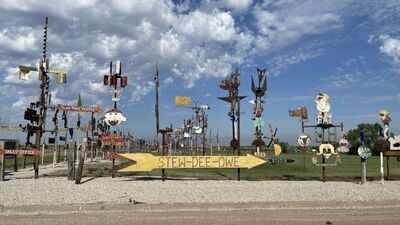
Image Credit: Lu Ann Stephens/KMUW
A Kansas artist spent roughly three decades turning his 70-acre property in Mullinville into an outdoor gallery of metal sculptures. M.T. Liggett filled the roadside landscape with hundreds of tall totems, whirligigs and smaller pieces made from discarded metal and objects from everyday life.
Many carried sharp political or social messages, while others drew on people and experiences from his own life. After Liggett died in 2017, efforts began to preserve this unique collection. The result is an art environment that still stands along the Kansas highways and continues to attract curious visitors.
How did M.T. Liggett fill his 70-acre property with metal sculptures
Liggett was born in Mullinville in 1930 and did not begin making art until later in life. According to KC Studio, he was in his late 50s when he created his first sculpture, a gargoyle made after one of his horses died from poisoning.
He believed the sculpture could keep away dark forces, and that first experiment eventually led to decades of metalworking.For the next 30 years, Liggett worked with an arc welder and other basic tools, turning discarded materials into sculptures. KC Studio says he used farm implement parts, road signs and railway equipment, while Kansas Tourism reported tractor parts, farm machinery and other found metal as materials for the installations.
The work gradually spread along the fences of his property beside US Highway 400 and Kansas Highway 54. The Kohler Foundation records the site as more than 70 acres and says it eventually contained as many as 600 large and small metal totems, alongside more than 500 smaller hearts and other artworks.
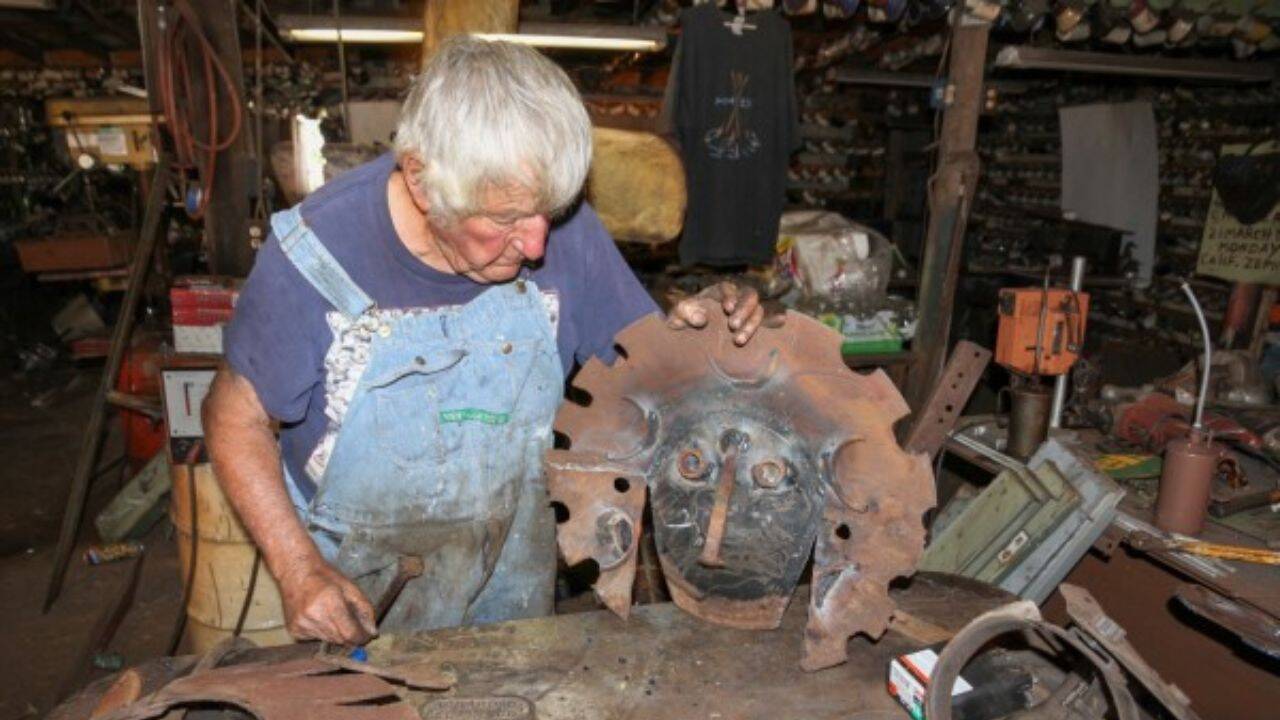
M.T. Ligget in his workshop. Image Credit: Arden Bradshaw/SPACES Archives
The roadside gallery became part of Mullinville
Liggett did not create a conventional sculpture park with carefully separated exhibits. Instead, the pieces became part of the landscape.
Some stood high above the fence line, while others moved in the prairie wind.Atlas Obscura describes hundreds of metal sculptures that squeak and turn in the Kansas wind, with some reaching more than 20 feet in height. The site included abstract figures, whirligigs and sculptures made by welding together objects that had previously served very different purposes.The display also became difficult for passing motorists to ignore. KMUW reported that, in 2001, The Wichita Eagle recorded as many as 100 vehicles a day pulling onto the shoulders of US 400 or US 54 to look at and photograph the artwork. The attention became enough of a concern that the Kansas Department of Transportation installed emergency parking only signs. By then, the unique roadside collection had become closely associated with Mullinville itself.
What did the sculptures say about politics and everyday life
A large part of Liggett’s work dealt with politics, public figures and institutions.
The sculptures did not stick to one side of the political spectrum. The Kohler Foundation describes them as pieces aimed at politicians, officials, international figures and anyone else who attracted Liggett’s critical attention.His approach was deliberately personal and direct. KC Studio notes that his subjects included politicians, the justice system, social issues and current events. Some pieces also referred to Greek mythology, friends and former wives.Folkartwork describes the collection as deliberately broad in its targets instead of being devoted to a single political viewpoint. Its account notes that Liggett criticised figures from different political camps and used the sculptures to express strong opinions instead of showing a consistent party message.That mixture helped make the site both humorous and uncomfortable. Some of the sculptures worked almost like oversized political cartoons, using exaggerated forms and words to make their point.
Atlas Obscura notes that Liggett also made pieces depicting his dogs, former wives and other subjects that were more personal than political.
The collection was preserved after Liggett died
Liggett died on 17 August 2017, leaving behind a collection that was too large and unusual to treat as an ordinary group of artworks. SPACES Archives reports that his 70-acre property contained as many as 600 small and large metal totems, and that the Kohler Foundation became involved in preserving the site after being contacted by Liggett’s family and estate trustees.The preservation work began in April 2019, according to KMUW. The Kohler Foundation funded and directed the project, while the wider effort included conservation of the sculptures and construction of a visitor centre.Kohler Foundation says conservation treatment continued for two years and that the new visitor centre includes salvaged materials from Liggett’s original studio, along with some of his tools. The centre also provides a restoration area and workshop for maintaining the large totems and smaller artworks.
The visitor centre keeps more than sculptures alive
The preservation project was not limited to keeping the metal pieces standing. The visitor centre also helps tell the story behind them. KMUW reports that the building contains interactive videos featuring relatives, friends, Mullinville residents and people from the art world who knew Liggett or his work. His tools, clothing and collection of more than 6,000 coffee mugs are also displayed there.The original studio and shed, which Liggett called his Stew-Dee-Owe, was demolished in 2019 because of safety problems.
Materials from that space were salvaged and incorporated into the preservation effort.The visitor centre also has an artist-in-residence programme, giving the site a role beyond simply displaying Liggett’s work. According to KMUW, the centre continues the preservation process while offering visitors a closer look at the artist and his methods.Liggett’s death did not end the public interest in his work. KMUW reported that more than 2,000 people stopped in Mullinville in the year before its 2023 report, while visitors came from 46 US states and 8 countries. The Kohler Foundation eventually gifted the preserved site to 5.4.7. Art Center of Greensburg in August 2021. Many members of the centre’s board had been friends of Liggett, according to the foundation.