
 6 months ago
45
6 months ago
45

Christine RoTechnology Reporter

 Erica Cirino
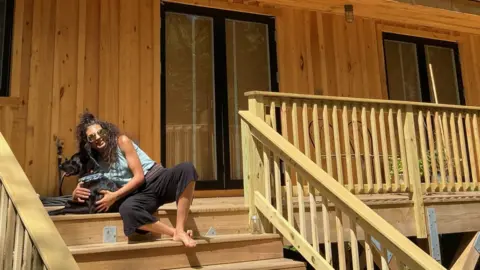
Erica Cirino built a low-plastic home in Connecticut
Back in 2021 and following two years of planning, Erica Cirino started building her dream home in rural Connecticut.
She wondered if she could construct a plastic-free house on a limited budget.
For her there was a professional as well as a personal interest - she was writing a book about solutions to plastic pollution.
She failed, she admits. Alternatives to polyvinyl chloride (PVC) pipes, such as copper pipes, were just too expensive.
But Cirino did succeed in building a low-plastic house.
For instance, the roof has metal rather than vinyl covering. The siding is made of wood and not PVC. The exterior is treated with pine tar and linseed oil instead of coatings containing PFAS (often called forever chemicals).
"Plastics have really become the default in home building," Cirino comments. So it took a lot of her own research to find specialised materials.
Even though she hired a builder with green credentials, she spotted him using a can of spray polyurethane foam – essentially a type of plastic – for insulation. She insisted on using hemp fibres, although that would take longer to install.
Cirino, now the communications manager for the Plastic Pollution Coalition, an environmental nonprofit, has more company now than when she began building her home during the Covid-19 pandemic.
Now there are resources like Informed, a guide to the healthiness of many common building materials.
The Informed website is a project of the US non-profit Habitable.
Teresa McGrath, Habitable's chief research officer, explains: "We started paying attention to plastic not because we inherently have a bias against plastic, but because [in] every product category that we looked at… the plastic materials ranked the worst consistently. They were using and releasing more hazardous chemicals consistently across the board."
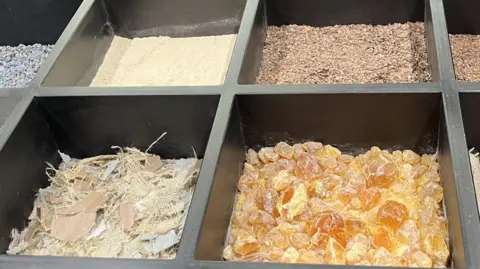
One of the products Habitable rates highly for flooring is linoleum, a durable natural product that has been widely replaced with PVC.
The company Forbo has a low-carbon linoleum range called Marmoleum that uses the traditional ingredients like linseed oil, and sometimes adds ingredients like cocoa shells.
 Christine Ro
Linoleum is largely made from natural materials like linseed oil
Avoiding plastic may feel like an extra burden during housing crises, including in post-disaster rebuilding.
"Rebuilding is a nightmare for most people," Cirino comments. "You're really often put between a rock and a hard place because the fastest, cheapest, easiest way is to just rebuild a plastic-heavy, very simple structure."
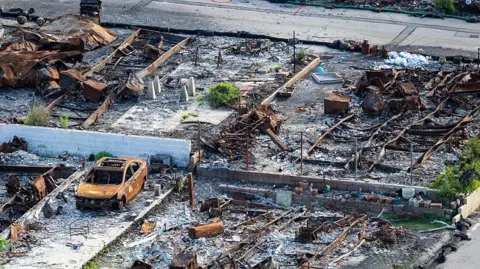
Will Beilharz has seen this himself. He's lived through two major fires, including the 2025 Los Angeles wildfires.
Beilharz is a builder and real estate developer who was already planning a new company creating prefabricated houses before the LA fires hit.
But that disaster made his company, which focuses on fire-resistant and mould-resistant homes, even more relevant.
Now, "we're getting a lot of clients who are interested in healthier homes," Beilharz says.
Anjo Homes' materials include rock wool insulation. Their prefab design has managed to avoid plastics except, like Cirino's house, in plumbing.
After high-profile fires, there is more awareness of the hazards of burnt plastic emanating from homes.
This toxic smoke can include carbon monoxide and hydrogen cyanide. After the 2017 Grenfell Tower fire in London, a dozen residents had to be treated for cyanide poisoning.
Chemical risks have also prevented some people displaced by the LA fires from returning as soon as they would like.
Volatile organic compounds like benzene, stemming from burnt PVC pipes, have entered drinking water.
Overall, plastic is linked to climate and fire risks in various ways.
The need to better protect residents against highly-variable weather and to reduce energy costs can lead to more home insulation. Yet those insulating materials may be combustible, as in the Grenfell fire.
And the plastics increasingly used to build and furnish homes derive from fossil fuels.
 Los Angeles Times via Getty Images
After devastating fires, like in LA in 2025, residents have to decide how to rebuild
The expense is a common concern, when building without plastic. For instance, linoleum flooring is costlier than sheet vinyl flooring.
But advocates of alternative materials argue that while upfront costs may be higher, they can be longer-lasting and better for residents' health, ultimately making them more cost-effective.
This is one reason that, according to McGrath, "the affordable housing sector is really leading the charge" on healthier materials.
She says that, compared to market-rate housing developers, affordable housing organisations are more likely to also be managing the developments themselves.
Rather than being able to walk away after construction, they have an incentive to ensure long-lasting materials.
For instance, McGrath says, Habitable's research has shown that plastic carpets are typically replaced 10 times over the life of the building.
And in many cases, healthier products are comparable in cost.
McGrath gives the example of paint. Even as a chemist, it wasn't until she started working for a large paint company that she realised that paint is often bound with plastic.
Yet it doesn't have to be.
McGrath says, referring to Habitable's guidance on paints: "There's no cost difference between the worst-in-class paints and the best-in-class paints. You just need to know to ask the question."
Another challenge is that "it's not transparent what is plastic and what isn't anymore," notes Kathleen Hetrick, who advises on sustainable design for the consultancy Buro Happold.
Hetrick urges companies within and outside of the plastics industry to develop better replacements to the most harmful types of plastic.
She believes that consumer demand could help spur more innovation, the way it has with PFAS-free cookware. "There's a huge market opportunity," for instance for substitutes for PVC pipes.
 Danny Desjarlais
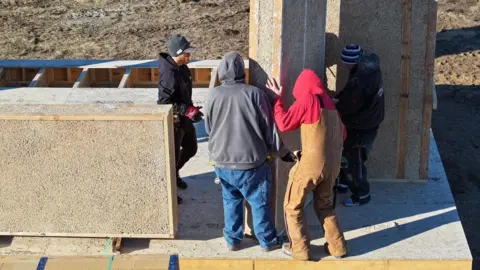
Hempcrete is becoming a more common building product
To replace some building materials, she's especially enthusiastic about the possibilities of hemp.
Hempcrete, which is made from hemp and lime, is resistant to fire, pests and mould. And it can be cheaper than standard materials.
However, builders will need to account for hempcrete's higher water absorption and lower strength, compared to concrete. Hempcrete is being used for purposes like insulation, for instance in a housing project underway in Lewes, England.
"We are still very much in the infancy stage here in the US, but people are becoming aware that this material is even an option and the benefits of using it in construction," explains Danny Desjarlais, who leads hemp projects in the Lower Sioux Indian Community.
He adds, "The number of hempcrete homes in the US continues to increase yearly and, with each new structure that's built, there's always a ripple effect that comes from that."
Minnesota is now moving toward allowing hempcrete and straw bale in all residential construction. This would make it "the first state in the US to adopt hempcrete into their state building code," Desjarlais says.
The state has also been a leader in other ways. In 2025, Minnesota's housing finance agency added an incentive for architects to attend trainings on healthier building materials.
Cirino and the Plastic Pollution Coalition are now calling on other public agencies to also encourage builders to use healthier materials.
Cirino doesn't want her daughter breathing in fibreglass or other plastics. But she's aware that there are limits to what she as an individual can do.
More Technology of Business


