16 hours ago
7
16 hours ago
7

 A man passes the time beside a military recruitment poster. The war in Ukraine has displaced 3.6 million people within the country, according to UNHCR. Credit: Karlos Zurutuza/IPS
UZHGOROD, Ukraine, August 28 (IPS) - It is impossible to ignore. Loudspeakers across the city broadcast a recorded voice announcing a minute’s silence for those who have fallen in the war. After 60 ticks of the second hand, it is time for the national anthem: “Ukraine has not yet perished.”
This happens every day at 9 am, in every Ukrainian city and town.
On 24 February 2022, Moscow launched a full-scale invasion of the country. Since then, the war in the east and south has become a war of attrition fought from the trenches, with Russia occupying 20% of the territory and Ukraine resisting with Western support. Moscow is demanding territory, while Kyiv is calling for a full withdrawal.
The conflict is frozen, with no active peace negotiations in 2026, but the bombing continues unabated. According to UNHCR data, the humanitarian catastrophe has resulted in tens of thousands of deaths, more than six million refugees and 3.6 million internally displaced people, in a country of 44 million inhabitants, including the occupied regions of Crimea and Donbas.
Many of the latter move to regions far from the front line, such as Transcarpathia. Uzhgorod, its capital, 800 kilometres south-east of Kyiv, is one of Ukraine’s humanitarian “bridge cities”: aid entering through the border passes through here, while hundreds of thousands of internally displaced people have made their way here.
Natalia arrived three years ago from Luhansk, 830 kilometres south-east of Kyiv, together with her husband. “At first we thought it would only be for a few months, but today I don’t think we will ever see our home again. All I know is that a Russian family is living there. I hope they are taking good care of it,” the 68-year-old woman tells IPS from a bench overlooking the Uzh River.
She has one son in the Czech Republic and another at the front, as well as three grandchildren in Kyiv. They are what keeps her in the country; she has no plans to move in the short term. “The worst thing is the feeling of helplessness. Every day that passes feels endless: I can’t stop thinking about them, but what can I do?” the displaced woman says sadly.
While official figures for the Transcarpathia region put the number of internally displaced people at 130,000, staff at the Red Cross office in the city tell IPS that the real figure could be more than twice as high. “Many of them do not register because they are afraid of being sent to the front, but we know they are here because their phones identify their location,” NGO officials explain.
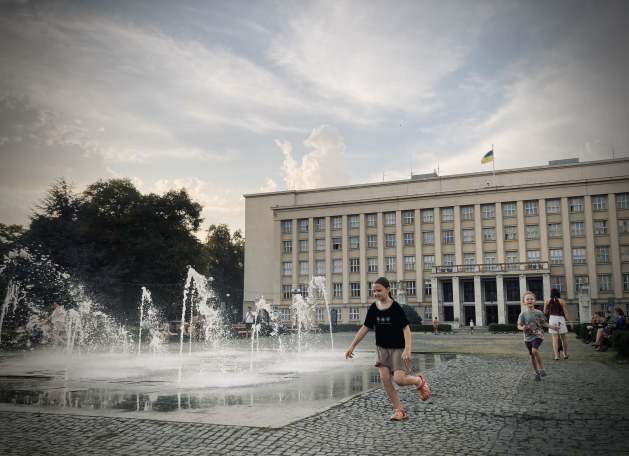 Children play in the centre of Uzhgorod. Located 20 kilometres from the Hungarian border and five from the Slovak border, this once tourist city is now a sought-after destination for internally displaced people, Credit: Karlos Zurutuza/IPS
Twenty-two-year-old Maria belongs to this group of unregistered people. She cannot receive the food, medicine or clothing aid provided by NGOs working on the ground. She arrived here with her boyfriend two years ago from Donetsk, but he is not exempt from military service, so he works online from home.
“My brother and my father are at the front and my mother is still in Donetsk. I think that is enough. I don’t want to add any more drama to my life,” the young Ukrainian woman tells IPS in a central park in Uzhgorod.
Her earnings from working as a babysitter, together with her boyfriend’s income, barely cover their rent of almost 500 US dollars a month, but they have not found anything better. They have also ruled out returning to their town permanently. “It has been completely destroyed. If the war ends, we will move to Kharkiv,” the young woman says.
The arrival of hundreds of thousands of internally displaced people has caused demand for housing to soar, but supply has not increased. The law obliges the Government to provide a solution for IDPs, and many summer camps have been converted for this purpose. The problem is that most are already overcrowded and offer no protection from the harsh Ukrainian winter.
As a result, many displaced people depend on the private rental sector, where prices have soared. This, of course, also affects the local population: when limited housing supply is combined with a lack of jobs, the chances of a young person in the region becoming independent and starting a life of their own are practically nil.
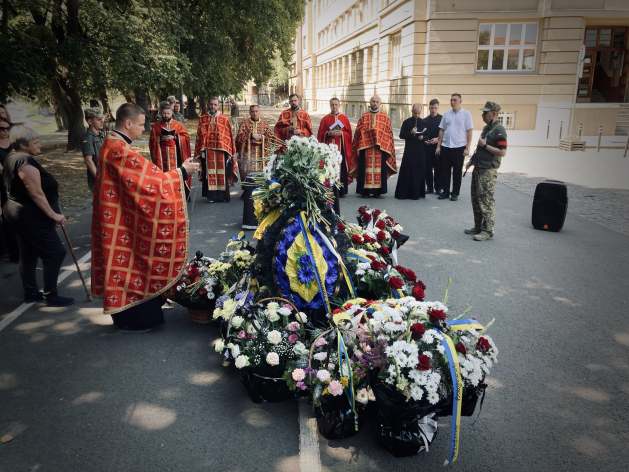 A funeral in the middle of a street in Uzhgorod. Although there are no official figures for Ukrainian war dead, they are estimated to be in the tens of thousands. Credit: Karlos Zurutuza/IPS
Not Looking Back
In Uzhgorod, there is no more coveted terrace than the one on the top floor of the Pannonia building. The city’s most exclusive menu and panoramic views of its churches’ domes and bell towers, silhouetted against the Carpathian mountain range, make it impossible to book a dinner table for the rest of the month.
The staff confirm to IPS that many of the diners are displaced people from the east of the country. But wealthy people account for only a tiny proportion of this group.
It was the most pressing emergency that led schools and abandoned buildings across the country to be adapted to accommodate that human tide.
A former office block on the outskirts of the city is now the closest thing to a home for 35 people. The shared bathrooms and kitchen are still there, but where there were once offices and computers, there are now beds and clothes hanging from makeshift wardrobes.
Like everyone else, Alina also thought it would be a temporary solution, but it has now been four years since the 33-year-old woman left Sloviansk, 660 kilometres south-east of Kyiv, with her two children. In fact, they celebrated the younger child’s first birthday here. He is now five.
Being registered as an IDP entitles her to benefits such as free nursery care for the younger child or a voucher for school meals for the older one, who is 14. She prefers not to look back because, she says, all she sees is hell.
“It was apocalyptic. The bombing was constant and there were drones everywhere you looked, like birds or flies,” she recalls from a communal room. “Go home? My city is in ruins! What worries me most now is getting my parents out of there. I don’t know how to do it,” the displaced woman tells.
Ludmila’s case is different. She is 64, from Kyiv, and could still return if she wanted to. In fact, her daughter and granddaughter remain in the capital and, whenever the situation and her strength allow it, she gets on a train to visit them. The visits are always short.
Ludmila remembers that, when it all began, she spent weeks sleeping on a mattress in the underground and never coming up to the surface. She paid for it with her health, both physical and mental. She starts trembling as she explains that she still suffers panic attacks. She then apologises for not being able to tell the whole story “properly”. She really cannot.
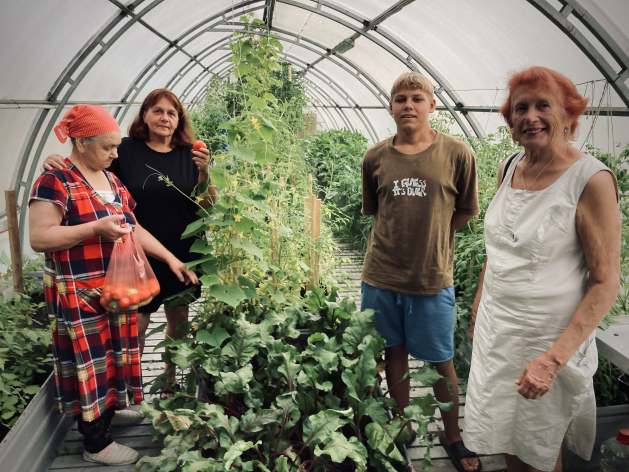 Internally displaced people on the outskirts of Uzhgorod pose in the greenhouse they run. The humanitarian emergency has forced summer camps, schools and abandoned apartment blocks to be turned into the closest thing to a home for millions of them. Credit: Karlos Zurutuza/IPS
Not Looking Ahead
They are all here thanks to the work of volunteers such as 47-year-old Victoria Räcz, a woman from Uzhgorod who also helped arrange this meeting. She is one of the founders of Western Unity, a local NGO that emerged two years ago in response to the humanitarian emergency.
“I know of seven other places like this in the region, but there are probably many more. Something had to be done. We could not turn our backs on all these people,” Räcz explains IPS. One of the major challenges when the war ends, she adds, will be “living alongside all the crazed people, both those returning from the front and those who lost their minds at home”.
Someone suggests going to the greenhouse that the community runs outside the building. As well as supplying the community with vegetables, it is the closest thing to a leisure activity in the current circumstances.
On the way, 76-year-old Zoia says she is the one responsible for baking bread for everyone; after all, she worked as a baker for 40 years. But that was another life, before she fled Pervomayskoye, 300 kilometres south-east of Kyiv, three years ago.
“I got on a bus, then a train and then another bus, never knowing where I was going… At least I was lucky enough to find this place thanks to volunteers who were waiting at the stations,” she recalls.
It is almost a replica of Sandra’s story. The 80-year-old from Severodonetsk, 730 kilometres south-east of Kyiv, explains that she has a daughter in Canada, but at her age she is afraid of such a long journey. She ruled out returning home a long time ago, and has even ruled out leaving the office block.
She says she will stay put, whiling away whatever time she has left learning English on Duolingo and scribbling in an invoice book she found on a shelf.
© Inter Press Service (20260828103742) — All Rights Reserved. Original source: Inter Press Service