1 hour ago
2
1 hour ago
2

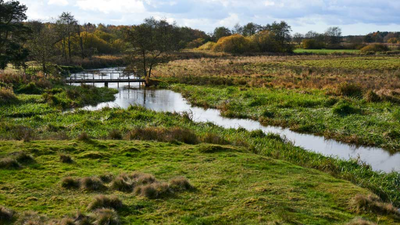
In 2001, Denmark began restoring 19 km of the straightened River Skjern by turning it into 26 km of winding river. Researchers later found that some of the habitats lost during decades of river engineering could take centuries to return.
The large civil engineering project along the lower River Skjern in West Jutland aimed to repair serious environmental damage caused by state-sponsored drainage projects in the 1960s.A long-term study published in the journal Ecological Engineering (Volume 66) examined the river’s hydrological changes about a decade after construction was completed. Researchers studied the lower River Skjern at three main levels: changes in in-stream habitats, the stability of the river channel, and how well the river had reconnected with the surrounding floodplain.The study found that regular flooding has now reconnected the river with its floodplain. However, the engineered design still strongly controls how the water moves. During the ten-year monitoring period, researchers observed only small amounts of bank erosion and sediment movement. Overall, the river channel changed much more slowly than expected. Models predicted a maximum bank retreat of only 6.8 metres over 100 years.
This suggests that natural river processes could take centuries to recreate complex features such as oxbow lakes, side channels, and river islands without additional intervention.
Aquatic species recover but fall short of historical diversity
A later long-term study published in Ecological Engineering (Volume 218) by Peter Wiberg-Larsen, Brian Kronvang, Esben Astrup Kristensen, and Annette Baattrup-Pedersen from the Department of Ecoscience and Department of Biology at Aarhus University examined how biodiversity changed over several decades.
The researchers compared species numbers before the river was channelised, during the period of agricultural drainage, and during the ten years after the river was reconstructed.The researchers found an immediate increase in aquatic plant species and sensitive insect groups, including Ephemeroptera (mayflies), Plecoptera (stoneflies), and Trichoptera (caddisflies), which are collectively known as EPT taxa.
This improvement appeared within one year of the completion of the new river bends and remained stable during the following decade.However, the total number of species did not return to pre-channelisation levels. Species that depend on quiet backwater habitats showed little recovery. The study found that engineers recreated only 5.8 per cent of the river’s original backwater area during the 2000–2002 construction period.
Because natural changes happen slowly in low-gradient lowland rivers, new backwaters develop at a very slow rate.
Recolonisation barriers along European lowland river networks
The findings show some of the wider challenges facing river restoration across Northern Europe. Historically, the lower River Skjern was an important biodiversity hotspot of national and European importance. When agricultural policies in the 1960s required rivers to be straightened and marshes to be drained to increase farmland, many specialized aquatic species disappeared locally or survived only in isolated areas.Today, backwater habitats remain limited across Danish river networks. This creates isolation that makes natural recolonisation difficult. Specialized aquatic insects and plants cannot easily travel from distant river catchments to repopulate the restored sections of the Skjern.The authors of the Ecological Engineering Volume 66 study concluded that depending only on natural river processes produces slow results:"The restoration of River Skjern has therefore failed to re-create the natural habitats formerly present and the natural dynamic processes that shape these habitats are slow.
To speed up this process we therefore recommend restoration engineering using a natural guiding image when restoring lowland rivers in the future and through this restoring the lost habitats and the dynamic processes characteristic of natural rivers.
"Wiberg-Larsen and his co-authors similarly concluded in Volume 218 that returning the river to its historical level of biodiversity could take several decades or longer unless environmental managers use active biological and physical interventions.
Agricultural history and the cost of river channelisation
The original changes to the River Skjern in the 1960s were part of one of Denmark’s largest engineering projects of the twentieth century. The state straightened the main river channel and drained thousands of hectares of peat bogs and wet meadows. This converted nutrient-rich wetlands into productive farmland for dairy and crop farming.Although the drainage project increased agricultural production, it also caused major ecological damage across the catchment.
The loss of wetlands removed natural areas that could absorb nutrients, increasing nitrogen and phosphorus runoff into Ringkøbing Fjord, a sheltered coastal lagoon. The large amount of agricultural nutrients entering the fjord caused serious oxygen shortages, harmful algal blooms, and widespread fish deaths.
These changes badly affected local fisheries and wildfowl populations.By the late 1980s, changing environmental priorities led the Danish Parliament to approve a major restoration plan.
Carried out between 2000 and 2002 at a cost of more than 280 million Danish kroner, the state-funded project changed 19 km of straight canal into a 26 km winding river. Earthmoving equipment was used to restore 2,200 hectares of wetlands, meadows, and shallow lakes that could capture agricultural nutrients before they reached the fjord.
Implications for future river restoration design
Long-term monitoring of the River Skjern provides useful lessons for river managers carrying out large-scale restoration projects across Western Europe.
Simply creating winding river channels can restore the river’s appearance and basic flood connections, but it does not automatically bring back the original ecological conditions quickly.Lowland rivers have low stream power, which means their currents do not have enough energy to quickly create deep pools, erode riverbanks, or cut through meanders to form oxbow lakes. When human engineering creates a fixed channel, even one with natural-looking curves, it can make the riverbed more stable and reduce the erosion and movement needed to create different types of habitats.Ecologists now support more dynamic approaches to river restoration. These methods can include adding physical wood structures, artificial backwaters, and different types of gravel during the initial construction work. Building these complex features directly into the project reduces dependence on slow natural river processes and provides immediate shelter and habitat for sensitive plants and invertebrates.