2 hours ago
2
2 hours ago
2

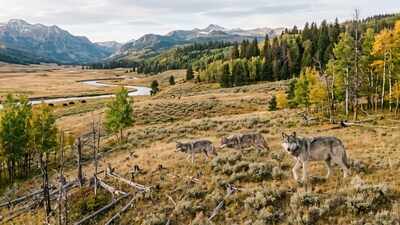
Representative image of wolves in Yellowstone National Park (AI-generated)
Three decades after wolves returned to Yellowstone National Park, young aspen trees are growing tall in parts of the park’s northern range for the first time in generations. The change has added fresh evidence to one of conservation’s best-known stories, but scientists say the results are more complicated than the popular version suggests.The United States began restoring wolves to Yellowstone in January 1995. Fourteen animals from Canada were brought to the park that year, followed by 17 more in 1996. In total, 31 wolves were relocated during the two-year programme. It was the first deliberate attempt to return a large predator to such a vast ecosystem in the country.The return of wolves changed how predators and prey interacted across Yellowstone. Elk numbers declined, while bears and cougars also played a part in increasing pressure on the herds.
With fewer elk feeding on young trees in some areas, aspen shoots finally had a better chance of growing beyond the height at which they could be eaten.
What happened after Yellowstone lost its wolves
Wolves were once common in Yellowstone, but government predator-control programmes and hunting pushed them towards extinction in the park. Between 1914 and 1926, at least 136 wolves were killed there. By the 1940s, established packs had almost disappeared, and a survey in the 1970s found no evidence of a resident population.
During the decades without wolves, Yellowstone’s elk population grew and placed heavy pressure on aspen, willow and other vegetation. Elk repeatedly ate young shoots before they could become trees. Old aspens remained standing, but few young ones survived to replace them.This decline affected more than the trees. Aspen stands provide food and shelter for beavers, insects and birds, including species that nest inside holes in older trunks.
When the trees struggled to regenerate, the habitat they created also began to disappear.The wolf restoration programme was not designed only to save aspens. Its main purpose was to restore a native predator that had been removed by humans. But researchers were interested in whether bringing back wolves would create wider changes across the food web.
Study found new trees in stands that had been suppressed for decades
A 2025 study examined 87 aspen stands across Yellowstone’s northern range. Researchers found large numbers of tall saplings across about one-third of the stands.
Another third contained smaller patches of young trees that were beginning to join the overstory. The remaining stands were still being held back by grazing animals.The researchers described the growth as the first new generation of overstory aspens recorded in the area in around 80 years. Surveys conducted during the 1990s had found no comparable group of tall young trees in the stands examined.Lead researcher Luke Painter said the restoration of large carnivores had restarted a recovery process that had been blocked for decades.
The stands with many tall saplings also had lower rates of browsing, while trees in other areas were still being heavily eaten.This pattern supports the idea of a trophic cascade. The term describes a process in which changes involving predators at the top of a food web affect animals and plants below them.In Yellowstone, wolves did not directly help the aspens. Instead, they preyed on elk and contributed to changes in elk numbers and behaviour.
That reduced pressure on young trees in some locations, allowing them to grow.
New research warns against declaring a park-wide recovery
The signs of new growth do not mean every aspen stand in Yellowstone is recovering.A study being presented at the Ecological Society of America’s 2026 annual meeting is titled “Persistent landscape-scale aspen decline following large carnivore restoration in northern Yellowstone National Park.” The research is led by Dan MacNulty of Utah State University and includes scientists from Utah State and the University of Wisconsin-Stevens Point.The presentation brings attention back to the scale at which recovery is measured. A group of stands can contain many new trees even while the wider landscape continues to lose older aspens. Local recovery and a broader decline can happen at the same time.Scientists have debated this issue for years. Earlier research found that elk did not always avoid aspen stands in places where the risk of meeting wolves was higher.
This challenged the simple idea that fear alone caused elk to leave certain valleys and allowed trees to return.The National Park Service also describes the relationship between wolves, elk and vegetation as complex. Yellowstone contains several large predators, including wolves, bears and cougars. Elk numbers are also affected by weather, food availability and hunting outside the park. The effect of wolves can therefore differ from one part of the ecosystem to another.
Rising bison numbers may create another challenge
Elk are not the only animals that eat young aspens. Researchers say Yellowstone’s growing bison population may now be limiting tree recovery in some areas.Bison can feed on young shoots and sometimes break saplings while moving through or browsing inside aspen stands. This means a tree that is no longer being heavily eaten by elk may still struggle to survive because of pressure from another large herbivore.Conditions such as drought, soil quality, fires and the location of individual stands can also affect growth.
Trees near water or in productive soil may recover more easily than those growing in dry or exposed places.These factors help explain why some parts of northern Yellowstone now contain tall young aspens while others remain largely unchanged.Thirty years after wolves returned, the evidence shows that the animals helped reshape Yellowstone. They restored a missing predator, affected elk populations and created conditions that allowed aspens to grow in some locations.But the recovery did not happen everywhere, and wolves did not act alone. Yellowstone’s changing forest is the result of several predators, herbivores, climate conditions and local habitats interacting over decades.The young aspens are an important sign of progress. They are not proof that every part of the ecosystem has returned to its earlier state.