1 month ago
53
1 month ago
53

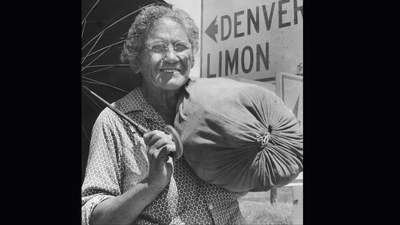
In 1953, Emma Gatewood tried hiking the Appalachian Trail, got lost and was rescued
When park rangers found 65-year-old Emma Gatewood lost and confused in Maine in 1953 after she broke her glasses on the Appalachian Trail, they advised her to give up and return home.
Two years later, at age 67, Gatewood returned to the trail. She started at Mount Oglethorpe in Georgia, kept her plans secret from her adult children and walked all 2,190 miles alone. In 1955, she became the first woman to complete a solo thru-hike of the Appalachian Trail in a single season. Known to millions as Grandma Gatewood, she completed the journey in 146 days and changed the way people viewed long-distance hiking and physical endurance. Her story, preserved in historical archives including the Appalachian Mountain Club (AMC) Library & Archives and described in Ben Montgomery's 2014 book Grandma Gatewood's Walk, is a story of survival, strength and independence.
Overcoming a difficult early life
Emma Rowena Caldwell was born on 25 October 1887 on a farm in Gallia County, Ohio. She grew up doing hard physical work with her 14 siblings in a small log cabin. Her father, Hugh Caldwell, was a Civil War veteran who had lost a leg. He also struggled with alcoholism and gambling. At 19, Emma married 26-year-old farmer Perry Clayton Gatewood. The marriage began decades of severe hardship. In Grandma Gatewood's Walk, Montgomery, who is Gatewood's great-great-grandnephew, used family journals and legal records to document more than 30 years of domestic violence.
The abuse became increasingly severe. In 1939, a violent attack left Gatewood with cracked ribs, broken teeth and head injuries. When police arrived, they initially arrested Gatewood after she threw a sack of flour while defending herself. After seeing her injuries, the mayor of her town in West Virginia took her into his home for protection.
In 1940, Gatewood obtained a rare legal divorce. She received custody of her three youngest children and supported her family through her own work.
A simple approach to a huge journey
Gatewood became interested in the Appalachian Trail in the early 1950s after reading a National Geographic article about Earl Shaffer, who completed the first reported A.T. thru-hike in 1948. She noticed that no woman had completed the entire trail alone and decided to try it herself. Her first attempt in 1953 ended in Maine after she became lost and broke her glasses. For her second attempt in 1955, she changed her strategy.
She began in Georgia and avoided the park rangers who had advised her to stop two years earlier. She told her adult children only that she was "going for a hike in the woods.
" She did not tell them that she planned to walk the entire Appalachian Trail because she feared they would try to stop her. Gatewood also avoided the expensive and heavy equipment used by many modern hikers. She carried her belongings in a handmade denim sack over her shoulder.
Her equipment included:
- A wool blanket, plastic shower curtain, tin cup, canteen and small cooking pot.
- A Swiss Army knife, raincoat, warm coat, spare clothes and a first-aid kit.
- Simple food such as raisins, nuts, chicken bouillon cubes and canned Vienna sausages.
- Canvas Keds shoes, going through seven pairs during the journey.
She did not carry a sleeping bag, tent, compass or detailed map. Instead, she relied on her knowledge of wild plants and found places to sleep wherever she could, including porch swings, park benches and beds of dried leaves. She walked about 14 miles a day, often starting at dawn and continuing until she was completely exhausted. At times, she even walked faster than Boy Scout groups that tried to accompany her.
Reaching Mount Katahdin
On 25 September 1955, 146 days after leaving Georgia, Gatewood reached Mount Katahdin in Maine, the northern end of the trail.
The final stage was difficult. She had fallen the previous day, broken her glasses, sprained her ankle and bruised her face. Despite these injuries, she continued to the summit, where she sang "America the Beautiful."When reporters asked why she had taken on such a difficult journey at age 67, her answer was simple: "Because I wanted to."Her achievement received national attention. Photographs and trail records preserved by the AMC Library & Archives document her journey and later visits to locations such as Lonesome Lake Hut and Carter Notch Hut.
Gatewood did not stop after completing the trail once. In 1957, she walked the Appalachian Trail a second time, becoming the first person to complete the entire route twice. In 1964, at age 76, she completed the trail for a third time, this time hiking it in sections.Her achievement also became an important part of the history of women on the Appalachian Trail. Historical figures from the Appalachian Trail Conservancy show that women made up about 15 percent of successful thru-hikers during the trail's early decades. By 2018, women accounted for more than 33 percent of successful thru-hikers. Gatewood's remarkable 1955 journey helped establish an enduring example of what women could accomplish on one of America's most demanding long-distance trails.