
 5 months ago
24
5 months ago
24

I take 120 tablets a week due to vaginal mesh pain
A mum-of-three left in "constant, disabling pain" after an operation says women like her should not suffer in silence.
Kerry Watson, 40, uses a walking stick and takes more than 100 tablets a week to deal with the agony caused by having a vaginal mesh implant to treat a prolapsed bladder in 2014.
She is one of 25 women who have received compensation following operations carried out by a single surgeon in north Wales.
The Betsi Cadwaladr University Health Board has apologised, admitting Kerry was not fully informed of the risks and side effects or of the alternatives to the mesh surgery.
Kerry, from Kinmel Bay in Conwy county, said she woke up from the operation in pain which never went away, and got gradually worse.
"It felt like I had a needle through my back, and it was coming out my front, and I couldn't twist past it," she said.

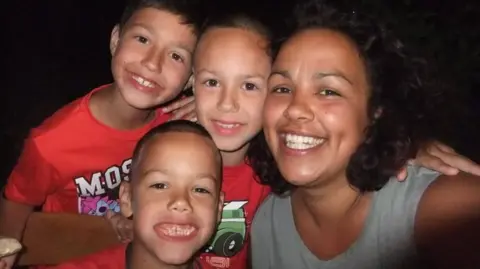 Kerry Watson
Kerry says the constant pain made it harder for her to be a mum to her three sons
"Your mental health is affected. You get brain fog, you're tired, you're fatigued. You can't function as a woman – and that's every day for 10 years," she said.
"I'm a mum to three boys, but I felt like I was failing. As they were getting older, I couldn't even stand to watch them play football.
"After 10 years, I couldn't walk, I couldn't drive, I couldn't do jobs that a mum would do for her children.
"That was when I didn't want to be here at all."
Vaginal mesh surgery is when a piece of synthetic mesh, a plastic product that looks like a net, is inserted to hold the pelvic organs in place.
It has been used to treat pelvic organ prolapse and stress urinary incontinence, but can cause debilitating harm to some women.
Side effects for some have included infection, pelvic pain, difficulty urinating, pain during sex, and incontinence.
The NHS announced it would pause using vaginal mesh in 2018 following patient safety concerns.
By June 2024, things had got so bad for Kerry that she had an operation to partly remove the mesh.
The pain has improved, but it has not gone away and she is waiting for more surgery.
"It's a woman thing – you try and hide everything. You end up distancing yourself from friends and family.
"I was defined by the pain, by the way I felt – it consumed me.
"But what's happened to me has happened to other women as well. I can't bear the thought of others sitting at home, so uncomfortable, so in pain.
"I want to share my story to give others the courage to come forward and not suffer in silence."
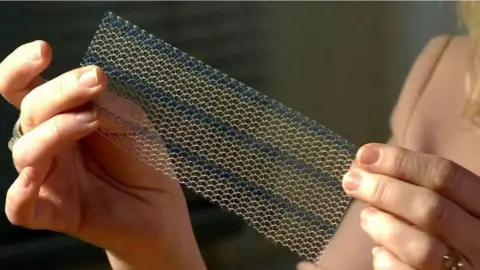
Vaginal mesh, sometimes also called pelvic mesh or tape, was implanted into some women's bodies before 2018 to support organs such as the bladder
The consultant who carried out Kerry's operation is Derek Klazinga, who retired in 2016.
Kerry is one of several women who say they were not adequately informed of the risks involved before operations took place under his care.
BBC Wales contacted Derek Klazinga to ask about the way he obtained Kerry's consent for the operation, and whether he explained to her that other treatments were possible, but he did not respond.
In a statement to S4C's Y Byd Ar Bedwar, he said previously: "I wish to express my sincerest sympathy that these ladies have had to endure such physical and psychological pain caused by, what we now know to be, defective medical products used in their treatments.
"Before retiring in 2016, I always practised with the patient at the centre of my care, while abiding by the first principle of medicine: 'first, do no harm'."
The Betsi Cadwaladr University Health Board (BCUHB), which runs the NHS in north Wales, has apologised for the suffering that vaginal mesh has caused in some cases.
Executive medical director Dr Clara Day said: "I want to acknowledge the stress and pain this has caused to a small proportion of women in our region who underwent those procedures.
"I have been made aware of some historic claims in relation to one clinician who left the health board in 2016.
"Via the legal system, we have acknowledged physical harm to some patients who underwent procedures and we have found record keeping and consent had not been completed to the required standard in a number of cases.
"Every claim has resulted in learning for us, which has been scrutinised by experts outside of our Health Board."


