6 months ago
67
6 months ago
67

OPINION — Africa presents a range of security, economic, and humanitarian challenges to US national security that the Intelligence Community must stay ahead of even as Washington looks to refine its strategy for the region. Creative use of geospatial intelligence (GEOINT) is one way to make this happen. Commercial remote sensing and geospatial analytics have significantly expanded coverage and revisit rates across the African continent, enabling sustained monitoring of infrastructure development, environmental stress, and security-relevant activity even in areas with limited physical access.
Complex African Undercurrents
Africa watchers know well that a core complication in following the continent with few resource commitments is that challenges and opportunities are persistent, geographically dispersed, and rarely confined to a single subregion.
North Africa and the Sahel—from the Atlantic to the Mediterranean to the Red Sea—illustrate how African dynamics create a complex nexus of US security and commercial concerns that intersect with Europe and the Middle East. Extremism, maritime chokepoints, energy infrastructure, and military modernization hold implications beyond the continent itself.
Central and Southern Africa are at the heart of the increasing US focus on critical minerals. This includes the recent US deal with Congo on mineral access—Congo produces more than 70 percent of the world’s cobalt—and the sustained US investment in the Lobito corridor, a critical infrastructure project spanning 1,300 kilometers from Zambia to Angola. Most recently, the US proposed a critical mineral trade bloc, which would include key producers from the region.
Eastern Africa is host to the largest US military base on the continent, located in Djibouti—also home to China’s only major overseas military base—where US forces carry out operations across the Red Sea and sustained military strikes in Somalia. Kenya, meanwhile, is a Major Non-NATO Ally and in December signed a $2.5 billion health cooperation framework with the US, a cornerstone of Washington’s more than $11 billion commitment to overhauling how it awards assistance to African countries.
African Dynamics Require Agility
These realities reinforce a long-standing requirement: sustaining continental-scale awareness and early warning during periods when Africa is not a top policy priority, while preserving the ability to re-engage quickly when conditions change. Importantly, we must achieve this without falling into a defeatist trap of “settling for less because it just feels easier—not because it is strategically sound.” We must know when to ramp up and when to ratchet back.
For example, even while the National Security Strategy offers a concise priority list on Africa, our ability to ameliorate conflict and foster mutually beneficial trade relationships is subject to strategic competition around weapons procurement, energy and resource projects, and foreign infrastructure development—including civilian infrastructure repurposed for military use—all of which are observable and assessable through GEOINT without requiring persistent on-the-ground presence.
Environmental stress across the Sahel, Horn of Africa, and North Africa is ever-present. The resulting population movements, economic plight, and conflict dynamics often emerge gradually rather than through sudden shocks, a sweet spot for GEOINT. For example, while desertification and drought are longstanding areas of focus for Africa watchers, persistent flooding that we can monitor from space creates mass displacement–4 million displaced in 2025 alone—and destruction of agriculture and healthcare facilities, hindering the very self-help approaches Washington is encouraging across Africa.
Intelligence Community findings have pointed to African security challenges that are broadly demographics-based and develop incrementally below the threshold of sustained international attention. This increases the risk of surprise and compressed response timelines. In this context, GEOINT becomes less a surge capability and more a continuity mechanism, enabling awareness with resources such as human geography mapping to keep tabs on possible conflict hotspots.
Africa at Scale: A Continental-Sized Intelligence Gathering Chore
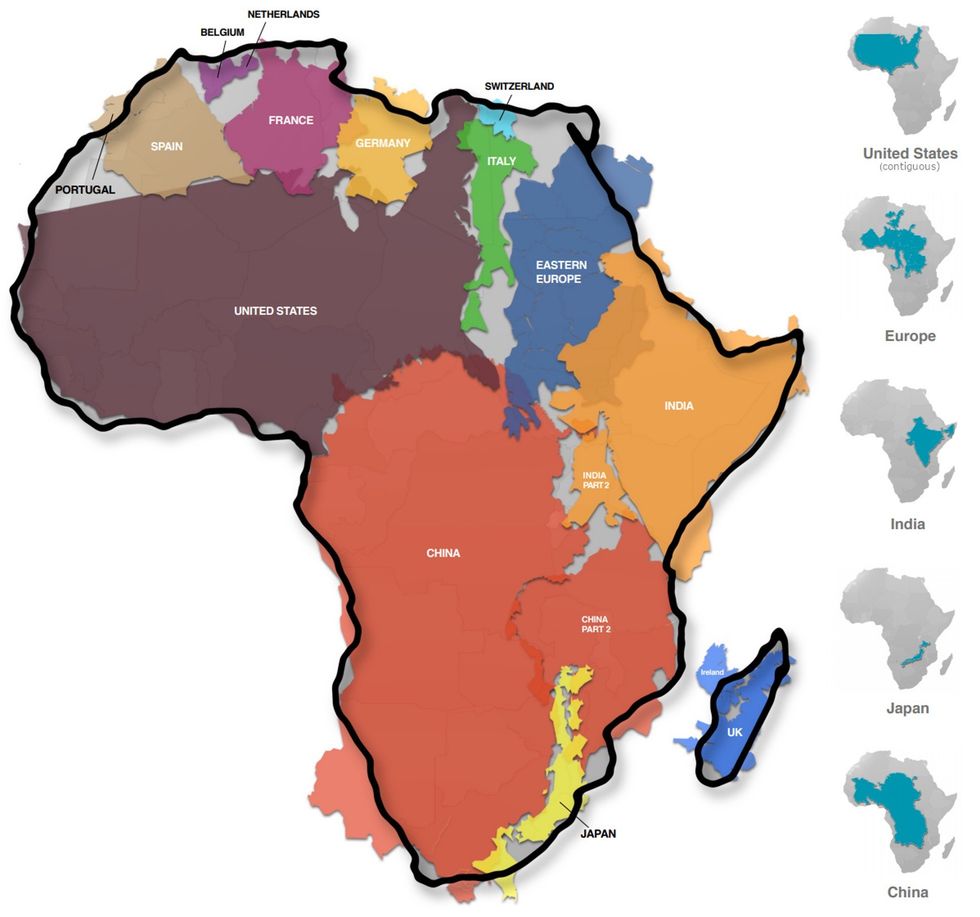
Africa's enormity makes staying abreast of threats and opportunities a daunting task, even when resources are most abundant. GEOINT helps to provide the US with the ability to discriminate in our coverage by choosing where and when we need information. Even with GEOINT as a tool, the continent makes up 1/5th of the globes land area, making it a big task.
Implications for US Government and Industry Partners – Finding Resilience with GEOINT
GEOINT is not a silver bullet, but it does offer a relatively low-resource opportunity for persistent, baseline awareness. National Geospatial-Intelligence Agency (NGA) officers are exceedingly enterprising in their ability to task the constellation of imagery assets in a way that is not an extra tax on the system but instead piggybacks on planned areas of coverage. As NGA augments its capabilities with AI, automation provides increasing windows to create intelligence insights at cost savings. Below is a sampling for the general reader and touches just the basics of what GEOINT can offer.
GEOINT enables ongoing monitoring of agreements, insecurity, infrastructure, and environmental trends across Africa without forward deployment, expanded aid programs, or sustained senior-level engagement, making it well suited to periods of constrained attention. Indeed, the US Embassy in Kinshasa last year noted intelligence sharing as a core area of focus for monitoring implementation of the US-brokered peace accord in eastern Congo, a clear opening for GEOINT.
GEOINT creates rapid knowledge discovery between periods of focus. This function is resource-efficient because it allows policymakers to develop context and targets quickly when fast-moving requirements emerge in areas not typically covered with other intelligence sources. For example, the US in 2025 for the first time conducted precision strikes against ISIS-aligned militants in northwest Nigeria; the US Commander of AFRICOM subsequently confirmed US Intelligence Surveillance and Reconnaissance cooperation with Nigeria.
Innovations in GEOINT can help us prepare for unexpected requirements. NGA’s ongoing efforts to build a Foundation Digital Twin “will allow users to immerse themselves in a 3D representation of the operational environment and interact with geospatial mission data in the software package of their choice.” Even as we move forward with less presence in tough- to-reach African outposts, this evolving technology can provide clarity for operational success, such as with recent Embassy evacuations on the continent.
The Cipher Brief is committed to publishing a range of perspectives on national security issues submitted by deeply experienced national security professionals. Opinions expressed are those of the author and do not represent the views or opinions of The Cipher Brief.
Have a perspective to share based on your experience in the national security field? Send it to Editor@thecipherbrief.com for publication consideration.
Read more expert-driven national security insights, perspective and analysis in The Cipher Brief