7 months ago
48
7 months ago
48


 Scott Garfield/Getty Images
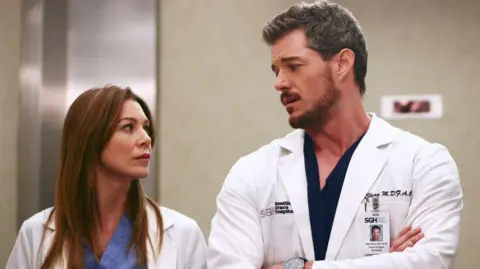
Dane was best known for appearing in more than 100 episodes of hospital drama Grey's Anatomy as Dr Mark Sloan, or "Dr McSteamy"
Eric Dane, best known for starring in Grey's Anatomy, has died 10 months after confirming he had been diagnosed with amyotrophic lateral sclerosis (ALS).
The actor spent his final months raising funds and awareness for the rare, incurable condition - the most common form of motor-neurone disease (MND), which causes a progressive paralysis of the muscles.
"I'm trying to save my life," Dane told Time magazine in remarks published less than a fortnight ago, as the on-screen surgeon turned real-life campaigner was named one of its most 100 influential people in health.
"If my actions can move the needle forward for myself and countless others, I'm satisfied."
The 53-year-old shared in April 2025 that he had been diagnosed with the debilitating and painful condition.
It causes the loss of cells which control voluntary muscle movements and, eventually, patients lose their ability to speak, eat, walk and breathe independently.
He helped to launch a three-year campaign in September aiming to raise more than $1bn (£742,000) in federal funding for research.
In a campaign video, he stressed the importance of "finally push[ing] toward ending this disease" - introducing himself as an actor, a father "and now a person living with ALS".
By December, he had joined the board of directors of Target ALS, an organisation dedicated to research for effective ALS treatments and a cure - who said he had helped one of its campaigns surpass a fundraising target of $500,000 (£371,000).
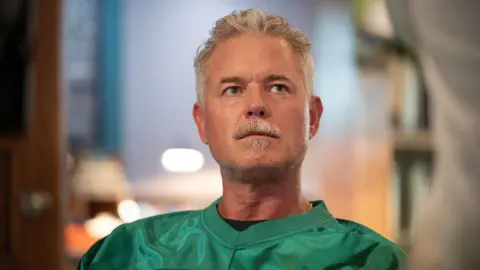
He also used his craft to raise awareness, appearing on an episode of medical drama Brilliant Minds in November as a firefighter struggling to accept help after an ALS diagnosis.
 Pief Weyman/NBC via Getty Images
Dane's character on Brilliant Minds grappled with sharing the diagnosis with his family, and accepting it himself
He told a virtual panel the following month that playing a role "so close" to him had been challenging but "cathartic".
"I make sure that people are aware of what ALS is and what it's about, and more importantly, what we can do to combat it and improve the landscape - because it's so rocky and littered with hurdles and bureaucracy and all this other nonsense," he said, per People magazine.
He said it was "imperative" to share his journey, "because I don't feel like my life is about me anymore".
Medical treatments and technologies can improve the quality of life of those with ALS, but no cure has been found.
Professor Kevin Talbot, who runs the University of Oxford's Nuffield Department of Clinic Neurosciences, told the BBC this is because it does not "have a single unifying cause".
Another complication is that the condition is rare, Neil Thackur of the ALS Association previously told the BBC.
"It takes a long time to fully recruit enough people onto an ALS clinical trial, because the disease progresses so rapidly and people are only eligible early in the disease," he told BBC Future.
Not everyone within the small number of patients will be willing or able to take part in research studies, he explained.
'His quality of life was deteriorating so rapidly'
All the while, the California-born actor's condition was growing worse.
When he announced his diagnosis, he said he would be returning to the set of HBO's Euphoria the following week.
Two months later, he said he had lost the use of his right arm and predicted that "maybe a couple, few more months and I won't have my left hand either".
He had first noticed symptoms - a weakness in his right hand - just over a year prior, he told ABC's Good Morning America.
Following the news of his death late on Thursday, his Grey's Anatomy co-star Patrick Dempsey said Dane's "quality of life was deteriorating so rapidly".
"He was bedridden and it was very hard for him to swallow," he told Virgin Radio, adding that Dane had been losing his ability to speak.
According to Talbot, the condition affects individuals differently - but "long survivors" are rare.
"ALS is a very aggressive disorder," he says. "10% of affected people die within the first year, 50% within two-and-a-half years and 90% by five years."
ALS has a fairly consistent way of behaving, he says: "If progression is slow at the beginning, then it usually continues that way."
The clinician adds that the condition can't currently be detected until the patient has started developing weakness - at which point there has been "irreversible loss" of nerve cells in the brain and spine.
"When patients arrive in a neurology clinic they have used up their internal reserve capacity, so the progression of weakness is often rapid."
When it comes to a cure, "we are making progress and funding has been critical to that," says Talbot.
But there is "a lot of work to do," he cautions. He says "spectacular advances" in other areas like cancer have created a tendency to underestimate how difficult solving ALS will be.
He says the same is true for other neurodegenerative brain disorders like Alzheimer's and Parkinson's - and reaching a cure would require "major funding, sustained for years".