1 hour ago
4
1 hour ago
4

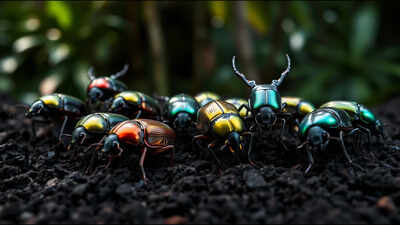
Representative Image of diverse Calosoma beetle species with a focus on their failed introductions to Hawaii (AI Generated Image)
For six decades, scientists repeatedly introduced predatory beetles to Hawaii in an effort to control crop-damaging caterpillars, but none of the intentionally released species established a lasting population.
A study published in Biological Control titled Calosoma (Coleoptera: Carabidae) biological control introductions to Hawaiʻi: Taxonomic ignorance and confusion lead to an unexpected result documents 13 introductions of beetles from the genus Calosoma between 1897 and 1957. The beetles were brought in as predators of nutgrass armyworm, armyworm and lawn armyworm. Researchers examined museum specimens, archival field notes and published records and identified eight flight-capable Calosoma species involved in the failed introductions. The only Calosoma species currently resident in Hawaii is Calosoma anthracinum, a rarely collected Mexican beetle that was never intentionally introduced.
The researchers say it appears to have arrived accidentally in a mixed shipment of beetles.
Calosoma beetles were introduced to Hawaii 13 times between 1897 and 1957
The study by James K. Liebherr, Janis N. Matsunaga and Ann E. Hajek reconstructs a history of biological control attempts involving eight Calosoma species: C. calidum, C. frigidum, C. marginale, C. peregrinator, C. prominens, C. protractum, C. semilaeve and C. senegalense. All eight were flight-capable species, and none established a persistent population following the purposeful introductions documented by the researchers.
The beetles were introduced as predators of three caterpillar pests: nutgrass armyworm (Spodoptera exempta), armyworm (Mythimna unipuncta) and lawn armyworm (Spodoptera mauritia). The researchers reconstructed the introduction history using institutional voucher specimens, archival records and previously published literature. Their work also uncovered cases in which the identity of imported beetles had been recorded incorrectly.
Taxonomic confusion complicated the historical record
One of the study's central findings concerns the difficulty of identifying some of the beetles correctly. Two abundant and closely associated species, Calosoma peregrinator and C. prominens, were repeatedly confused during the period covered by the introductions. The researchers say this resulted in mixed-species introductions to Hawaii. The same problem affected the species that ultimately became established.
Calosoma anthracinum was initially identified as C. semilaeve and was later recorded under another name, Calosoma blaptoides tehuanacum. Because C. anthracinum was rare, had a limited native distribution and was absent from the taxonomic keys available at the time, the species was not properly recognised during the historical introductions.The researchers found that C. anthracinum and C. protractum had both been collected at Cuernavaca in Morelos, Mexico, during explorations connected with Hawaii.
Based on the historical records and specimen evidence, they hypothesise that the two species were introduced together in a 1923 release at Waikiʻi on Hawaii Island. This means the beetle that eventually established may have entered Hawaii as part of a shipment intended to introduce a different Calosoma species.
Calosoma anthracinum was the unexpected survivor
Unlike the eight flight-capable species deliberately introduced for biological control, C. anthracinum has vestigial wings and is incapable of normal flight.
It is also the only Calosoma species currently known to be resident in Hawaii. The researchers describe it as a rarely collected species native to Mexico that was never intentionally selected for introduction.Its presence in Hawaii was eventually understood through later examination of specimens and historical records. The researchers say specimens initially identified under other Calosoma names were actually C.
anthracinum. The species therefore remained overlooked in the historical record until its identity could be reassessed using modern taxonomic knowledge. The researchers also note that three species that failed to establish, C.
marginale, C. peregrinator and C. semilaeve, were encountered in Hawaii decades after their introductions. However, these later records consisted of single individuals or pairs, with no evidence that the species had established populations.
Flightlessness was the one unusual trait of the successful beetle
The study compares the Calosoma species involved in the Hawaiian introductions by examining their ecology, dispersal abilities, introduction histories, native ranges and associated climates. Among the characteristics considered, the researchers identify flightlessness as the only unique characteristic of C. anthracinum, the species that successfully colonised Hawaii. The finding does not establish that flightlessness alone caused the species to succeed.
Instead, it distinguishes C. anthracinum from the eight flight-capable species whose purposeful introductions failed to establish. The authors use the history to emphasise the importance of understanding the ecological requirements, biological characteristics and habitat needs of potential biological control agents.
What the beetle history reveals about biological control
The Hawaii records show how difficult it can be to reconstruct the outcome of historical species introductions.
Some of the beetles released for biological control were not correctly identified, while species collected from the same locations could enter introduction programmes together. In the case of C. anthracinum, the researchers believe a species that was never intentionally selected for release may have been introduced alongside another beetle and subsequently established.
The study's authors argue that biological control programmes benefit from robust and accessible taxonomic classifications based on accurately identified specimens, as well as a detailed understanding of the ecological requirements and habitat preferences of candidate species. The history of Calosoma in Hawaii provides an unusual example: after 13 purposeful introductions over six decades, the genus' only established Hawaiian species was the one that researchers had not deliberately set out to introduce.