6 months ago
45
6 months ago
45

6 minutes ago
Robbie MeredithEducation and arts correspondent, BBC News NI
 Getty Images
The NI Audit Office published a report assessing the quality of education
GCSEs come "too late" in a child's school life to judge the quality of education they receive, the Northern Ireland Audit Office (NIAO) has said.
An audit report also found there was little evidence that hundreds of millions of pounds invested in Special Educational Needs (SEN) "is being spent effectively or delivering a high-quality education to those who need it".
The NIAO said the Department of Education (DE) also had no clear definition of what was meant by "quality of education".
Education Minister Paul Givan said the report rightly highlighted the importance of having reliable, comprehensive and earlier assessment information to support children's learning.
What did the report say about GCSEs?
The NIAO report assessed the quality of education in Northern Ireland.
It said GCSE and A-level results were only one way to measure the performance of our education system, but GCSEs were often the first indication of how a pupil was performing in school.
"This is very late in a child's education journey and is the end of the formal education process for some," it said.
"It is therefore too late to target support and address underachievement.
"The department is without basic information on pupil, school and system performance.
"Current performance measures do not provide the department with a complete picture of the quality of education being provided."
The NIAO also found that around 1,900 pupils were omitted by their schools from their overall GCSE exam results.
While pupils can be ruled ineligible to be included in a school's public GCSE and A-level results for several reasons, including illness, welfare issues or because they have been withdrawn from their school - it is a controversial practice which has been criticised.
 Getty Images
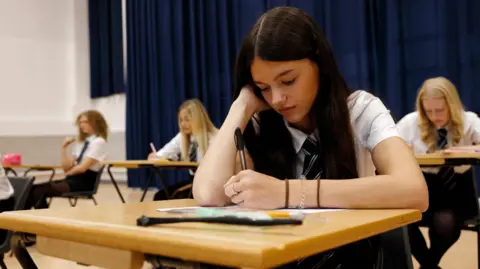
The way students are examined in Northern Ireland is set for a major overhaul
How much is spent on Northern Ireland's education system?
Around £3bn is spent each year on the education system, and there are about 350,000 pupils in about 1,100 schools.
That figure does not include further and higher education, which is not the responsibility of DE.
The NIAO said that investment in education brought many benefits.
"Countries that adequately invest in basic education, higher education, and vocational training see stronger economic resilience and higher capacity for innovation," it said.
"Enhancing the quality of education should be at the core of any education system."
But the report found that education was not just about academic achievement, but "also comprises equity, inclusivity, and fostering a learning environment where every child can thrive".
Separately, there have been warnings from DE to schools that they will face "serious challenges" as their budgets will only rise by around 1% in 2026/27.
Why have there been problems with school inspections in Northern Ireland?
The NIAO said school inspections carried out by the Education and Training Inspectorate (ETI) had been curtailed by industrial action by unions.
That meant only 13 primary schools received a full inspection unaffected by industrial action between 2018 and 2023.
Not a single post-primary school had received a full inspection in that period.
Full inspections are where ETI inspectors directly observed teaching and learning in the classroom, but industrial action had restricted this.
"As a result, the department was not obtaining assurance on the quality of education being provided in schools over this period," the NIAO said.
"As well as impacting assessment of the quality of education, disrupted inspections have also impacted evaluation of child protection arrangements, increasing the risk that vulnerable pupils were not receiving adequate support."
The Department of Education has previously said it plans to change the law to fine teachers up to £2,500 for not taking part in school inspections, but legislation has not yet been brought forward.
Does your family's income affect how well you do at school?
Yes, it does, according to the audit report.
The NIAO said there was still a "significant" gap between how children entitled to free school meals (FSME) performed in exams like GCSEs compared to their peers.
In 2025, for example, just over half of FSME pupils (53%) achieved five or more GCSEs at grades A* to C including English and Maths.
That compared to around 80% of pupils not entitled to free school meals.
What about the money spent on special educational needs?
The NIAO said the money spent on special educational needs (SEN) had risen from £255m in 2017/18 to £622m in 2024/25.
But the watchdog said there was little evidence that hundreds of millions of pounds spent on SEN "is being spent effectively or delivering a high-quality education to those who need it".
The Department of Education welcomed the NIAO report and described it as "an important and constructive contribution to improving outcomes for children and young people".
In a statement, minister Paul Givan said that "high‑quality education is fundamental to the wellbeing of our children and to the future prosperity of Northern Ireland".
"The report rightly highlights the importance of having reliable, comprehensive and earlier assessment information to support children's learning," he said.