4 months ago
36
4 months ago
36

Katie RazzallCulture and media editor, in Los Angeles

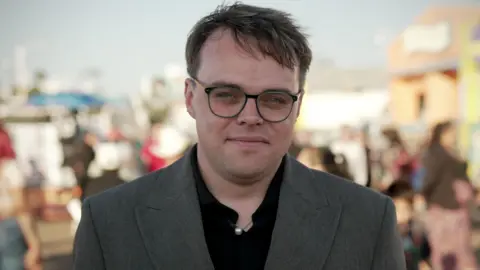 BBC/Maxine Collins
Pavel Talankin is in Los Angeles for the Oscars, where Mr Nobody against Putin nominated for best documentary
Pavel Talankin had never been outside Russia before he went into exile in summer 2024, leaving his home in the Ural mountains for his own safety after he quietly stood up to President Putin's war machine.
In less than two years, Pasha, as he's known, transformed from an events coordinator and videographer at a primary school in Karabash, one of the most polluted places on earth, to an Oscar nominee.
The director has already taken selfies with Hollywood's finest including two of this year's best actor contenders, Leonardo Dicaprio and Ethan Hawke.
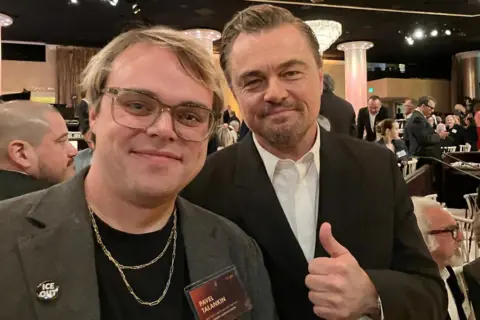 Pavel Talankin
Pavel Talankin with One Battle After Another star Leonardo DiCaprio at the nominees' luncheon in February
"They are just normal people like the rest of us," he told me when we met in Los Angeles ahead of Sunday's Academy Awards.
But Pasha is far from normal; an unlikely hero whose film, Mr Nobody Against Putin, made with the Copenhagen-based American director David Borenstein, already won best documentary at the Bafta Film Awards in February.
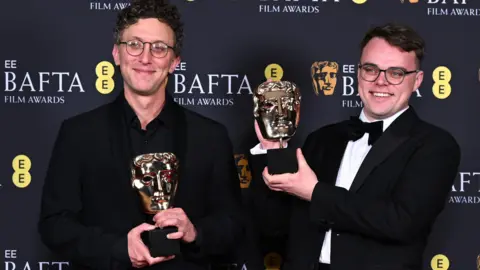 Getty Images
David Borenstein and Pavel Talankin won best documentary at the Bafta Film Awards in February
The self-styled Mr Nobody has become a Mr Somebody in Hollywood.
The pair are hoping an Oscar will be next.
We met on Pasha's 35th birthday. He turned up to our interview with shiny pink balloons - a '3' and a '5' - that he said he had bought himself that morning.
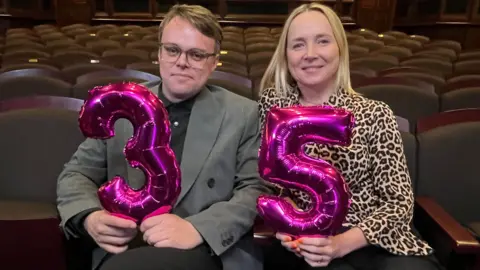
Pasha celebrated his 35th birthday on the day the BBC's Katie Razzall met him in LA
His most pressing Oscar-related concern was about the statuette.
"How much does it weigh?" he asked. "This question interests me a lot, because in all the shops they sell plastic Chinese fakes and they weigh nothing, so I'm curious how much it weighs."
The answer, if you're interested, is 3.86kg, but it's typical of his sardonic humour, everything said with a straight face.
Comedy is also front and centre of the film, despite its serious subject matter.
"Pasha obviously has used humour as a way of coping with what was happening around him," Borenstein told me.
"And of course, humour has always been a huge part of living under the daily realities of authoritarianism. Soviet jokes are some of the best jokes. It's just how people cope."
The BBC documentary charts the story of what happened after Russia's full scale invasion of Ukraine in 2022 and how Pasha was reluctantly drawn into Putin's propaganda machine.
His role at the school was to film student music videos, performances and graduation ceremonies.
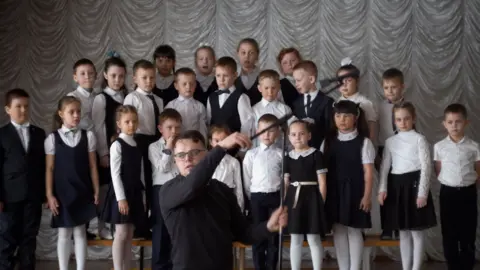 Pavel Talankin
Pavel Talankin setting up his microphone, before filming pupils at Karabash School No 1 in Russia's Ural Mountains
But the war brought diktats from the Kremlin, introducing more patriotism, militarisation and duty into school life, as well as flag-raising ceremonies.
Pasha said he was instructed to film and send proof to the authorities that the school was obeying the new curriculum.
He realised it made him "a kind of monitor of the teachers, to make them understand, 'Look, I'm here, I've got a camera, I'm filming, so you will say everything you are supposed to say, you will speak as instructed, you will use the material provided by the government.'"
He rebelled, at great risk to himself, deciding to become a filmmaking whistleblower. He began to send his footage to Borenstein through encrypted servers, a decision made in an instant, but with longterm consequences.
"In those seconds I was driven by rage," he recalled. "I didn't care really. I thought, let anyone do it, let anyone show this film, let anyone edit it. The main thing is that it exists, to show what is happening."
Borenstein added: "We thought it was so important for the world to see that Putin obviously has no intention of stopping with just Ukraine... he's telling the children of Russia every single day that you need to prepare for a future of warfare and Empire."
Pasha recorded Wagner mercenary group soldiers in school showing the children how to spot mines and handle guns - and teachers lecturing their students about the "denazification" of Ukraine.
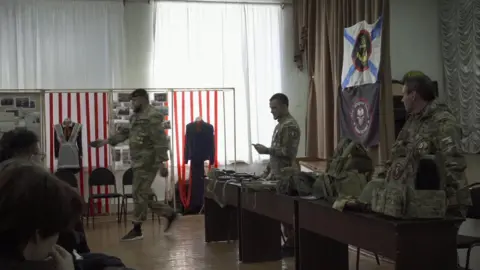 Pavel Talankin/BBC Storyville/Made in Copenhagen
Wagner mercenaries came to Karabash school No 1 and showed weapons and a mine called a petal to the pupils
We hear the stories of former students dying on the battlefield and a mother sobbing at her son's graveside. It was too dangerous for Talankin to film the funeral, but he recorded her harrowing audio instead.
We also see his own acts of resistance.
He's a true prankster, who changed the pro-war Z symbols on the school windows into X's and took down the school's Russian flag while blasting out Lady Gaga singing the US National Anthem.
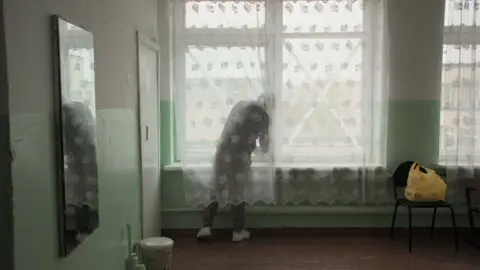 Pavel Talankin/BBC Storyville/Made in Copenhagen
Pasha replaced the pro-war Z symbols on the school windows with X's, in support of Ukrainian refugees
He stood up to the regime but he refuses to accept that he is brave.
"No," he told me, "it's just normal".
Borenstein disagrees. "I would describe him as someone that is very brave, someone that feels emotions very, very strongly, someone that is really, really concerned about truth and someone who really, really, really loves his birthday."
For the filmmakers outside Russia, protecting Pasha and the people in the film from reprisals was uppermost in their minds.
"We had a long list of security protocols," Borenstein explained, "and we were hearing from people who really gave us a dire assessment of the risks in Russia.
"We were reading news articles about school teachers, about people in Russia who had gotten sentenced to huge prison sentences, not for working with foreigners, not for making an undercover film, simply for desecrating the Russian flag, which is one little small thing he did in the film."
"We were scared. He wasn't scared."
In the end, when Pasha spots a police car outside his apartment and there are concerns his life may be at risk, he realises it's time to flee.
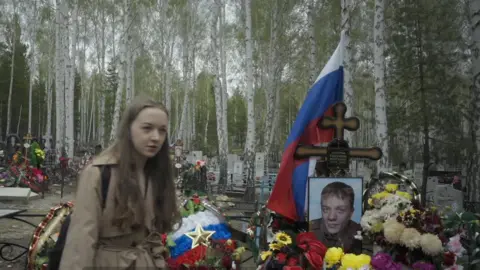 Pavel Talankin/BBC Storyville/Made in Copenhagen
In the documentary we see student Masha at the graveside of her brother, who was deployed to Ukraine
In the film, we hear a Russian-speaking producer tell him: "Before you cross the border, you must delete our secure messaging app.
"You need to be very careful about how you take your footage past border control. Just be calm. You have a return ticket. They'll think you are returning in seven days. Just believe in yourself. I think what you've done is going to make a big impact."
He left his motherland - and his mother - and now lives in an undisclosed location in Europe. He believes it won't be forever. "When the regime has fallen, I am planning to return and be useful."
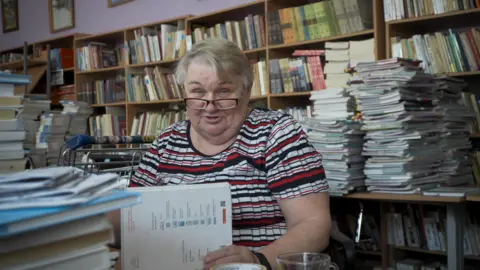 Pavel Talankin/BBC Storyville/Made in Copenhagen
Pavel's mother, who also appears in the documentary, works as the school librarian
For now, he is focused on ensuring the film is seen as widely as possible. He knows people in Karabash have watched it.
When it premiered at the Sundance Film Festival last year, Borenstein says someone recorded it digitally and then shared it around the town.
As they were making the film, Talankin says nearly 200,000 teachers left their jobs rather than be part of a system that is indoctrinating children.
He hopes Mr Nobody Against Putin will show Russians "who think similarly to me that they are not alone".
On the day we met, as we strolled along Santa Monica pier in the sunshine, the spectre of war still loomed over him. He shared the news he had learnt a few hours before.
"Today I found out one of my students died."
Nineteen-year old Nikita was killed in Ukraine, he said. "I know him. He is a kind guy and he would never have gone without the propaganda."
It's a sombre end to our time together.
But if Mr Nobody Against Putin does win the Oscar, his acceptance speech will be written by his former students. They're already working on it.
"If we win, it's going to be their speech."
Storyville: Mr Nobody Against Putin is on BBC iPlayer.