1 hour ago
2
1 hour ago
2

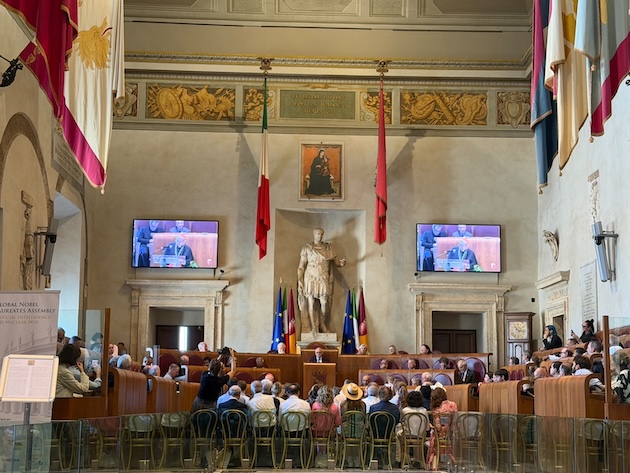 The Global Nobel Laureates Assembly on Artificial Intelligence and Nuclear War brought together more than 200 of the world’s most authoritative figures on peace and artificial intelligence. Here the 'The Rome Declaration for a Disarmed and Disarming Peace' was signed in the main council chamber in Rome's city hall Campidoglio. Credit: Katsuhiro Asagiri/INPS Japan
ROME, July 24 (IPS) - After two days of debate at an international conference devoted to the challenges of artificial intelligence (AI), nuclear war and global security, Nobel laureates, former heads of state and government, scientists, human rights defenders, religious leaders and representatives of civil society adopted a joint declaration, calling for it to be based on human dignity.
Inspired by Pope Leo XIV’s encyclical Magnifica Humanitas and signed in the halls of the Capitol, Rome’s city hall, this text states that artificial intelligence cannot be left solely to military or commercial interests. It also calls for international cooperation based on human dignity, the development of global AI governance and the continuation of efforts towards nuclear disarmament.
As major powers are investing increasingly substantial sums in the development of AI, participants considered that humanity stands at a genuine crossroads. The choices that will be made will have a decisive impact not only on tomorrow’s geopolitical balances but also on the future and place of human beings in a world where decisions could increasingly be entrusted to artificial intelligence.
This point was highlighted by Rome’s mayor, Roberto Gualtieri, the master of ceremonies of this meeting, organised by the Global Nobel Laureates Assembly on Artificial Intelligence and Nuclear War, who described it as historic.
The declaration, named “The Rome Declaration for a Disarmed and Disarming Peace”, was signed on Thursday, July 16.
For Rome’s mayor, “the crucial issue, both at the global and local levels, is technological development, which must be inspired by fundamental ethical principles: respect for individuals, equality among human beings and democratic responsibility in the name of the common good.”
Gualtieri also stressed that today, more than ever, “the world needs an international coalition capable of promoting a new model of development combining economic growth, social justice, human rights and environmental protection”, thus echoing Pope Leo XIV’s call for “a disarmed and disarming peace”.
A few hours earlier, Agnès Callamard, secretary general of Amnesty International, had warned against the development of autonomous weapons.
“The idea that decisions to kill could be made by machines is repugnant to us.”
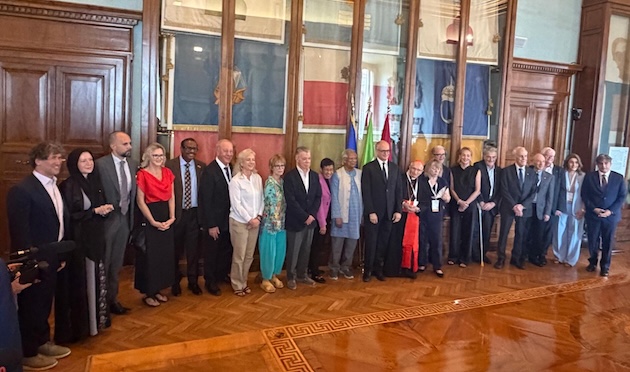 Delegates at the Global Nobel Laureates Assembly on Artificial Intelligence and Nuclear War pose during the conference on artificial intelligence held at Borgo Laudato Si’. Credit: Katsuhiro Asagiri/INPS Japan
According to Callamard, the danger does not lie in an artificial intelligence that would suddenly become conscious but rather in the decision to delegate to it responsibilities that belong exclusively to moral judgement.
“It is not that the machine decides that it will become the boss; it is we who programme these systems,” she explained.
For the head of Amnesty International, the growing integration of AI into military operations represents a major change. These systems can already analyse enormous quantities of data, identify targets and recommend strikes, while gradually reducing the need for human intervention.
Beyond autonomous weapons, the Callamard reminded the world that it must pay close attention to the implications of the progressive integration of AI into what the military calls, in its jargon, the “kill chain”, meaning the process from target identification to the conduct of an operation.
“Even when a human being officially retains the final decision, the growing dependence on automated systems profoundly changes the way military operations are prepared and conducted,” Callamard stated, adding that these technologies rely on immense volumes of data that may themselves be altered.
“Analyses and recommendations can be biased because they are based on data that themselves carry these biases. We must remain attentive to the risks arising from erroneous or discriminatory decisions in contexts where the consequences can be irreversible.”
Another danger: the multiplication of force. Thanks to artificial intelligence, a single operator could simultaneously supervise dozens, or even hundreds, of drones or other autonomous systems, considerably increasing military capabilities.
“These technological developments are taking place within a broader context of strategic competition between states. We are living in a period when many governments are seeking military hegemony,” Callamard concluded.
Beyond military issues, several speakers also insisted on the geopolitical consequences of this technological revolution. Romano Prodi, former president of the European Commission and former Italian prime minister, estimated that the growing rivalry between the United States and China considerably complicates the emergence of genuine international regulation.
In an increasingly fragmented world, Prodi warned, no nation will be able to address alone the challenges linked to artificial intelligence, global security or the control of ever more powerful technologies.
These words anticipated the essence of the final declaration, according to which international cooperation is now an indispensable condition for preventing artificial intelligence from fuelling a new arms race and widening geopolitical fractures.
The discussions also focused on the economic and social consequences of this technological revolution. In the world of work, the sudden arrival of AI is already raising many concerns, particularly regarding the professional future of younger generations and the profound transformation of several professions in the coming years.
The programme brought together a number of leading international figures, including Nobel Peace Prize laureate and former Chief Advisor to Bangladesh Muhammad Yunus; Yoshiyuki Nagaoka, Executive Director of the Office of Public Affairs at Soka Gakkai; Filipino journalist and Nobel Peace Prize laureate Maria Ressa; Amnesty International Secretary General Agnès Callamard; and several scientists and nuclear experts.
Research published by King’s College London shows that a study carried out on hundreds of millions of job advertisements across 39 countries reveals an average 6.1% decline in job offers in professions most exposed to automation, while the remaining positions require increasingly specialised skills.
Ultimately, what will remain of this conference and of the Rome Declaration? The main point to remember is that participants accept the development of artificial intelligence and do not believe it should frighten us. On the contrary, they consider that this technology can become a powerful driver of progress – provided, however, that it remains at the service of humanity. The ball is therefore in the court of states and their leaders, who must above all place human dignity at the forefront.
The real question is no longer only what artificial intelligence will make possible, but rather what limits societies and humanity as a whole will choose to set for it before the imperatives of power permanently override collective responsibility.
Note: This article is brought to you by IPS Noram in collaboration with INPS Japan and Soka Gakkai International in consultative status with ECOSOC.
IPS UN Bureau Report
© Inter Press Service (20260724121618) — All Rights Reserved. Original source: Inter Press Service