55 minutes ago
2
55 minutes ago
2

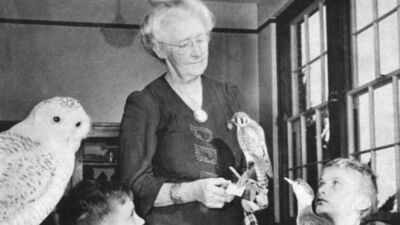
Elizabeth Dickens (Image Credit: Rhode Island Natural History Survey)
In 1912, a Rhode Island woman began recording every day's bird sightings on Block Island. What started as a personal habit continued for more than five decades,creating a remarkable record of the island's birdlife, migration patterns and seasonal changes.
Her name was Elizabeth Dickens, a self-taught naturalist who would later become known as the “Bird Lady of Block Island.” According to the Rhode Island Natural History Survey, which documents her life and work, Dickens' observations became an important contribution to the study of birds on the island and the wider Atlantic migration route.
A habit that lasted decades
Elizabeth Dickens was born in 1877 and spent her entire life on Block Island, Rhode Island.
She was not formally trained as an ornithologist, but her curiosity about birds gradually developed into a lifelong commitment to observing and recording them. Her daily journals began in 1912 and continued until 1963. For more than 50 years, Dickens noted the birds she encountered on the island, creating a long-running record that captured the presence and movements of species across generations.
Today, those journals are held by the Audubon Society of Rhode Island.
The importance of such a record lies partly in its consistency. Wildlife observations made over a few days or even a few years can provide only a limited picture. Dickens, however, watched the same island landscape over half a century. Her notes documented the birds that appeared during migration, the species that were regularly present and the occasional visitors that turned up unexpectedly.
More than a birdwatcher
Dickens' interest in birds extended well beyond her journals.
In 1911, Harold Madison Sr., curator at the Museum of Natural History at Roger Williams Park, gave her a set of Audubon Bird Leaflets and suggested that she share them with local schoolchildren. She took that suggestion seriously. From 1911 until 1960, Dickens taught Bird Study once a month to children at Block Island's schools. Over the years, her enthusiasm encouraged young islanders to pay closer attention to the wildlife around them.The children also helped contribute to her growing bird collection, bringing her birds they found dead. Dickens refused to accept birds that had been deliberately shot for the purpose of adding them to the collection. As a result, many specimens came from birds killed by predators, collisions or other accidental causes. The collection eventually became an important historical and ornithological record in its own right.
It spans 43 years and includes 172 mounted specimens, including several unusual birds and important regional records.
A window into migration
Block Island occupies an important position along the Atlantic Flyway, a major migration route used by countless birds travelling between their breeding and wintering grounds. Dickens' observations helped build scientific understanding of Block Island's role as a stepping stone along the offshore migration route of the Atlantic Flyway.Her work was recognised by professional naturalists and ornithologists, with whom she corresponded over the years. In 1956, John W. Aldrich of the US Fish and Wildlife Service credited Dickens' records with contributing significantly to knowledge of Block Island's place in the offshore migration route and to wider ornithological publications.The value of her records is also evident in later comparisons. A blog published by the Ocean View Foundation examined Dickens' observations alongside data collected by modern raptor researchers on Block Island.
The comparison connected bird records separated by nearly a century, showing how long-term observations can provide a valuable historical baseline for understanding wildlife.
A legacy beyond the journals
Dickens died in 1963, but her journals, spanning from 1912 to 1963, remain an important record of Block Island's birdlife. They continue to offer a glimpse into the island's natural history during the first half of the 20th century. Her legacy was not built through a laboratory or a university research programme.
Instead, it grew from a simple act repeated day after day: noticing the birds around her and writing down what she saw.Over time, that persistence produced something much larger than a personal diary. Her observations, her bird collection and her work with generations of schoolchildren helped create a lasting connection between Block Island and the wildlife that passes through it. More than a century after Dickens first opened her journal in 1912, her work remains a reminder that some of the most valuable records of the natural world begin with patience, curiosity and the decision to keep looking.