2 hours ago
5
2 hours ago
5

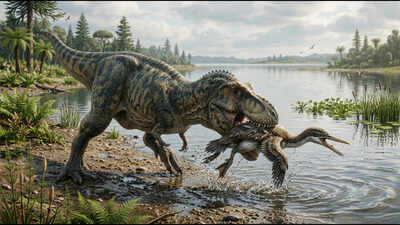
Tyrannosaur preying on an ancient diving bird (Representational AI photo)
A 66-million-year-old feather found inside fossilised dinosaur poop may offer a clue to why some birds survived the asteroid impact that wiped out most dinosaurs. Scientists say the feather belonged to a hesperornithiform, an extinct group of aquatic birds that lived alongside dinosaurs.The feather was preserved inside a coprolite, the scientific term for fossilised faeces. Researchers found several feathers, tiny fish scales and leg bones belonging to a hesperornithiform bird inside the fossil.The discovery, reported in the journal Current Biology and reported by Science Daily, suggests that feathers may have played a role in determining which birds survived the mass extinction. Hesperornithiforms lived in aquatic environments but disappeared along with most other birds, while one branch, known as Neornithes, survived and eventually gave rise to every bird species alive today.About 66 million years ago, an asteroid struck Earth and caused a mass extinction at the end of the Cretaceous Period. Dust and debris entered the atmosphere, reducing sunlight and causing severe cooling known as an impact winter. Most dinosaur groups disappeared, but some birds survived.
Feather in the poop
The unusual fossil was discovered in 2016 by David DeMar Jr, a research scientist and Hell Creek Project collections manager at the University of Washington Burke Museum.
He was working in northeastern Montana when he spotted a small, dark reddish-brown rock.“I was crawling up a rocky outcrop collecting fish fossils when I came across a dark, reddish-brown nodule about half the size of a golf ball,” DeMar said.He examined it with a hand lens and noticed a tiny fossil feather on its surface. The discovery was unexpected because feathers had not previously been found in the Hell Creek Formation, despite more than 150 years of prospecting there.Researchers later studied the specimen’s mineral composition and used CT imaging to examine its interior. CT scans combine thousands of X-rays to create detailed digital images without destroying the fossil.Nate Carroll, a co-author and paleontologist at the Carter County Museum in Ekalaka, Montana, suspected the rock might be a coprolite. A micro-CT scan revealed what was preserved inside.“Every hour processing the data revealed another feather, another scale, another bone, in stunning 3D,” Carroll said.
Inside the fossil
The coprolite contained several feathers, tiny scales from a gar fish and leg bones from a hesperornithiform bird. Since the feathers and bird bones were found together, researchers concluded that the feathers most likely came from the same bird.Hesperornithiforms were aquatic birds similar in some ways to modern loons. Most could not fly. They used specialised feet to dive underwater and hunt fish.The feathers also showed adaptations for life underwater.
Some appeared modern and waterproof, while others were smaller and fuzzy.Jingmai O’Connor, the study’s lead author and associate curator of fossil reptiles at the Field Museum in Chicago, said scientists had not previously studied feathers preserved in coprolites.“As far as I know, no one has ever thought to look for feathers or to study feathers in coprolites,” O’Connor said.
Why some birds survived
Scientists have long studied why Neornithes survived while most other birds disappeared.
One theory suggested that living around aquatic environments may have helped some birds survive the conditions after the asteroid impact.The newly studied fossil complicates that explanation. Hesperornithiforms also lived in aquatic environments but became extinct. O’Connor said the difference may instead have involved feathers and how birds replaced them.“We think the types of feathers that these birds had, and/or the way they molted those feathers, may have been one of the underlying causes of the selectivity of the end-Cretaceous mass extinction, essentially, why some birds died out and why others survived,” she said.The feathers are the first ever identified from a hesperornithiform. Their structure falls between the plumage seen in enantiornithines, another extinct bird group, and modern birds.
Primitive feathers may have mattered
The researchers found that some hesperornithiform feathers were waterproof and suited to diving. But the birds also had smaller, fuzzy body feathers that were more primitive.Body feathers help birds retain heat. During the impact winter, when sunlight was reduced and temperatures dropped, better insulation may have helped some birds survive.“The hesperornithiforms retain primitive feather types that may not have been as efficient for insulation as modern plumaceous feathers, and that could explain why they went extinct along with the enantiornithines,” O’Connor said.The researchers do not say feather insulation was the only reason some birds survived. However, the finding adds evidence to the question of why the extinction affected different bird groups differently.
Dinosaur poop preserves ancient meal
The fossil also gives scientists a rare look at predator-prey interactions shortly before the end of the dinosaur era.Gregory Wilson Mantilla, a University of Washington professor and vertebrate paleontology curator at the Burke Museum, said bird fossils and feathers are rarely preserved. Finding them inside fossilised dinosaur dung makes the specimen especially valuable.The coprolite may have been produced by a large dinosaur, possibly a Tyrannosaurus rex or Nanotyrannus, after it ate the bird.
The fossil therefore preserves part of an ancient food chain from about 66 million years ago.For O’Connor, studying the specimen was different from examining large fossil slabs containing complete skeletons.“I usually work with fossils that are preserved in big stone slabs, and the entire skeleton and even the soft tissue is preserved- they make it easy for me,” she said. “But with this project, we just had this coprolite and its contents to go off of, and it made me feel like a detective, piecing together all these little clues.”The researchers hope the discovery encourages scientists to CT-scan more coprolites. Fossilised droppings may contain feathers, bones, scales and other remains that cannot be seen from the outside, offering more clues about ancient animals and ecosystems.