6 months ago
36
6 months ago
36

9 minutes ago
Nick TriggleHealth correspondent

 PA Media
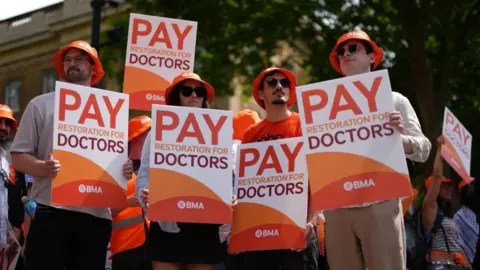
The government has withdrawn an offer of creating 1,000 more doctor training posts in England after the British Medical Association (BMA) refused to call off a six-day strike next week.
The extra posts were part of a wider package of measures put forward by ministers earlier this year to resolve the long-running dispute with resident doctors, previously known as junior doctors.
Prime Minister Sir Keir Starmer set a 48-hour deadline on Tuesday evening for the walkout to be cancelled if the union wanted to keep them.
The strike was called last week when talks between the two sides over pay and job shortages broke down.
A Department of Health and Social Care spokesman said doctors had been offered a "generous deal", but said it was now not possible to give the go-ahead on the training posts.
"These posts would have gone live this month, but as systems now need to prepare for strikes and more uncertainty, it simply won't be operationally or financially possible to launch these posts in time to recruit for this year."
The government said the move would not impact the overall number of doctors in the NHS as the posts were going to be created from existing short-term posts. Resident doctors fill these when they cannot get official training posts.
Dr Jack Fletcher, BMA resident doctor committee chair, said the announcement was "extremely disappointing".
"It is genuinely disheartening to be at this point after what had been constructive talks up until a few weeks ago when the government moved the goalposts.
"It is simply wrong that the development of the doctors of the future is being used as a pawn like this.
"We have consistently maintained that we are willing to postpone industrial action should a genuinely credible offer be provided."
Alongside the extra training posts, the government had offered to cover some out-of-pocket expenses such as exam fees as well as ensuring faster pay progression.
But the BMA ended the talks saying the deal - and in particular its pay progression element - had been watered-down at the last minute.
It also coincided with the government accepting the recommendations of the independent pay review body that all doctors, including resident doctors, should get a 3.5% pay rise from this month.
The BMA called it a "crushing blow", pointing out that inflation was set to rise because of the Iran war.
While the pay rise means resident doctor pay has risen by a third over the past four years, the BMA argues it is still a fifth lower than it was in 2008 once inflation is taken into account.
The union uses a measure of inflation - RPI - that is higher than others. It says it does this because the government uses that measure of inflation when adding interest to student loans.
The training posts that were offered are the ones doctors move into after the first two years of training. This is the point at which they specialise in areas such as general practice or surgery.
Last summer there were 30,000 applicants for around 10,000 jobs, although some of those were doctors applying from abroad.
Next week's walkout, which begins at 07:00 BST on Tuesday, will be the joint longest since the dispute began - only once before have resident doctors taken part in a six-day walkout.
It's the 15th walkout since the long-running dispute started in March 2023.
Resident doctors make up nearly half of medics working in the NHS - two thirds of them are BMA members.