2 months ago
38
2 months ago
38


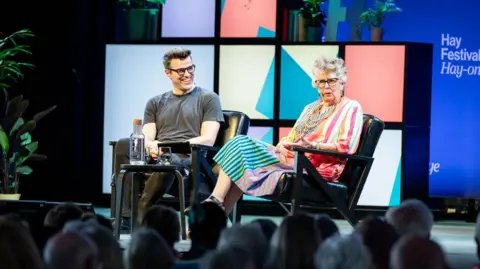 Adam Tatton-Reid/Hay Festival
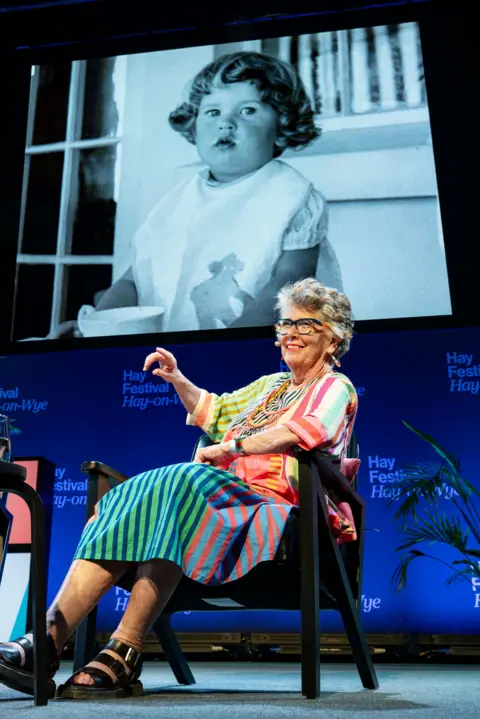
Dame Prue Leith was a guest at Hay Festival's My Life in Books series
Dame Prue Leith has recounted the time she called the editor of the Michelin Guide to demand an answer to why her restaurant hadn't received a star.
Speaking at Hay Festival in Hay-on-Wye, the celebrity restauranter said her boldness then shocks her now, as she took part in a series called My Life in Books, where guests discuss the literature which has shaped them.
"Now I think, how could I have done that?"
Leith opened her first restaurant, Leith's, in Notting Hill, London, in 1969.
"My restaurant did eventually get a Michelin star but it took me 25 years," she told festival-goers.
"I rang them up and, to my surprise, they put me through to the editor.
"I said I wanted to know why we haven't got a star."
The Michelin Guide recommends restaurants and hotels worldwide, with its iconic star rating signifying exceptional food quality.
The editor suggested he and his inspector attend Leith's restaurant for lunch and "we can talk about it".
"We sat down and it was fantastic," said Leith, explaining he had "a big book" with every visit they'd ever made logged, detailing every tiny observation.
These included suggested subtle changes for the salad dressings, as well as the fact that, on one visit, the bread basket included seven kinds of bread, while on the next there were only three types, and just one the next.
"I was listening to this and thinking that was when we had a fantastic baker and then he left... and then the chef went on strike about making the bread," said Leith.
"They were absolutely right. We did all the things he told us and, the next year, we got a Michelin star."
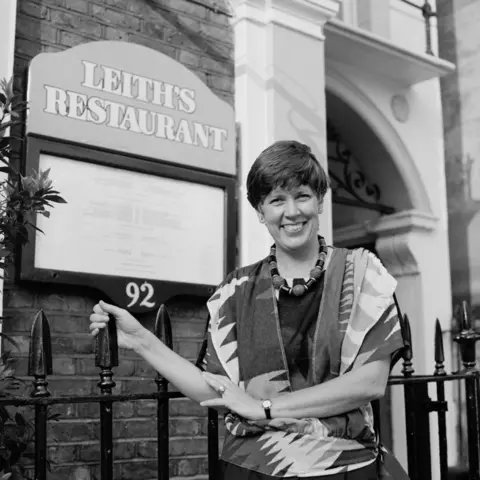 Getty Images
Prue Leith at her first restaurant Leith's in Notting Hill in 1986
Leith had been sharing the impact the book Kitchen Confidential by Anthony Bourdain had on her - ultimately boosting her efforts to address misogyny in the hospitality industry.
"I'd always worked for myself. When I first started hiring people, I mostly hired women and I mostly hired friends. And it wasn't for a long time that I'd have large kitchens full of men," she said.
"When I read Kitchen Confidential I couldn't recognise it, it wasn't the industry I knew. I was just horrified that was what was going on.
"It blew the lid off the culture of bullying and sexual harassment. It was just thought of as funny and a joke."
Leith added "the first time it touched me personally" was when she hired a young man who was "very good" but quit after three weeks and she couldn't understand why.
She later discovered he was "being bullied all the time because he's middle class and most of the lads are working class".
"I [spoke to] the chef and he was horrified. He said 'of course we rib him, but it's only joking'. I said 'no, it's not'.
She then started talking to other restauranters about the concepts of "initiation ceremonies" and "the idea you toughen people up" and discovered it was a widespread problem.
Leith said she also found it difficult, when sending pupils from her cookery schools out for work experience, to find placements for her female pupils.
She claimed on one occasion, a boss at London's Savoy Hotel told her he didn't want women in his kitchen because he believed they interfered with the cooking processes "at a certain time of the month".
"He was talking about witchcraft. This is not the 1500s, we are talking 1990."
She said she served as head of the Restaurant Association of Great Britain (now UK Hospitality) in the early 1990s and "was way ahead of my time" in calling out inappropriate behaviour.
"I became extremely unpopular in telling members we had to change the culture in kitchens.
"But a lot of people would secretly agree with me, and then publicly agree with me."
 Adam Tatton-Reid/Hay Festival
Dame Prue Leith spoke about the books which were important to her as a young girl growing up in South Africa
Other books picked by Leith included Jane Austen's Pride and Prejudice and children's book Snow Goose by Paul Gallico, which she recalled her father reading to her as she and her two brothers sat on his lap.
She said the latter book was a tear-jerker but a childhood favourite, which she recently shared with her husband, John Playfair.
"I'm quite tough. My mother used to call me hard-hearted honey because I don't cry easily. But my husband cries at anything."
She added her love for Austen first began when travelling home to South Africa, where she grew up with her family when she was about 11.
"My mother was a mad Jane Austen fan and we were travelling on one of those Union-Castle liners from Southampton to Capetown.
"When we got off the ship I noticed my mother had a beautiful collection of Jane Austen's six novels.
"Leather-bound, beautiful. I wanted to read one so she gave me Pride and Prejudice. I opened it and saw it had the Union-Castle library stamp in it.
"I said 'mum did you steal this book?', and she said 'yes I did, but if you look in the stamp, it's now 1967 and it hasn't been taken out of the library since 1930 when it was put in. I felt so sorry for them, so I rescued them'.
"I don't think I had any perception [of romance]. I didn't start lusting after boys until I was about 15, so I was a bit of a late starter.
"Mr Darcy was socially terrible, but of course so sexy you couldn't resist him."
Referring to cosy, period drama, she said she loved "all that stuff".
"They are every good stories and they're addictive. I always long to have a Downton Abbey in the background of my life so when I'm tired... I can just plonk myself in front of the telly... and forget myself in a wonderful world.
"Unfortunately, my husband is not as soppy as me."