3 months ago
24
3 months ago
24

Will GrantCuba correspondent reporting from Havana

 BBC
BBC
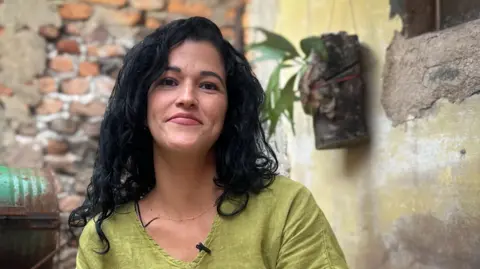
Indira Martínez is seven months pregnant and fears her baby will have limited prospects in life due to the crisis facing Cuba
Since the Trump administration imposed a near-total fuel blockade on Cuba three months ago, Mauren Echevarría Peña has been inside a ward in Havana's specialist maternity and neonatal hospital.
Mauren, 26, is expecting her first baby, but her pregnancy has been complicated.
"I've had gestational diabetes and chronic hypertension," she explains, sitting on a bed at the Ramón González Coro maternity hospital.
With her baby boy due this week, Mauren is understandably nervous.
Not only has she had to endure weeks of bed rest and constant supervision, but she must now give birth in a nation experiencing rolling blackouts and days-long power cuts.
Over the weekend, there was another nationwide collapse of the crumbling electrical grid.
Watch: Expectant mothers in Cuba struggle under fuel blockade
Still, Mauren is grateful for the attention she's received from the medical staff who have been working around the clock under extremely challenging conditions.
The BBC was granted access to the state-run facility as a coalition of international solidarity movements arrived in Havana with boxes of aid donations for the maternity hospital.
"They have done everything they can for me at the hospital," she says, while her doctors are in the room. "They've given me the medicines and insulin I need for the health of baby and the placenta."
Mauren strikes a defiant tone, saying that the country will always "find a way to move forward" in a crisis, but admits to being worried about the prospect of potentially giving birth during another blackout.
There are an estimated 32,800 pregnant women in Cuba at present, according to government statistics.
Most have not been able to count on the kind of support Mauren has received from the state.
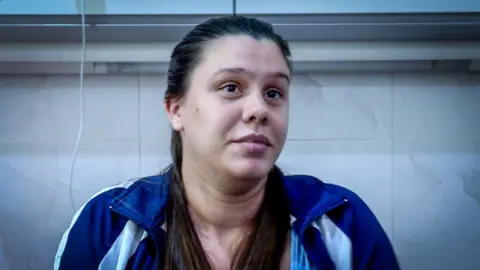
Mauren Echevarría Peña hopes there will not be a blackout when she gives birth
At her home in a Havana suburb, Indira Martínez, who is seven months pregnant, has not been able to cook breakfast – or even make a cup of warm milky coffee – for days.
On the morning I visit her, the power has been out since the previous afternoon. The fridge lies empty, the electric stove is not working, and the only available cooking method is a small charcoal grill her husband built.
"You must get up in the small hours when the power comes back on to cook whatever is available. And often it doesn't contain the vitamins and proteins I need – and it definitely doesn't cover my increased appetite because of the pregnancy," she explains.
Although she is irrepressibly good natured and smiley, it is clear that the difficult circumstances are grinding down Indira's resilience.
A hair stylist, she has not been able to work because she cannot be exposed to the chemicals in the hair dyes while pregnant so the family relies on her husband's modest income as a blacksmith.
Indira's mother, a retired nurse, worries about her daughter's reduced caloric intake and her stress levels in these final weeks.
Indira has already had the mosquito-borne disease, chikungunya, in the first trimester during a nationwide outbreak in Cuba.
Although she was so weak she could barely walk to the bathroom, the doctors say, thankfully, her baby girl remains in good health.
Since then, the Trump administration has, in essence, shut down all deliveries of crude oil to Cuba.
Washington warned the island's main energy partners, particularly Mexico, that they would be hit with tariffs if they sent any more fuel shipments to Cuba.
Instead, Mexico has sent hundreds of tonnes of humanitarian aid including powdered milk intended for pregnant mothers.
Indira says she hasn't seen any of it – and no additional state support at all.
"None of the humanitarian aid sent to Cuba has reached me," she comments.
"My husband and I didn't enter this pregnancy irresponsibly. We did it knowing full well that we can't rely on any help from the government. It's just us against the world!"
All they can do is pray that everything works out in the end, she adds.
 REUTERS/Norlys Perez
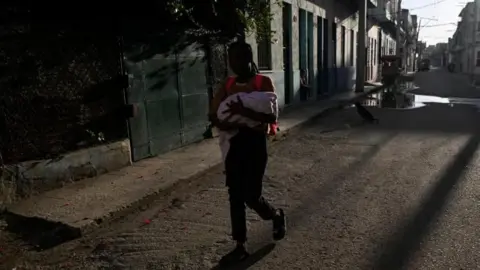
The recurrent blackouts have been particularly hard for mothers with young babies and the elderly
Like Mauren, who is already in hospital and days away from giving birth, Indira is increasingly fearful of the birth itself and cannot help but picture herself in labour inside a darkened hospital ward as the child is delivered by mobile-phone light.
Hospitals have generators but are struggling to source the fuel to run them.
However, her fears extend beyond the pregnancy and into the life which awaits her daughter – to be named Ainoa – in Cuba.
"How am I going to tell her she has no prospects in life? Because she won't have any," says Indira with clarity and resignation.
Education has long been one of the pillars of the Cuban Revolution but like so much on the island, Indira says it has deteriorated through lack of investment and through a lack of qualified teachers.
Furthermore, she says the dire economic situation on the island forces young people to do things to earn a little more money than the minuscule state wages: Indira was a trained IT systems technician before she turned to hairdressing and her husband was an accountant before having to pick up his tools as a blacksmith.
"As a parent, one would like to offer your child a real life and to motivate them. But I have no basis to tell her that she has a meaningful future ahead of her or can maximise her full intellectual capacity.
"If I say that, I'll be lying. She'll have no opportunity for growth here, none."
It is a thoroughly depressing and bleak conclusion to what is so often depicted as a time of expectation, of excitement even, and hope.
Cuba has an ageing population, a very low birth rate and huge outward migration. Despite the current crisis, the island needs more of its young people to have children.
But even before the crippling fuel blockade was imposed, many young Cubans were thinking twice before starting a family on the island.
Little wonder, as Mauren's baby boy – and probably Indira's baby girl, who is not due for two months – will be born into, quite simply, some of the hardest times in the modern history of their birthplace.
The BBC's Will Grant reports from Cuba as the island is plunged into darkness