7 months ago
29
7 months ago
29

Rachel Stonehouse,BBC West Investigationsand Nathan Heath,BBC West Investigations

 BBC
BBC
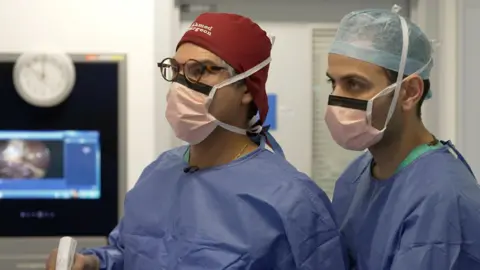
NHS England recorded more than 80,000 gallbladder surgeries in 2024-25
More research is needed into whether there may be a link between weight-loss injections and an increase in gallbladder removals, specialist doctors have said.
The number of gallbladder surgeries recorded by NHS England in 2024-25 was at its highest peak in the past decade.
The president of the British Obesity and Metabolic Specialist Society, Ahmed Ahmed, said he was doing more of these operations with "more and more" people telling him they had taken weight loss injections.
Gallstones are listed as a common side effect of the jabs and the UK's official medical licensing body said they were kept under "continual review".
On Thursday, the Medicines and Healthcare products Regulatory Agency (MHRA) updated its guidance on GLP-1 injections, like Wegovy, regarding the risk of acute pancreatitis, which is often linked to gallstones.
The makers of weight loss injections Mounjaro, Wegovy and Saxenda, said patient safety was a top priority and they monitor reports of adverse drug reactions.
Ahmed, who is a consultant surgeon and also carries out gastric band surgeries, said: "We don't know whether it's the injections that are causing the gallstones, or is it because the injections are causing rapid weight loss, which then in turn causes the gallstones?
"Clearly this area needs further research to find out if it's causative or not."
Sue Peacock was diagnosed with gallstones and told she would have to have her gallbladder removed
According to the latest best estimates by researchers from University College London, about 1.6 million UK adults have used weight-loss injections in the past year – mostly bought through private prescriptions rather than on the NHS.
Most had positive experiences, with no gallstone complications.
But mother-of-five Sue Peacock, from Wirral, in Merseyside, said she was left worried for her life after becoming seriously unwell.
After a consultation with her GP, she said she initially thought using Mounjaro sounded "great", but weeks later she was diagnosed with gallstones - hard deposits made of cholesterol and bile that form in the gallbladder.
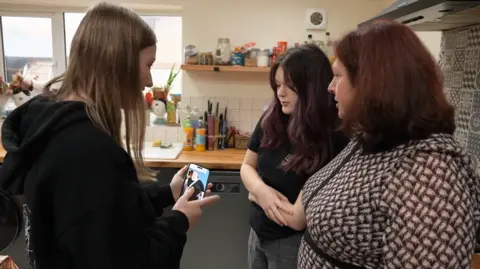
Peacock said her daughters now worry about her getting ill again
She was told she would have to have her gallbladder removed, but before she could have the operation, her gallstones caused pancreatitis – an inflammatory disease that can be fatal.
"I felt like I was dying... the pain was worse than it had ever been," she said.
"I was struggling to breathe. I was really, really sick... I was petrified."
Peacock said she had no health problems before using the injections and believes they are what caused her to be so unwell.
She added the experience had been "life changing" and that her children constantly worried about her becoming unwell again.
"For me, there's a lifelong impact... it almost kind of brings your mortality into focus," she said.
Since the drugs were approved in the UK for weight loss – Wegovy and Saxenda in 2021 and Mounjaro in 2023 – gallbladder removals have risen.
In 2024-25, there were 80,196 gallbladder operations carried out by the NHS in England, compared to 69,745 in 2023-24, which is a 15% increase, and also the highest number in the past decade.
Patient leaflets on weight-loss injections state that gallstones are a "common" side effect, and in medical trials the injections also sometimes led to inflammation of the gallbladder. For example in Mounjaro, it has been reported this may affect up to 1 in 100 people.
It is known that rapid weight loss can lead to gallstones, including in people that have been on severe diets - without the use of jabs.
The likelihood of developing gallstones is also higher among women and over-40s, as well as among those living with obesity, according to the NHS.
Therefore, Ahmed, who is based in London, said it was difficult without more research to know exactly what is behind the rise in cases.
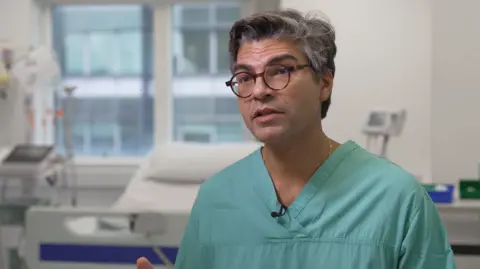
Ahmed Ahmed is calling for a "high quality" research trial
He has now also called for a trial to compare weight-loss injections with bariatric surgery, where the size of the stomach is restricted to reduce appetite.
He said this research would help establish which method was more clinically effective and more cost effective.

Surgeon James Hewes has noticed a rise in patients with gallstones
James Hewes, a Bristol consultant surgeon who also specialises in obesity and bariatric surgery, acknowledged that weight loss injections had "transformed the way that we manage people living with obesity".
But, like Ahmed, he would like more research to be done on the long-term effects.
"Anecdotally, we are seeing more patients presenting with gallstones," Hewes said.
"Often, it's difficult to know if that's related to the injection, or whether they had them originally but weren't assessed properly beforehand."
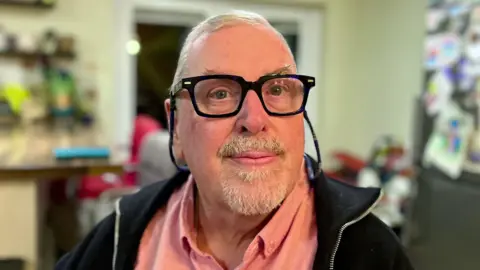
Steve O'Farrell has lost more than five stone (34kg) since using weight loss injections
For many, though, weight-loss injections have been positive.
Grandfather and father-of-three Steve O'Farrell, 67, from Bristol, said he had struggled with his weight throughout his adult life, and Mounjaro had been the only treatment to make a lasting difference.
O'Farrell said his weight loss with the drug was "almost instant" and that, as well as losing more than five stone (34kg) so far, he has more energy and has been able to exercise for the first time in years.
He added that he did a lot of research before ordering the drug from a pharmacy, but that for him, the risks, such as developing gallstones, were worth taking.
"You can't go into these things blind... you've got to see the pros and cons," he said.
"It's up to you to make that decision... and let's face it, it's a small price to pay getting your gallbladder out if you're going to lose pounds."
The NHS says gallbladder removal is a common and safe procedure but as with any operation there are risks, including blood clots or infection.

Steve O'Farrell has been able to exercise for the first time in years
For others considering using weight-loss drugs and whether there was anything they could do to reduce the risk of developing gallstones, Hewes said: "Losing weight in a slower and a controlled manner is likely to reduce your chances of getting gallstones."
Both of the surgeons the BBC talked to also agree that it is important for patients to speak to their healthcare professional about the benefits or risks of the drugs.
Eli Lilly, the makers of Mounjaro, as well as Novo Nordisk, the makers of Wegovy and Saxenda, said that anyone who experiences side effects should talk to a doctor or healthcare professional.
Novo Nordisk said that anyone experiencing side effects is advised to report it to a healthcare provider, as well as to the MHRA's Yellow Card scheme, which is designed to help the agency discover safety issues as soon as possible.
Additional reporting by Ema Sabljak, BBC England Data Unit
If you want to contact us regarding this story, email westinvestigations@bbc.co.uk
Follow BBC West on Facebook, X, and Instagram. Send your story ideas via WhatsApp on 0800 313 4630.