2 months ago
14
2 months ago
14

Just now
Nadine YousifSenior Canada reporter

 Getty Images
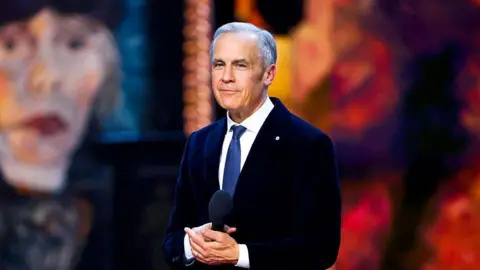
As Mark Carney enters his second year as Canada's prime minister, his popularity with the public is at an all-time high.
Mark Carney arrived on Canada's political scene last year as an Ivy League and Oxford educated economist and a former central banker for two countries.
He had an impressive resume and ambitions to be prime minister but had never run for public office until replacing Justin Trudeau as Liberal leader.
There was concern his lack of political experience would be a liability, but under his leadership, the Liberals won a minority government, which in a year had solidified into a narrow majority following the defection of five opposition members of parliament to his party.
Carney tore up the rulebook, jumping from political neophyte to leading a G7 nation, and he is enjoying a lengthy honeymoon both in Canada and around the world as a globetrotting prime minister.
Last week, Time Magazine named Carney one of the most influential people of the year.
In the write up, penned by European Central Bank president Christine Lagarde, she called him a "rock-star", and credited him with being "the first to conceptualise the breaking point" of the old geopolitical order now fractured under the second Donald Trump presidency.
"I trust he will now reinvent cooperation among the willing for the common good of all," Lagarde wrote.
Carney has promised a lot to Canadians - the most ambitious housing plan since World War Two, turning the country into an energy superpower, reducing its dependency on its largest trading partner, the US, and fighting American tariffs - and the expectations on him are immense.
Some argue he has now arrived at an inflection point where Canadians will be watching to see if he fulfills the transformative change he has promised, particularly on the domestic front.
"The country has been willing to give him a lot of rope to go out and do what he believes he needs to do in order to protect the country's interests," said Carlene Variyan, an Ottawa strategist who has worked with Canada's Liberal party for over a decade, including as its former campaign spokesperson.
The question defining where Carney goes forward, she added, whether he can be "the mascot globally" for a new coalition "while also taking care of his own people here at home?"
 Getty Images
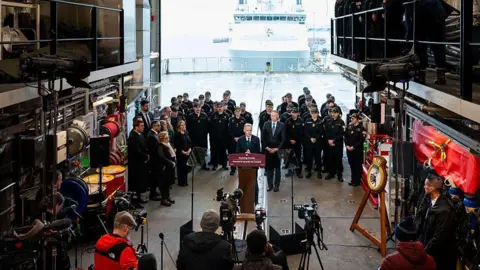
Prime Minister Mark Carney has promised to build ambitious infrastructure projects in Canada at a rate not seen since World War II.
Carney spent weeks abroad in his first year, visiting countries like China, India and the United Arab Emirates to drum up business and investment.
He emerged as the face of a global anti-Trump movement after his speech at the World Economic Forum in Davos in January. The address was hailed for its honesty in naming a "rupture" in the international rules-based order and called for middle powers to work together to counter the "era of great power rivalry".
That speech raised his profile both abroad and at home, said David Coletto, a Canadian pollster and CEO of Abacus Data.
"It matters to Canadians that Canada has a leader that many in other parts of the world wish they had," Coletto told the BBC, adding that it reinforced the image of Carney as "right for the job" of prime minister at this turbulent moment in history.
He is currently enjoying his highest poll numbers yet, with 46% of voters saying they support him, according to poll aggregate website 338Canada.
Carney owes much of his success to Trump's unpopularity with Canadians, who are angered by US tariffs and the president's repeated assertions that Canada should become the "51st state".
That dynamic with the US has rewritten political norms in Canada, Coletto said, where voters typically judge governments on how they handle domestic issues.
Canadians now see the biggest threat as coming from the outside, giving Carney room – and importantly time – to fix problems they believe are largely outside his control.
In a recent address to Canadians, Carney said that ties to the US are 'weaknesses we must correct'
Still, there are signs the extended honeymoon has an expiry date.
Carney is under pressure to negotiate a win with the US on the North American free trade agreement, known as the USMCA, which is undergoing a mandatory review this summer.
A big issue has been steep sector-specific tariffs imposed by the Trump administration on Canadian metals, automotives and lumber, which have already cost thousands of jobs.
So far, it doesn't seem like the two sides are any closer to a deal. Canada's newly appointed ambassador to the US, Mark Wiseman, told parliamentarians on Thursday that no date has been set for a formal round of negotiations to begin.
"This is going to be the thing that Carney will have to carefully manage the public's expectations on," Coletto said.
The prime minister appears have taken note. Last week, he released a 10-minute social media video telling Canadians that his government "is acting and will continue to act" to solve the country's problems.
Conservative opposition leader Pierre Poilievre said Canadians need more than assurances on YouTube.
"What has Mark Carney really done in a year on this? He hasn't held negotiations in five months," he told reporters in Ottawa last week, and criticised him for a lack of transparency on his trade plans.
"He's done absolutely nothing on this file in the last year other than to stoke fear and distract from his catastrophic failings here at home."
Affordability is also creeping back to the top of the agenda for many Canadians. The ongoing US and Israel war on Iran has raised prices at the pump globally, including in Canada, home prices continue to be out of reach for many, and youth unemployment is stubbornly high.
Nodding to those concerns, Carney recently announced a temporary tax break on fuel and a one-time grocery rebate that will be delivered to Canadians' bank accounts in June.
Other pledges have proven harder to fulfill, like the prime minister's vow to double the number of homes built annually in Canada to bring down costs. Experts have noted that Carney's first budget does not devote enough money to the effort, and instead appears to be banking on reducing demand by tightening immigration.
The housing promises, in effect, have been "watered down", wrote Canadian economist and former Trudeau advisor Mike Moffatt late last year in the Toronto Star, shortly after the budget was released.
Even if the bold promises catch up to the Carney government, the prime minister still has the gift of time on his side, Variyan noted. A majority government could mean that Canadians won't head to the polls until 2029 - that's when voters will judge Carney on how much he has been able to achieve.