2 months ago
36
2 months ago
36

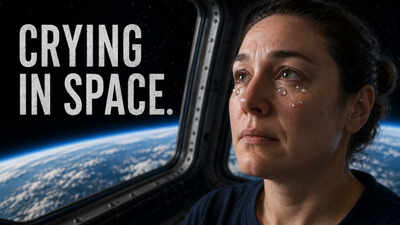
Representative image generated using AI
If Farah Khan ever decided to remake Om Shanti Om in space, she would never be able to recreate the iconic Ek Chutki Sindoor moment. Because when Shantipriya is asked to shed a single tear, as her trembling voice delivers the emotionally charged dialogue, it would turn into a disaster.
Not because the actor couldn’t express the emotion, but because the drop of the tear would refuse to fall in zero gravity.
It would just sit there, clinging to her cheek. And if another tear emerges, it would turn into an uncomfortable blob.That single drop, which is supposed to cascade like a benediction, carrying with it the weight of everything she’s suffered, would instead hover on her face like a question mark. The cinematographer would lose it, and so would Khan.
In other words, that iconic moment would simply not exist if the director were to film it in space. This isn’t hypothetical cruelty towards cinema, but the actual physics of crying in space, the strange reality that astronauts endure.
Even something as human as crying changes once you leave Earth’s gravity behind.
Astronaut ke aansu (tears)… tum kya jaano?

In space, astronauts don’t walk or eat the same way as Earthlings, so why do we assume they cry like us up there? In zero gravity, tears don’t flow the way they do on Earth.
So, if you cry, the tears would just pool around the eyes and face, forming little blobs of liquid that refuse to fall away. There won’t be any dramatic roll down the cheek for the cinematographer to push in. The very idea of ‘shedding tears’ becomes almost meaningless in space.
Chris Hadfield, the Canadian astronaut and former commander of the International Space Station, once demonstrated the physics of tears in space.
He made this weirdly fascinating phenomenon viral in a video, where he squirted water into his eye to simulate tears. The liquid just kept piling up on his face, and that’s exactly what happens without gravity to pull it down.“You can see it just forms a ball on my eye,” the astronaut said.What happens if there are more tears? “If you keep crying, you just end up with a bigger and bigger ball of water in your eye until eventually it crosses across your nose and gets into your other eye or evaporates or maybe spreads over your cheek, or you grab a towel and dry it off,” he said.Not being able to cry in space may sound absurd until you think about the implications. You can cry, but the tears won’t fall down. “Your eyes will definitely cry in space, but the big difference is tears don’t fall. So grab a hanky,” Hadfield added. The tears won’t fall in space; they just cling to your face.
If you’re not as particular as filmmakers about tears rolling perfectly down the cheek, you can still cry, because the emotions are pretty much the same, regardless of whether you are on Earth or far away.
Clayton C. Anderson, a NASA astronaut, once spoke about tearing up in space. “I cried in space several times… due to some very emotional circumstances. Crying is exactly the same as here on Earth, except the tears don’t fall down, as there is no gravity.
Not a big deal at all… the emotions I experienced, however, were a big deal,” he explained.A peer-reviewed study published in Frontiers in Physiology explains that, in the absence of gravity, fluids around the eye are controlled mainly by surface tension. So, instead of falling or draining away, the tears just hang out at the point of origin. They cling to the eyes and face like a toxic ex. The sensation feels more physical than emotional.Now that’s your cue to appreciate Earth a little more, where tears fall on cue and emotions don’t just hover mid-air. And maybe, just maybe, be grateful that Farah Khan made Om Shanti Om where gravity still works.