1 hour ago
1
1 hour ago
1

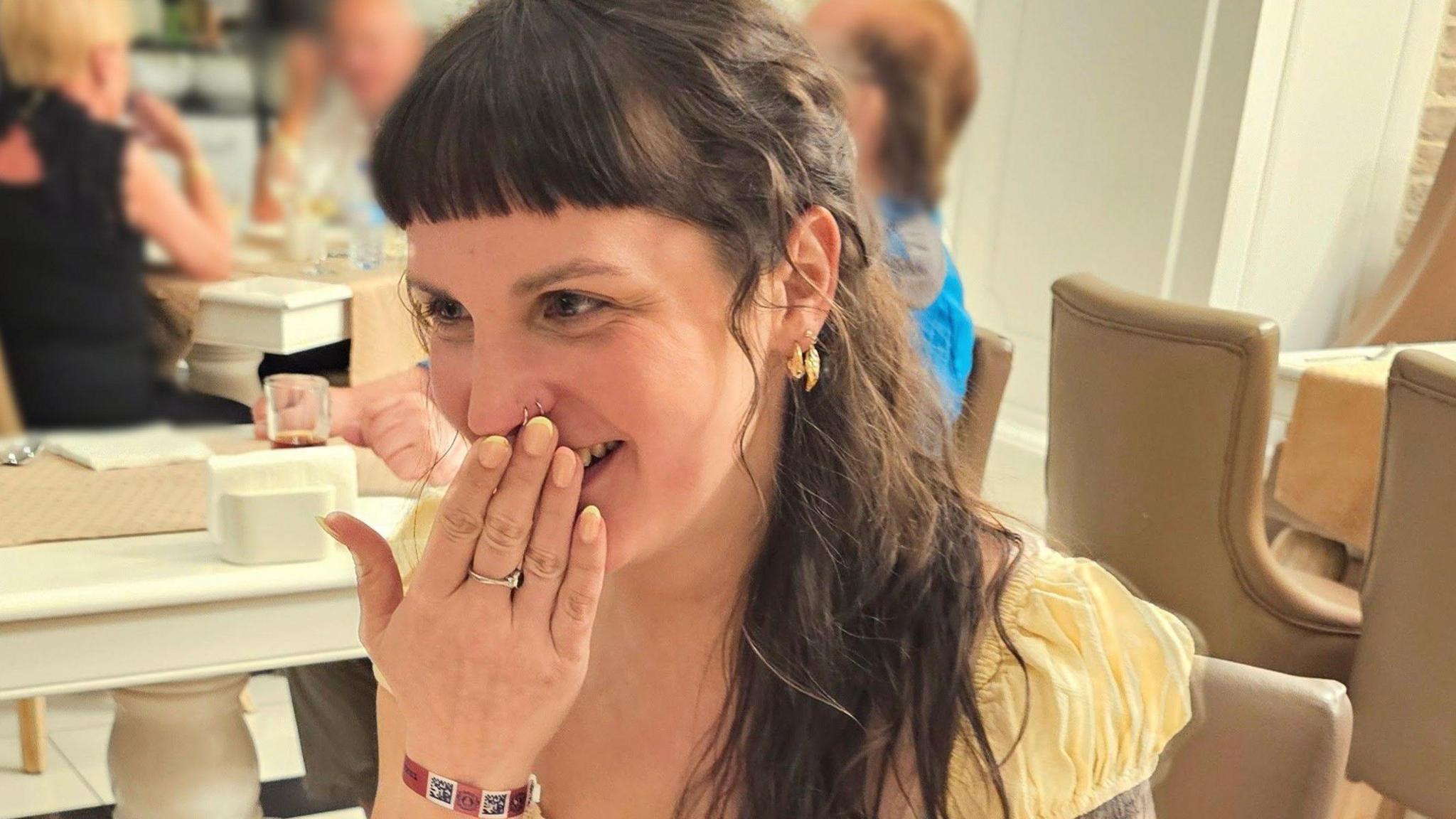
Stacy Hunter's death has prompted calls for stronger protection for women
ByCalum Watson
BBC Scotland
Domestic abuse campaigners are calling for greater use of location tracking technology to monitor high-risk suspects following the murder of a woman in Renfrewshire last month.
An online petition is calling for a "Stacy's law" in memory of Stacy Hunter who was killed at her home near Houston by her estranged husband while he was on bail.
Scottish ministers have previously faced criticism over the slow rollout of Global Positioning System (GPS) equipment, which is used far less in Scotland than in some other countries.
The Scottish government said it was listening to victims and support organisations and would carefully consider the petition.
The campaign has been started by Lynne Mackenzie, herself a domestic abuse survivor, who lives a few miles from the isolated cottage where Stacy was killed in July.
Stacy's husband Jim Mair, 43, whose body was found beside her, had been charged with assaulting her but had reportedly been granted bail, external on condition that he did not approach her.
While Mackenzie did not know Stacy personally, she said she was shocked at her murder which happened just six days after the death of another domestic abuse victim, Vikki Soloman, in Edinburgh.
She told BBC Scotland News the killings led her to question whether enough was being done to protect women in Stacy's situation.
"Every time driving in and out of the village I was aware of the police at the end of the road," she said.
"And it really got me thinking what could we have done? What could have been put in place beforehand? What else do we need?"
She has been in contact with Stacy's family who have agreed for her name to be associated with the campaign.
 Image source, Getty Images
Many countries are now rolling out lightweight electronic monitoring equipment for offenders who are not in custody
The petition calls for high-risk domestic abuse perpetrators or suspects released on bail to have their location monitored using GPS equipment.
This could include individually assessed exclusion zones around victims, homes or workplaces and alerts, triggering police responses, when conditions are breached.
Mike Nellis, emeritus professor of Criminal and Community Justice at the University of Strathclyde and one of the UK's leading experts on electronic monitoring, said it was perfectly feasible to introduce such a system.
He said it could work by setting an exclusion zone around a victim's home that triggered an alert if an abuser violated it, although the zone would have to be sufficiently large to allow time for police to get there first.
Prof Nellis said that while Scotland has been slow to embrace GPS technology, the campaign could now find itself "pushing at an open door" because ministers are actively exploring ways of reducing the prison population.
However, he cautioned that no system was foolproof.
"I think probably every jurisdiction that has used it has at one point in time had an offender who still managed to assault, injure or kill the victim," he told BBC Scotland News.
"It's a helpful solution but it's not perfect."
He also added that some women's support groups have in the past voiced concern that such systems might give a false sense of security.
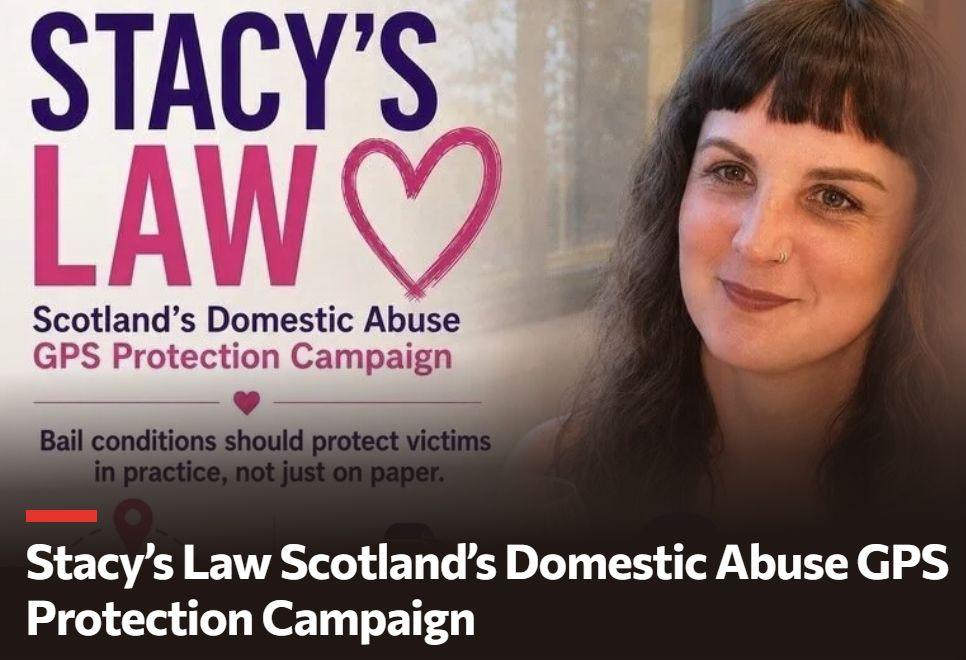
The campaign has been named after Stacy Hunter with the support of her family
In Scotland, electronic tagging has mainly relied on older radio frequency (RF) equipment which is focused on home curfews or detention.
These devices are linked to a receiver in the offender's home and cannot track movements away from the property.
Last year, public body Community Justice Scotland (CJS) issued an urgent National Improvement Recommendation to the Scottish government, external urging it to accelerate the expansion of more sophisticated monitoring systems.
CJS expressed frustration that neither GPS nor alcohol monitoring technologies had been adopted in Scotland despite an expert group having backed them in 2016.
By contrast, both technologies have already been widely used in England and Wales since 2018 and there are plans to start imposing new restriction zones on offenders this autumn.
Scotland's victims minister, Kirsten Oswald, said her thoughts were with Stacy's family.
In a statement she said: "We are listening carefully to victims and support organisations about what more can be done to prevent and tackle violence against women and girls and we will carefully consider the petition.
"The first minister has pledged his personal leadership on tackling the scourge of violence against women and girls.
"As the first minister has made clear, government has a vital role to play in tackling violence against women and girls, but lasting change requires all of us to play our part."
She added: "Men, in particular, must challenge sexism, confront abusive behaviour and help create a culture where every woman and girl can live free from violence, abuse and fear.
"While decisions on bail and remand are always a matter for the independent court, bail can be electronically monitored."
Lynne Mackenzie is a co-founder of Rise Against Abuse, external, a not-for-profit group which supports those affected by domestic abuse, but she has started the petition in an individual capacity.
Stacy's family now prefer her to be remembered by her pre-marriage surname Hunter, rather than her husband's name Mair.