1 month ago
53
1 month ago
53

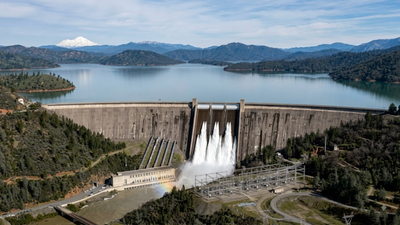
Before Shasta Lake covered the landscape of northern California, the Sacramento River valley was home to a mining town shaped by copper, railroads and the industries that followed them.Its name was Kennett; the town grew from a railroad construction camp into an important mining community in Shasta County. Copper mines helped drive its economy, while rail connections and industrial works tied Kennett to the wider region.Then came one of the largest engineering projects in California's history. The federal government began building Shasta Dam on the Sacramento River as part of the Central Valley Project, an enormous water-management scheme intended to store water, support irrigation, control floods and provide hydroelectric power.
The dam eventually transformed the valley, but it also erased Kennett from the landscape.Water storage in the newly created Lake Shasta began in February 1944. As the reservoir filled, Kennett disappeared beneath it.Today, the town survives largely through historical records, photographs and the industrial remains documented before the reservoir covered the valley.
Kennett grew with California's mining and railroad boom
The landscape around present-day Shasta Lake had a long history before the mining town appeared.
The National Park Service notes that Indigenous peoples, including the Hupa, Achumawi, Achomawi and Shasta, had lived across the region for thousands of years before the arrival of large-scale Euro-American settlement. The rivers and streams of the area later became increasingly important to settlers, miners and engineers.Kennett emerged during the era when railroads and mining were transforming northern California.
The town's industrial identity was closely tied to the mineral resources around it. Copper mining became particularly important, creating demand for transportation, processing and other infrastructure.The Pacific Coast Architecture Database, which documents California's historic built environment, records the industrial development associated with Kennett and the surrounding mining district. Its records include the Holt and Gregg Company, which operated a limestone quarry and kiln near Kennett to produce material used in concrete.
The company had earlier operated elsewhere in Shasta County before shifting its quarry and kiln operations closer to Kennett.That detail illustrates something important about the old town. Kennett was not simply a collection of miners' homes scattered around a mine. It belonged to a wider industrial landscape in which mines, railways, processing facilities and construction-material operations were connected.
The town existed within an increasingly industrialised valley.
Then the federal government planned a giant dam
The transformation began long before the reservoir reached Kennett. California had spent decades considering ways to capture water from the wetter northern part of the state and move or store it for the Central Valley, where agriculture depended heavily on reliable water supplies.The state developed plans for a Central Valley water project, but during the Great Depression it struggled to finance the enormous infrastructure required.
The federal government eventually took control and established the Central Valley Project.Shasta Dam became one of its most important components. Originally called Kennett Dam, the project was planned on the Sacramento River north of Redding. Construction was an enormous undertaking. According to the National Park Service, crews eventually numbered about 4,700 workers, excavating millions of tons of granite and building a 9.6-mile conveyor system to transport aggregate to the dam site.The project also required major changes to the existing transportation network.About 30 miles of Southern Pacific Railroad track had to be relocated because the railway ran directly through the construction area. Crews constructed bridges, trestles and tunnels as part of the rerouting effort. One of those tunnels was later used to divert the Sacramento River around the dam construction site.The scale of the project was extraordinary. By August 1942, around four million cubic yards of concrete had already been placed.
The final bucket of concrete was poured on 2 January 1945. At 602 feet high, Shasta Dam was among the largest concrete dams in the world when it was completed.But while the dam was rising, the future reservoir was already changing the fate of the communities in the valley below.
Kennett disappeared as Lake Shasta filled
Shasta Dam was built to hold back an enormous quantity of water. The resulting reservoir, Lake Shasta, now has a shoreline stretching for roughly 365 miles through the surrounding hills.
Shasta Dam was a key part of the Central Valley Project, providing water for irrigation, towns and industries while also helping with flood control and generating hydroelectric power.Those benefits came with a profound transformation of the landscape. Kennett was among the communities that would be lost beneath the reservoir. By the time the lake began filling in February 1944, the town's future had already been decided.
As the water rose, the streets, buildings and industrial landscape were progressively swallowed by the reservoir.Historical records from the period preserve a remarkable snapshot of the town just before its disappearance. The Library of Congress, for example, holds a 1942 photograph by photographer Russell Lee showing an old bank vault in Kennett. Its original description identifies Kennett as a once-booming mining town that would be inundated after completion of Shasta Dam.The photograph captures a community caught between two eras. The old mining town was still physically present, but the massive federal water project was already reshaping its future.
The industrial landscape vanished with the town
When people think about a submerged town, it is easy to imagine houses and streets disappearing beneath the water.Kennett's story was more complicated. The surrounding landscape contained the infrastructure of an industrial mining economy: mines, processing operations, transportation routes and other facilities connected to the extraction and movement of materials.The Pacific Coast Architecture Database's documentation of industrial sites around Kennett helps preserve part of that history. Its record of the Holt and Gregg Company's limestone quarry and kilns shows how construction-related industries operated in the same landscape as the mining town.That industrial history matters because the reservoir did not simply cover a town. It covered a working landscape. The same valley that had once supported mining, transportation and settlement became part of a vast water-storage system.The transformation was almost complete: an industrial frontier was replaced by a reservoir designed to support a modern agricultural and urban economy elsewhere in California.
The water that erased Kennett also built modern California
There is an unavoidable tension in Kennett's history. Shasta Dam was not constructed simply to erase a mining town. It was part of a much larger project intended to solve some of California's most difficult water problems.The Central Valley was highly productive but vulnerable to both drought and flooding.
Shasta Dam stores water for irrigation, protects against floods and saltwater intrusion, supplies communities and industries, and generates hydroelectric power.The dam therefore became a crucial piece of California's water infrastructure. But large infrastructure projects often reshape landscapes in ways that are difficult to reverse. For Kennett, there was no return. The town that had grown around mines and railways became part of the reservoir itself.
What remains when a town disappears?
Kennett is now a ghost town in the most literal sense. There is no functioning settlement on the site. The physical landscape that once defined the community has been transformed by the reservoir.Yet the town has not completely disappeared. Its history remains in photographs, maps, industrial records and accounts of the mining communities that once occupied the Sacramento River valley. Records preserved by institutions such as the Library of Congress and the Pacific Coast Architecture Database allow researchers to reconstruct parts of a landscape that can no longer be seen in its original form.And the reservoir itself is a reminder of what replaced it. Every time water fills Lake Shasta, it conceals the valley beneath the surface. When water levels fall, parts of the reservoir's submerged landscape can become more visible, offering fleeting reminders of what existed before the dam.That does not mean Kennett simply re-emerges as an intact ghost town whenever the lake drops. Much of the old community remains submerged, and the visibility of individual remains depends on reservoir conditions.
But the changing waterline can make the history of the drowned landscape feel unexpectedly close again.
Kennett became part of a much larger transformation
The disappearance of Kennett illustrates the enormous physical consequences of America's dam-building era. The National Park Service describes Shasta Dam as a keystone of the Central Valley Project, an infrastructure system that connected northern California's water resources with the agricultural heart of the Central Valley.For California, the dam represented water security, irrigation, flood protection and power. For Kennett, it marked the end of a town. That contrast is what makes the submerged mining community so compelling. The reservoir is not merely covering an abandoned settlement. It occupies the place where one version of California gave way to another.The mines, railways and industrial works that helped build Kennett's identity belonged to an earlier era of resource extraction.
The lake that replaced them became part of a modern system designed to move, store and control water on a massive scale.More than 80 years after the reservoir began filling, Kennett remains hidden beneath Lake Shasta. Its streets are gone from the surface. Its industrial landscape has been swallowed by water. But the records left behind preserve evidence of the community that once stood there.And whenever the lake retreats far enough to expose traces of the old landscape, the buried history of Kennett becomes visible again, a reminder that beneath one of California's most important reservoirs lies the remains of a town that helped shape the region long before the dam changed it forever.