1 month ago
56
1 month ago
56

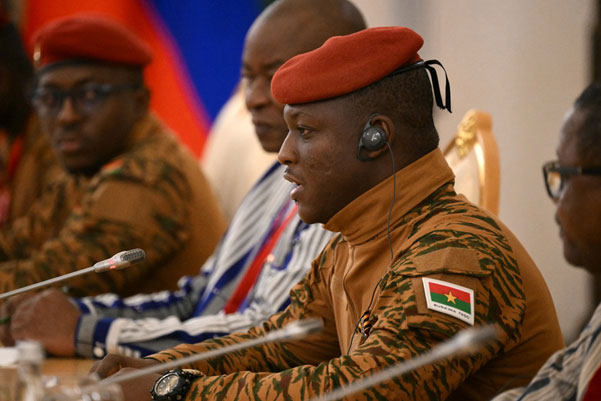 Burkina Faso’s junta leader Captain Ibrahim Traoré attends a meeting with Russian president Vladimir Putin in Moscow on 10 May 2025. Credit: Angelos Tzortzinis/AFP
LONDON, August 7 (IPS) - Burkina Faso’s charismatic young military leader, army captain Ibrahim Traoré, has stopped pretending. In April, he declared that people should ‘forget about the question of democracy’ because ‘democracy isn’t for us’. When Traoré seized power in September 2022, ousting a leader who’d staged a coup earlier that year, he promised elections by June 2024. The junta broke that pledge, pushing any transition back to 2029. Now Traoré has confirmed he has no intention of restoring democracy. Instead, Burkina Faso’s military junta is tightening its repression, while working with neighbouring states to internationalise its dangerously undemocratic model.
Crackdown intensifies
Repression has unfolded in a context of jihadist insurgency. Frustration with the democratically elected government’s security failures helped fuel the conditions that led to military rule, but the army hasn’t turned things around. The insurgency has grown, and civilians are paying the price. All sides are accused of crimes against humanity and war crimes, and since the coup, there’s evidence that Burkina Faso’s armed forces and allied militias have increasingly targeted civilians, particularly members of the Fulani ethnic group.
A military seen to be failing against the insurgency and killing civilians would lose any claims to legitimacy. That makes the junta determined to control the narrative, silence dissent and crush any perceived challenge to its power.
Traoré backs his anti-democratic rhetoric with actions. In January, the government dissolved all political parties, claiming they sowed division and weakened the social fabric. The junta is also targeting civil society organisations (CSOs). In recent months, authorities have suspended over a thousand organisations. In April, the government dissolved 118 CSOs, citing non-compliance with a July 2025 law that imposed strict and onerous registration, compliance and reporting requirements. The law supposedly gave CSOs a year to comply, but the government dissolved them before the deadline expired. It targeted human rights organisations such as the African Meeting for the Defence of Human Rights, the Burkinabè Coalition for Women’s Rights and Christian Action for the Abolition of Torture.
Religious associations and student groups have fared little better. Association As Salam and the Coordination of Young Muslims of Burkina have no explicit human rights focus, but authorities have suspended both for alleged public disorder and activities said to fall outside their stated purpose. In May, the government suspended the General Student Union of Burkina Faso, the country’s biggest student group, after it issued a statement criticising the government’s security record, which the government claimed glorified terrorism.
Authorities have suspended several media outlets, typically over their reporting on the security situation. In May, the state media regulator indefinitely suspended French TV channel TV5 Monde, accusing it of siding with terrorist groups.
Anybody who speaks out risks arrest, detention, enforced disappearance, forced conscription into the armed forces and torture. Burkina Faso’s LGBTQI+ people are particularly exposed, since in 2025 the junta criminalised same-sex relations, with jail sentences of up to five years. The government has also granted itself the power to strip citizenship from anyone deemed to be acting against the national interest. Last December, repression took an even more ominous turn when the junta announced its intention to reinstate the death penalty.
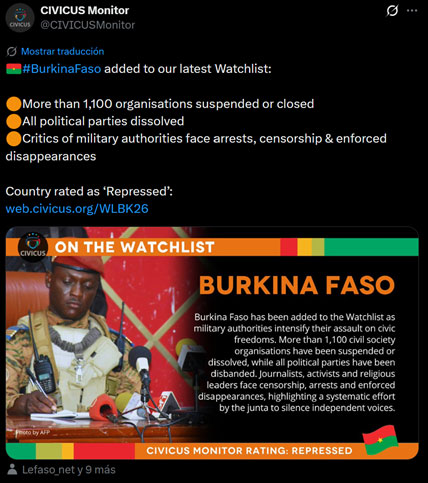
Due to these actions, Burkina Faso has recently been added to the CIVICUS Monitor Watchlist, which identifies countries where a severe deterioration in the quality of civic space is taking place.
Repressive alliance
Burkina Faso isn’t working alone. Under Traoré, it has forged close relations with two neighbouring military regimes, Mali and Niger. Together, they’re promoting a model that rejects democracy and international scrutiny. In January 2025, they completed their joint withdrawal from the key regional organisation, the Economic Community of West African States (ECOWAS), a year after forming their rival Alliance of Sahel States. The move was clearly a response to ECOWAS pressure to restore civilian rule.
The three states have now formally begun the process to leave the International Criminal Court (ICC). They’ve denounced the court as a ‘tool of neocolonial oppression’ and promised to set up an alternative, although any body they create is unlikely to retain the ICC’s power to issue arrest warrants against sitting heads of state and other senior figures. For survivors of human rights atrocities, withdrawal from the ICC and the ECOWAS Community Court of Justice removes vital potential routes to justice.
In February, Burkina Faso suspended the UN Human Rights Office, which had operated in the country since 2019, in retaliation for a statement by UN human rights chief Volker Türk urging the junta to reverse its ban on political parties and open up civic space. The UN has now concluded it has no choice but to close its office.
These moves shield military leaders and security forces from external accountability. They’re part of a wider realignment that has seen Burkina Faso and its allies turn away from former colonial power France and other democratic states and towards Russia, a partner with no interest in human rights. Burkina Faso’s relations with Russia have extended beyond military cooperation to stronger economic ties. Last year the two countries signed a gold-mining deal.
Even as he rejects international scrutiny, Traoré has cultivated a global following. Through adept use of social media and a steady stream of disinformation, he casts himself as a pan-African leader in the mould of liberation-era icons such as Thomas Sankara, Burkina Faso’s revolutionary former president. His message taps into real anger about colonialism and the power imbalances in relations with western states.
But the people whose rights he tramples aren’t westerners. The civilians being slaughtered by the army and the activists and journalists being silenced are Burkinabe people. There’s nothing un-African about democratic freedoms, and nothing pan-African about a leader who denies them. African democracies have the most to lose if Traoré’s model spreads, and are the most able to challenge it. They should refuse to normalise his narrative and press him to restore fundamental freedoms, rebuild a path to democratic rule and recognise the value of international accountability.
Andrew Firmin is CIVICUS Editor-in-Chief, co-director and writer for CIVICUS Lens and co-author of the State of Civil Society Report.
For interviews or more information, please contact [email protected]
© Inter Press Service (20260807055803) — All Rights Reserved. Original source: Inter Press Service