40 minutes ago
1
40 minutes ago
1

Bangladesh’s banana farmers could turn discarded banana stems into a source of income, as researchers estimate the waste could produce nearly 37,778 tonnes of banana fibre each year, creating a potential $94 million export opportunity.
According to the study published in the Journal of Hunan University, titled ‘Unlocking the Potential of Banana Fibre Exports from Bangladesh: A Comprehensive Marketing Strategy Analysis’, the country’s extensive banana cultivation leaves large quantities of pseudo-stems largely unused, even though they can be processed into fibre for textiles, packaging and paper. With global demand for sustainable materials growing, banana fibre could offer Bangladesh a new export product while creating employment in rural areas.
But reaching this potential will require investment in processing, quality control, research and international marketing.
Banana waste offers Bangladesh a $94 million export opportunity
The fibre estimate becomes particularly significant when its potential export value is considered. The study’s findings state that Bangladesh could earn “over $94 million annually” by exporting banana fibre at a price of $2.50 per kilogram. At the study’s estimated production of 37,778 tonnes, that price works out to about $94.4 million in potential annual revenue, which is why the opportunity can be rounded to $94 million.
The researchers are careful to present this as potential rather than money Bangladesh is already earning from banana fibre exports. Their conclusion says the country is “capable of producing approximately 37,778 tons of banana fibre each year from banana plant waste”, with export potential based on production capacity and an export price of $2.50 per kilogram. Existing Bangladeshi exporters operate on a much smaller scale, meaning substantial expansion would be required before the estimated opportunity could become actual export revenue.
Banana fibre can be used in many products
Banana fibre’s appeal comes not only from the quantity of available waste but also from the range of products it can be used to make. The study describes banana fibre as a biodegradable natural material composed primarily of cellulose, hemicellulose and lignin. It says fibres from different parts of the pseudo-stem can have different characteristics, with inner sheaths producing softer fibres and outer sheaths producing thicker, more robust material.Banana fibre can be used in textiles, packaging and pulp and paper, as well as for products including yarn, fabric, apparel, handicrafts, paper, security-printing materials and plywood. The researchers also point to its strength, moisture absorption and breathability as characteristics that could make it suitable for apparel, home furnishings and technical textiles.
Bangladesh needs investment to expand banana fibre exports
Bangladesh already has some foundations for a banana fibre trade.
The study identifies companies including Musa Banana Fibre and Modern Banana Fibre Company Ltd among the country’s manufacturers and exporters, with existing markets in Eastern Europe, South America, Oceania and Central America. However, the researchers say Bangladesh is “not currently able to export large volumes of banana fibres”, highlighting the gap between the country’s theoretical production potential and its present export capacity.Closing that gap would require investment in machinery, extraction technology, quality control, worker training, transport and storage, alongside stronger international marketing. The study recommends finding new overseas buyers, appointing agents in target markets, investing in research and development and building closer relationships with customers. It also calls for internationally recognised quality standards and says government support through measures such as subsidies, tax incentives and export-promotion schemes could help the industry develop.
Banana waste could create rural jobs
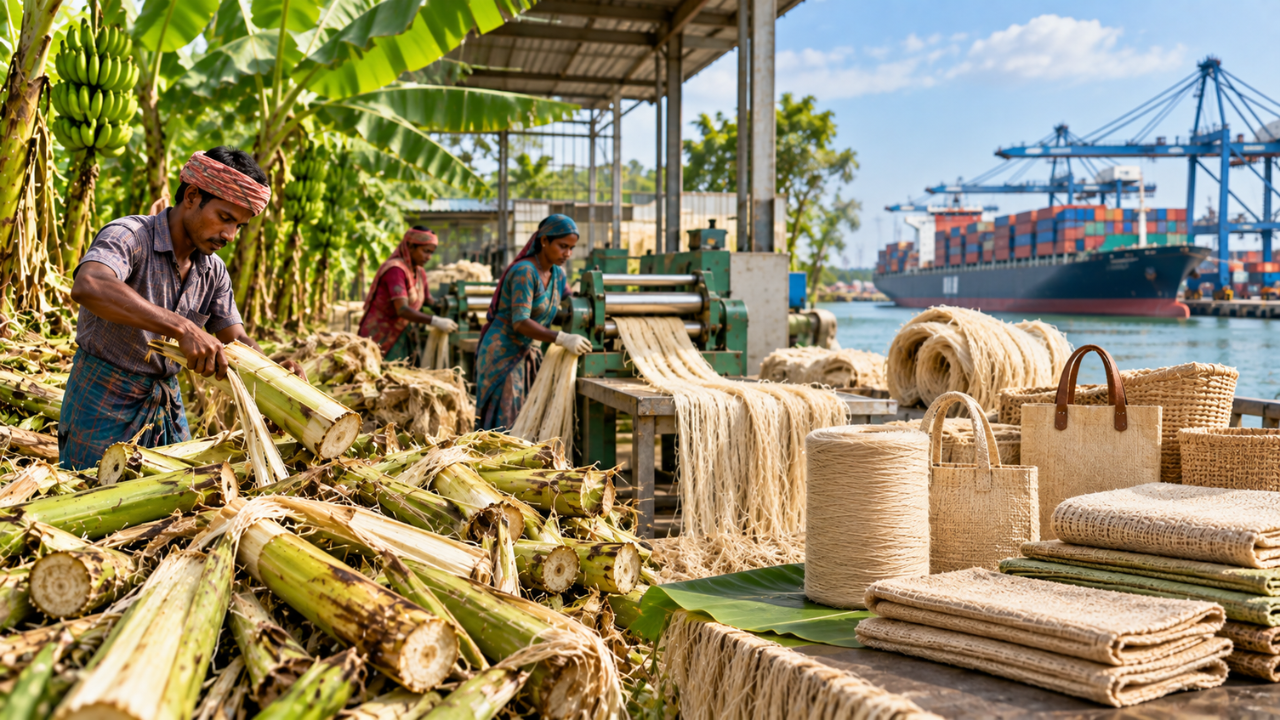
Image AI generated
They argue that using discarded pseudo-stems could help Bangladesh diversify its export basket, create rural employment and participate in the growing market for sustainable materials. Their study estimates that the global banana fibre market grew at a 5% compound annual growth rate from 2019 to 2023, while stressing that Bangladesh’s $94 million opportunity depends on developing the production, processing, quality and export infrastructure needed to turn agricultural waste into a commercially viable fibre industry.