6 months ago
51
6 months ago
51


 Getty Images
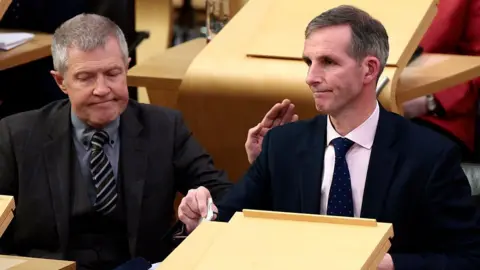
Liam McArthur (right) said legislation was needed to prevent "bad deaths"
The MSP behind the rejected bill to give Scots the right to medical help to end their lives says the issue is "not going away".
Scottish Liberal Democrat Liam McArthur says he is convinced support for assisted dying will continue to grow as more people suffer what he describes as "bad deaths".
The bill would have made the treatment available to terminally ill, mentally competent adults who have been given less than six months to live - but opponents said there were not enough protections against coercion.
McArthur was visibly emotional after the defeat and shared embraces with colleagues as the Holyrood chamber emptied.
But on Wednesday, he told the BBC he was resolute in his views.
Speaking to the Around Orkney programme, he said: "I'm fairly confident as a result of what we saw last night that the next attempt to get this over the line will be successful and probably fairly comfortably so.
"This issue is not going away, the number of people affected by these bad deaths - given the demographic trends, given the advances in medicine - those numbers are only going to increase, and meantime the overwhelming majority of people across Scotland are supportive of a change."
What's the public mood on assisted dying?
The Assisted Dying for Terminally Ill Adults (Scotland) Bill would have made it legal for a medical practitioner or authorised health professional to give an eligible patient a lethal drug to end their own life.
A bill to legalise assisted dying in England and Wales is being considered at Westminster, though it appears unlikely to pass before the end of the parliamentary term.
McArthur made several changes to the bill in a bid to win over swithering MSPs.
In the end, most Lib Dem and SNP MSPs supported the bill, with full support from the Greens, but it was defeated by a majority of Labour and Tory opponents, as well as 22 from the SNP - including John Swinney.
McArthur's assisted dying bill was the third to have come before the Scottish Parliament since devolution in 1999, but the first to make it past a stage one vote.
MSPs were granted a free vote on the proposals, meaning they were not whipped to vote along party lines.
Both sides of the debate claim huge public support for their arguments - though the results of recent polls vary. It was noted at stage three of the debate by Green MSP Ross Greer that answers differ considerably depending on how survey questions are asked.
A poll carried out in 2024 on behalf of the campaign group Dignity in Dying Scotland found that 78% of respondents said that they would support making it lawful for someone to seek assisted dying in Scotland.
However, another poll commissioned this year by campaign group Not Dead Yet UK found that 69% agreed Holyrood should prioritise improving access to care for disabled people before introducing "assisted suicide".
Improving access to palliative care has been a common theme in the reaction to the bill's defeat.
End-of-life charity Marie Curie has estimated that the need for palliative care in Scotland will rise by almost 20% by 2050, with almost 11,000 more people requiring care each year than in 2025.
The Scottish government has promised to spend £6.5m on hospices next year - but sector representatives have said this is not sustainable.
Alisdair Hungerford-Morgan, chief executive of Right To Life UK - which has campaigned against assisted dying and also opposes abortion - said it was vital that MSPs "redouble their efforts to invest in universal access to high-quality palliative care" after May's Holyrood election.
He said: "If this legislation had passed, countless vulnerable people would have been pressured or coerced into ending their lives".
Toby Porter, the chief executive of Hospice UK - which is neutral on assisted dying - said the debate had exposed "deep inequalities" in access to palliative care across Scotland.
He said over 60,000 people die in Scotland each year and the number of people who need palliative care is "rising rapidly" - and argued for long-term sustainable funding for hospices.
Emma Cooper, convener of Friends at the End (FATE) - who are in favour of assisted dying - said the debate had been "plagued by misinformation" and that end-of-life decisions that hasten death already happen in the NHS.
She added: "Scottish people are going to continue to suffer unnecessarily at the end of life."
Calls for better palliative care
Religious leaders have been vocal in the aftermath of the vote - differing in tone, but again all advocating better access to palliative care.
Bishop John Keenan, who is president of the Bishops' Conference of Scotland, said MSPs had taken the "correct" action.
He said that genuine compassion was about ensuring people receive the "medical, emotional, and spiritual support that recognises their dignity".
Omar Afzal, director of public affairs at the Scottish Association of Mosques, said the result was not a moment for celebration.
He said the debate had exposed a "hard truth" - that the palliative care system "remains under-resourced, uneven, and too often unable to meet the needs of those at the end of life".
Rt Rev Rosie Frew, the Church of Scotland's moderator, recognised the "diversity of views" within the church - though it ultimately did not support a change in the law.
She said had the bill passed, "many vulnerable people might have seen an assisted death as their only realistic option" and said the church would continue to advocate for more palliative care funding.