1 hour ago
2
1 hour ago
2

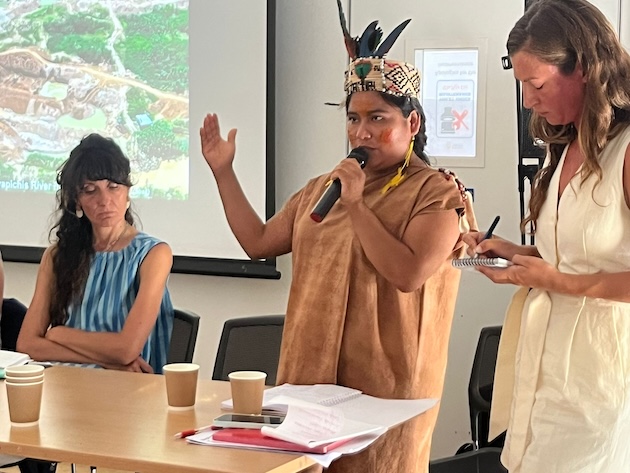 An Indigenous community leader, Jackeline Mendoza Díaz, addresses participants during the webinar “Gold’s Dark Web: The Hidden Price of a Booming Market” on June 25, speaking about the devastating impacts of illegal and poorly regulated gold mining on Indigenous lands, forests and local communities. The webinar brought together community leaders, investigators, civil society organisations, financial experts and policymakers to discuss how soaring gold prices are accelerating environmental destruction, organised crime and human rights abuses.
Credit: FERN
An Indigenous community leader, Jackeline Mendoza Díaz, addresses participants during the webinar “Gold’s Dark Web: The Hidden Price of a Booming Market” on June 25, speaking about the devastating impacts of illegal and poorly regulated gold mining on Indigenous lands, forests and local communities. The webinar brought together community leaders, investigators, civil society organisations, financial experts and policymakers to discuss how soaring gold prices are accelerating environmental destruction, organised crime and human rights abuses.
Credit: FERNDAR ES SALAAM, Tanzania, July 17 (IPS) - The sweltering heat inside a London conference hall did not deter Indigenous leader Jackeline Mendoza Díaz from condemning the sheer destruction of the Peruvian Amazon. Her voice occasionally trembled with emotion but delivered a strong message — painting a picture far removed from the glittering gold bars traded in the world’s financial capitals.
Behind the rising price of gold, she said, lie poisoned rivers, razed forests and Indigenous communities jostling to defend their ancestral lands from the rising wave of illegal mining.
In her Asháninka community, she said, rivers that once sustained life no longer provide edible fish. Women trek for hours searching for clean water, while community leaders who speak out against encroachment increasingly do so at personal risk.
“Our rivers are being contaminated with mercury. When the rivers are contaminated, the fish become contaminated as well, and we indigenous people depend on these rivers for our survival,” Díaz told participants during a webinar that brought together Indigenous leaders, environmental advocates, investigators, bankers and policymakers to discuss the growing crisis of illicit gold.
Her testimony offered a glimpse into a global phenomenon that experts say is accelerating, as gold prices fuel environmental destruction, organized crime and corruption across continents
Behind the soaring value of gold lies a darker reality, visible in remote forests, fragile river systems and marginalised communities globally.
A recent report by the Global Initiative Against Transnational Organised Crime (GI-TOC) warns that illicit gold has become one of the world’s most consequential criminal markets, functioning as an “accelerant economy” that fuels conflict, corruption, environmental crime and organised criminal networks worldwide.
The report says rising gold prices have enabled criminals to control entire supply chains.
For nearby communities, the consequences are dire.
“We are defenders of the forests and defenders of life. Yet because of this, Indigenous defenders are often attacked, and many of us are even killed for protecting our people, our territories and our way of life,” said Diaz.
Forests Falling, Rivers Dying
In Ghana, where illegal mining has become a national crisis, environmental campaigner Daryl Bosu described a country caught up in a moral dilemma to balance the worth of the precious metal with environmental woes.
“Ghana is Africa’s largest gold producer, and gold remains one of the most important pillars of our economy,” Bosu said. “However, alongside these economic benefits, we have witnessed an alarming increase in illegal and poorly regulated mining activities.”
The environmental consequences, he warned, have been severe.
“Many of our forest reserves have suffered extensive degradation. Rivers and water bodies that serve millions of people have become heavily polluted.”
Across gold-producing regions, forests are rapidly being cleared to dig mining pits, roads and processing kilns. Once mining begins, toxic substances often contaminate rivers and groundwater aquifers.
According to the GI-TOC report, illicit gold mining frequently paves the way for illegal logging, wildlife trafficking and land grabbing. Dirty money is increasingly being invested in cattle ranching that destroys critical forest ecosystems.
Mercury’s Silent Toll
While deforestation often captures public attention, experts say mercury pollution remains one of the most devastating but least visible consequences of artisanal and small-scale gold mining.
Speaking exclusively to IPS during the recent Global Environment Facility (GEF) Assembly in Samarkand, Uzbekistan, Monika Stankiewicz, Executive Secretary of the Minamata Convention on Mercury, warned that mercury contamination continues to threaten millions of people living in mining communities.
“Mercury contamination does not stop at the mining site,” Stankiewicz told IPS.
“It enters rivers and ecosystems, affecting fish, soil and water sources locally.”
For families dependent on fishing and farming, the consequences can be profound.
“Reduced food safety and food security, loss of income from contaminated natural resources, and long-term degradation of ecosystems they depend on,” she explained.
Mercury exposure can trigger neurological damage, memory loss, tremors, respiratory illnesses and reproductive health complications. Children are particularly vulnerable.
The impacts extend far beyond mining sites themselves.
Mercury released into the environment can travel vast distances through atmospheric circulation. Indigenous communities in the Arctic, for example, are experiencing mercury contamination despite having no mercury-intensive mining activities in their territories.
Following the Money
Yet environmental damage represents only one side of the illicit gold equation.
Several participants stressed that illicit gold is fundamentally a financial crime issue.
Julia Yansura, programme director, Environmental Crime & Illicit Finance, FACT Coalition, said billions of dollars earned through environmentally damaging mining activities continue to enter legitimate financial systems without scrutiny.
“What we are discussing today is not merely an environmental issue,” she said. “It is also a financial crime issue.”
Traditional responses have focused heavily on police raids and military operations targeting miners.
But according to Yansura, such interventions often fail because they focus on low-level actors while leaving intact the financial networks that sustain illegal mining.
“A more effective approach would focus on following the money,” she said.
The GI-TOC report supports that assessment, warning that criminals increasingly control entire gold supply chains.
The report also identifies growing use of cryptocurrencies and gold-backed stablecoins as emerging mechanisms for laundering illicit proceeds outside traditional anti-money laundering frameworks.
London’s Hidden Role
Much of the webinar focused on the responsibilities of major financial centres.
A coalition of 35 civil society organisations has urged governments gathering at the UK Illicit Finance Summit to recognise that gold has evolved beyond a commodity into what they describe as a strategic vehicle for organised crime, sanctions evasion and corruption.
The coalition notes that London remains the world’s largest over-the-counter gold trading hub, handling approximately 70 percent of global OTC gold trading volumes.
Because illicit gold frequently passes through multiple countries and refineries before reaching financial markets, campaigners argue that financial centres can no longer treat illegal mining as a problem confined to producer countries.
“The solution cannot come only from mining countries,” Yansura said. “It must also come from the financial centres where profits are ultimately laundered and legitimated.”
The coalition is calling for mandatory due diligence requirements, stronger beneficial ownership transparency, enhanced scrutiny of gold traders and robust anti-money laundering obligations across the entire gold supply chain.
A Crisis Outpacing Regulation
Sophia Pickles of the GI-TOC warned that existing international frameworks have failed to contain the evolving nature of illicit gold markets.
“There has undoubtedly been progress,” she acknowledged. “However, our recent research shows that criminal activity linked to gold mining is expanding.”
According to the GI-TOC report, voluntary responsible sourcing standards are insufficient against increasingly sophisticated criminal networks. Information gaps, weak customs oversight and opaque financial transactions continue to provide opportunities for illicit gold to enter legitimate markets.
Researchers argue that current approaches remain too narrowly focused on artisanal mining and conflict zones while overlooking broader vulnerabilities embedded throughout global supply chains.
Among the report’s key recommendations are legally binding due diligence requirements, stronger oversight of international bullion centres, mandatory transparency measures and enhanced scrutiny of financial institutions.
Searching for Solutions
Despite the scale of the challenge, Stankiewicz believes progress is possible.
Under the Minamata Convention, countries with significant artisanal and small-scale gold mining sectors are required to develop national action plans aimed at reducing mercury use and protecting communities.
The results, she says, are encouraging.
Countries are increasingly adopting mercury-free technologies, strengthening regulations and formalising parts of the mining sector.
Beyond the Gold Rush
As the webinar drew to an end, panellists emphasised that illicit gold is not just a mining issue but an environmental, health, governance, human rights and financial crime crisis.
For Mendoza Díaz and communities living on the edge of gold extraction, the message was crystal clear.
“We are not just defending our land and our territories; we are defending life itself and our ecosystem.”
IPS UN Bureau Report
© Inter Press Service (20260717115053) — All Rights Reserved. Original source: Inter Press Service