5 hours ago
2
5 hours ago
2

Tarah Welsh, Naresh Puri, Tara Mewawalla and Jade ThompsonBBC News

 BBC
BBC
Warning: This article contains details of violent deaths that some readers may find distressing
Helena is looking at an old photo on her phone of nine teenage girls smiling at the camera on their last day of secondary school.
"Leaving school with all their hopes and dreams," she says.
"Two women on that photo have been murdered by men."
One is her daughter, Isobella Knight - killed at home last year by her husband, Paul, as their two young girls lay sleeping in their bedroom.
 Family handout
Helena's photo of her daughter Izzy (far right) with friends on the last day of school, including Sabina Nessa (third from the left at the back)
The other is Sabina Nessa, murdered by a stranger almost five years ago as she walked through a park in London.
The two had been friends at the Bedfordshire comprehensive they attended together.
Helena describes violence against women as an "epidemic".
Ministers have described a "national emergency" and the UK government has pledged to halve violence against women and girls within a decade.
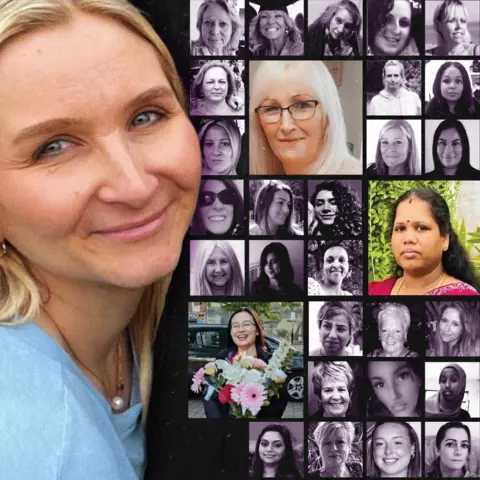
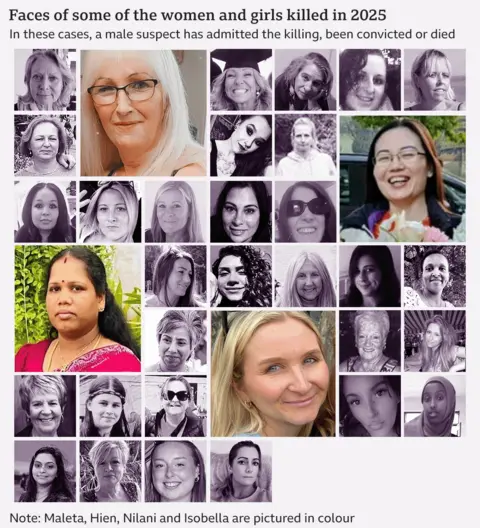
To get a deeper, more human understanding of the situation, we tracked news reports throughout 2025 from across the UK of women or girls who had been potentially killed by men or boys. Often, such stories had not made national headlines.
We looked at all cases where a female had been found dead and a male had been arrested - and cross-checked our own research with UK police forces, the Crown Prosecution Service (CPS), Scotland's Crown Office and Procurator Fiscal Service (COPFS), and the Northern Ireland Courts Service.
Males had been charged in 90 cases, we found.
To date, among those cases, 24 have resulted in convictions for murder and six for manslaughter. Four people have pleaded guilty to manslaughter but still face murder charges.
There were 10 more incidents of women or girls killed where a male suspect also died, according to our findings - making a total of 100.
In another 15 cases, males have been arrested on suspicion of murder or manslaughter, but no charges have been brought. We know that one other investigation is ongoing.
Although there is no exact statistical comparison with previous years in the UK, 2025 was not unique. For years, charities have said that, every three days, a woman is killed by a man.
While men are more likely than women to be victims of homicide, they are also more likely to be the perpetrators in the killings of both sexes.
Analysis of the number of homicides - murder and manslaughter - recorded by police in England and Wales each year is provided by the Office for National Statistics (ONS) and includes the number of female victims where the sex of the principal suspects was male.
For comparison, in that same year the number of male homicide victims was 254. In 230 of those cases, the principal suspect was also male.
There are no direct data comparisons with the other parts of the UK, but according to Scotland's official statistics, in the year to March 2025, a third of the 45 victims were female - with the vast majority of those accused of the crimes being male.
Four women killed, children nearby
Fierce conversations about women's safety were ignited five years ago after the murders of Sarah Everard and Sabina Nessa - with women urged to take to the streets they felt threatened on.
But our findings from 2025 are a reminder that for many women, it is the homes they go back to that are just as dangerous.
In most of the cases where a man has admitted killing a woman, the crime happened in a home or residential setting. And, in most of those cases, the victim and suspect knew each other.
It is an "uncomfortable truth" that "the greatest threat to women is not from strangers in dark alleys, but from those they know, trust and often live with", says Gemma Sherrington, CEO of women's charity Refuge.
That is echoed by Laura Buchan, Scotland's homicide prosecutions lead for the Crown Office and Procurator Fiscal Service, who told us most female homicide victims in the past decade "were killed by a partner at home, almost always a man".
We are focusing on the stories of four of the women confirmed to have been killed by men last year. All were mothers, killed while children were close by.
 Family handout
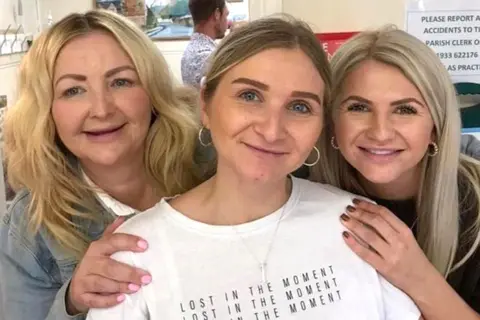
Isobella "Izzy" Knight (c) with her mother Helena (l) and sister Georgina (r)
Thirty-two-year-old Isobella Knight, known as Izzy, lived with her husband Paul, their two daughters and dogs in Northamptonshire.
"She was the funniest person I had ever known," says Helena - describing her daughter as kind and thoughtful and an amazing mum to her little girls.
On the evening before Izzy's murder in June last year, neighbours heard arguing coming from the family home about how money was being spent, and Paul Knight's drug use, according to testimony at Northampton Crown Court.
Knight strangled his wife in a fit of rage while "under the influence of cocaine", the court heard.
Helena says it crucifies her to think of how Izzy was strangled in her own bed. She is now raising her grandchildren, both under the age of seven, describing them as her salvation.
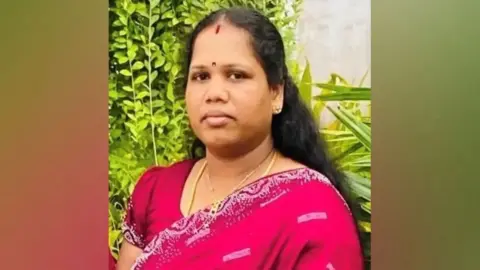
As in Izzy Knight's case, substance addiction was a factor in the case of Nilani Nimalarajah, in Merseyside.
Her alcoholic estranged husband, Nimalarajah Mathiyaparanam, stabbed her 18 times when he was drunk, Liverpool Crown Court was told. He murdered her in the shop beneath the flat where she lived with their three daughters in Sefton.
 Handout
Nilani Nimalarajah, 44, was estranged from her alcoholic husband
Mathiyaparanam had previously been given a restraining order and suspended sentence for domestic abuse and was not supposed to be anywhere near his wife or children on the day he killed her.
The killer, who had been living in Widnes in Cheshire, was angry he had not been invited to a family event, said the judge.
The estranged couple's eldest daughter witnessed the immediate aftermath of the "merciless attack" when she arrived home to find her mother dying, according to the court.
"There isn't a day that goes by without thinking of that day, and what I could have done to stop him. I feel angry and, most of all, sad," she said in her impact statement, which was read to the court.
"The person who made me feel safe and loved is gone. The person who took her away is my dad."
Children are the "forgotten victims" of domestic homicide, according to Children Heard and Seen, a charity that supports children whose parents are in prison.
It wants the government to introduce designated and specific care for children who are bereaved by such incidents. Its CEO Sarah Burrows said she was disappointed but not surprised that these "always overlooked" children had been "left out" of a recent Parliamentary debate on government support for bereaved children.
We put this to safeguarding minister Jess Phillips, who acknowledged there was "room for improvement" and said she was working with the Department for Education to look at "what therapeutic support children might need".
"Those children have really specific needs that the government absolutely has to make a specific pathway for," she said.
The three children of Hien Thi Vu had been living in a state of "shock, grief and fear" since their mother was murdered by their father, the eldest son said in an impact statement read in Woolwich Crown Court.
"The safety and trust we used to feel in our own home, and in our family, has been shattered," his statement said.
 Metropolitan Police Service
Hien Thi Vu ran a nail salon in south-east London
"[I] am constantly reminded of the scene of my mother's body in our home," her daughter, who was 19 at the time of the killing, said in her impact statement.
Hien Thi Vu ran a nail salon where customers described her as "lovely".
"[She] was very jovial and very smiley, but behind her eyes, sometimes you would think that she was really sad," Claudia, a customer and friend, tells the BBC.
Hien's husband, Hai Van Nguyen, had been controlling - the court heard - and had forced his wife to prove where she had been in the hours before the killing.
Coercive and controlling behaviour - defined as a pattern of psychological abuse and intimidation used to harm and frighten a victim - has been a criminal offence in England and Wales since 2015. It was made illegal in Scotland in 2019 and Northern Ireland in 2022.
Izzy Knight's mother Helena believes her daughter didn't "realise" it was happening in her relationship with the man who would eventually murder her.
"Coercive control comes under a huge umbrella," she says. "It's not just bruises."
It can include isolating someone's friends and family, making threats, and controlling and monitoring a victim, according to charity Women's Aid.
Izzy was 17 when her relationship began with Paul, who was three years older.
"Looking back now, we think that he love-bombed her… he was obsessed with her," says Helena.
"We've found out since [her death] that he hid her makeup, and he threw her hairbrush in the bin when she would be going out with friends."
The family "appeared to live a conventional life", the judge remarked, but said that in reality, the couple were sleeping in separate bedrooms and Izzy had wanted a divorce.
Helena says she wishes Izzy had just left the family home, rather than telling Paul the relationship was over - which can be "the most dangerous time" for women.
More than 200 miles away in Cornwall, Maleta was bludgeoned to death by her partner, Adrian Lawrence, after she had told him to leave her home, on 10 January last year.
Lawrence's controlling behaviour had been the cause of arguments between the pair and he went on to bludgeon 60-year-old Maleta, known as Milly, with an axe as she slept, according to the inquest into her death last month.
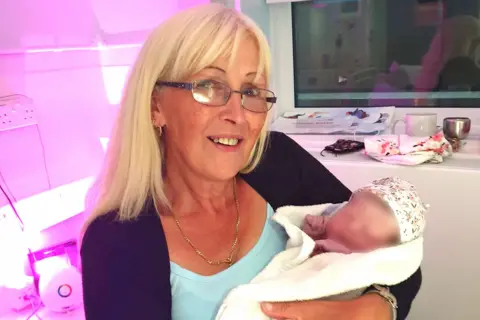 Handout
Maleta (pictured), who was known as Milly, was "a woman like no other" says her daughter Kayleigh
Milly, left behind four adult children and nine grandchildren - two of whom were in the next room when she was murdered.
They are struggling with the trauma, says their mother Kayleigh.
Everyone is devastated by the loss, she says. Milly was "a woman like no other" who loved to dance and was always laughing.
If anyone was ever miserable or upset, Milly's son Jamie says his mother "would do something to make you smile".
Adrian Lawrence took his own life after the killing.
"We'll never get any justice," says Jamie.
Milly's case is one of the 10 from last year where a male suspect also died, according to our findings.
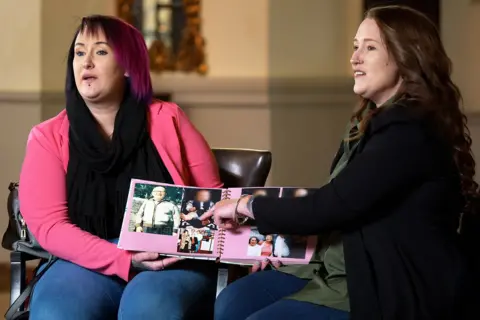
Milly would want people to reach out for help, says her daughter Kayleigh (l) - pictured with her twin Nadine (r)
The UK government is now pursuing what minister Jess Phillips has described as "the largest crackdown on violence against women and girls in British history".
The map below, of the dozens of deaths of women and girls last year, shows such violence can happen anywhere.
The current government's pledges are welcomed by Refuge CEO Gemma Sherrington, but she points to a system that has been subjected to years of "severe underfunding".
An additional £19m over three years in England for accommodation to house women safely represents "only a drop in the ocean compared with the scale of need among survivors living in fear", she says.
Refuge accommodation is vital, Jess Phillips told us, but because there is only "a finite amount of money to go round" she hoped the government's focus on prevention would reduce the need for women to "flee in the middle of the night with their children".
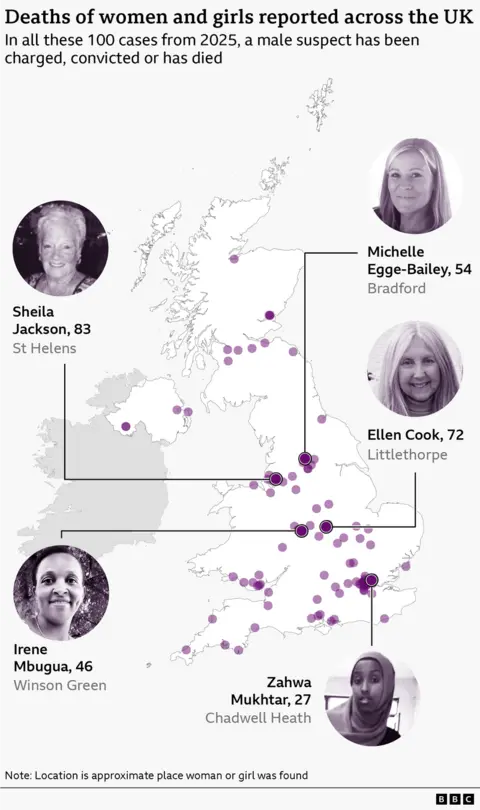
Rates of prosecution in domestic abuse cases are on the rise in England and Wales, ONS statistics suggest. We are "determined to bring offenders to justice and prevent abuse from escalating", says Kate Brown, the Crown Prosecution Service's lead on domestic abuse.
In Scotland, conviction rates for domestic abuse and serious sexual offending are also increasing, says Laura Buchan from the Crown Office and Procurator Fiscal Service - adding that prosecutors must be relentless in the targeting of those who abuse and murder women.
In Northern Ireland, £3m of funding was announced in 2024 as part of a seven-year strategy to focus on ending violence against women and girls.
The sentences handed down to the convicted killers in our analysis range from 21 months to, in the case of Nimalarajah Mathiyaparanam, 29 years.
Hai Nguyen was sentenced to 19 years in December for killing Hien Thi Vu.
Paul Knight was sentenced to 17 years in January for Isobella Knight's murder. Her family say he should never be released.
"He'll be out in his fifties," says Izzy's younger sister, Georgina. She feels angry he will be able to start a new life, despite taking her sister's.
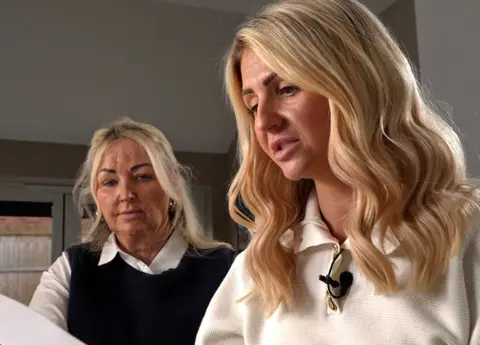
Izzy's mother Helena (l) and sister Georgina (r) say they are speaking out to help other women spot signs of abuse
Izzy's children will be young women when Knight is released and are "terrified", says their grandmother Helena.
The eldest asked about prison and whether the doors are locked and the keys are strong, she says.
"It's a conversation I shouldn't be having - we should be talking about fairies."
The Ministry of Justice recently made murders in England and Wales involving strangulation, and those connected with the end of a relationship, statutory aggravating factors - meaning a judge could consider a longer sentence than the minimum, 15-year life sentence.
But Izzy and Milly's families believe it is not a strong enough deterrent for violent men. They say they are speaking to the BBC to help other women spot the signs of abuse.
"If Izzy could do anything, it would be to help other women," says her sister Georgina. "I'm doing this to be my sister's voice now, because she doesn't have a voice."
Milly would want people to reach out for help, says her daughter Kayleigh. "If she could save another person, even if she didn't know them, my mum would go out [of] her way to help. That's who my mum was."
Additional reporting: Alastair Reid, Lizzie Asante, Harriet Agerholm, Jess Carr, Kirstie Brewer and Katherine Smith