5 months ago
36
5 months ago
36


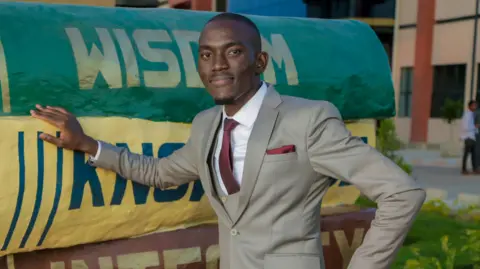 Malama Muleba
Estate agent Malama Muleba says some property managers and landlords consider race when renting out houses
Zambia likes to pride itself as being at the forefront of African nationalism and the fight against colonial rule, however several Zambians have told the BBC that racism remains a problem in the country more than 60 years after independence from the UK.
Although it is rarely overt, they say that subtle everyday discrimination can make it feel like they are second-class citizens in their own country.
They give accounts of black people being passed over for certain jobs, snubbed at restaurants and disregarded by landlords. But there was also an element of optimism, with some Zambians pleased that conversations about race were slowly becoming more common. Zambia's government denies that racism is a problem in the country.
Alexander Bwalya, a black Zambian who asked us not to use his real name, says he finds it "very strange" that people can "live in an African country and be racist to black people".
He recounts visiting a wine bar with his friends in the capital, Lusaka, where they attempted to order relatively expensive bottles of wine. However, the waiters at the bar explained that they were out of stock, he recalls.
"And then came a white family who they were being very friendly with. And then they kept on offering them [the bottles that were supposedly out of stock]," Bwalya says.
"When we complained to the manager, we were told: 'If you don't appreciate the service, you're more than welcome to leave.'"
A heated argument ensued and during the altercation, the white manager allegedly directed a racial slur towards Bwalya's black friend.
Bwalya told the BBC he did not report the matter to the police as he felt it would not be taken seriously.
This is six decades after Kenneth Kaunda - a central figure in the fight against colonialism in Africa - became the country's first president.
Prior to independence in 1964, black Zambians had to carry passes that restricted their movement, schools and hospitals were segregated and skilled, high-paid mining jobs in the copper-rich country were reserved for white workers.
As president, one of Kaunda's missions was to empower the black majority. He imposed a "Zambianisation" policy, which saw white executives in key industries replaced with black ones, and rallied behind groups fighting for independence and the end of white-minority rule in neighbouring countries.
Kaunda's message was clear - black Africans must no longer be subjugated.
In his first press conference after taking office, he said Zambia's task was "building a nation founded on respect for all people of all races, all colours and all religions".
But in 2019 a report from a UN human rights committee found that "like other post-colonial societies, Zambia had struggled with how to prevent and eliminate the racial and class inequalities left by the colonialists".
At the height of colonisation, white people made up less than 2% of the population. Many left after independence and there are no specific figures for the numbers of white people in the country today but ethnic minorities, also including Indians, Chinese and Arabs, make up roughly 9% of the population.
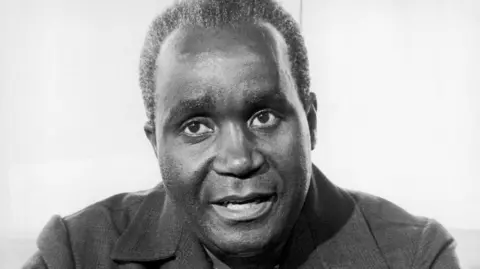 Gamma-Keystone via Getty Images
In 1964, committed pan-Africanist Kenneth Kaunda became Zambia's first president
There is no public official data on racial inequality in Zambia, but anecdotes and discussions on the topic abound on social media.
In January, a Zambia-based worker from employment firm Recruitment Matters posted an opening for a sales and marketing manager, writing in capital letters, "THIS ROLE IS CURRENTLY NOT OPEN TO ZAMBIAN NATIONALS; WE ARE LOOKING FOR EXPATS OR FOREIGN RESIDENTS IN ZAMBIA".
The advert was widely shared on social media, angering many, who felt it was discriminatory.
Omar Chanshi, a 37-year-old who works in marketing, told the BBC: "There are contracts and systems and a lot of opportunities that we just don't have access to as locals. Forget trying to show whether you are the best or most qualified person, you just don't have access."
The Recruitment Matters employee apologised following the backlash and deleted their post. Subsequently, the company acknowledged the "concern" caused.
"The wording did not meet our standards and did not reflect our approach to recruitment," Recruitment Matters told the BBC.
"Recruitment Matters operates a non-discriminatory, skills-based recruitment policy."
Victoria Phiri Chitungu, a historian and director of the Livingstone Museum, explains that Kaunda's message that discrimination was not to be tolerated may have simply pushed the issue below the surface.
"The obvious racist signs and acceptance of racism was no longer welcome and people were aware of that," Chitungu says.
But then "people started conforming to behave in ways that would not show racism. That doesn't mean that it's now absent", she adds.
Malama Muleba, a Lusaka-based property manager says he thinks racism is not a "big issue" in Zambia as a whole, but admits it exists within his industry.
Muleba tells the BBC that when landlords and property managers are assessing tenants, "if a person's skin colour is white, people look at it, they see stability".
"They say: 'OK, this person will be able to pay the rent or they will be able to not give me problems.' Personally, it makes me feel a bit disappointed, but on the other side, it's the reality."
Zambia's small white population - comprising both foreigners and Zambian citizens - is concentrated in towns and cities like Lusaka, Livingstone and Mkushi. According to Muleba, many white people in Lusaka work for big multinational companies.
Numerous Zambians who spoke to the BBC highlighted the intersection between race and wealth, saying it is often assumed that non-black people have money and are therefore treated better than black Zambians.
One word surfaced repeatedly in the BBC's interviews with Zambians - queues.
"When it comes to accessing certain services, you'll find maybe there's a queue and you've got some black Zambians, you've got some Indians and you've got a few white people there," Muleba says.
"You'll find in certain situations the white man will come first in getting attended to. The other Zambians will be looking among each other saying: 'Look, we have been here long before this white man came here!'"
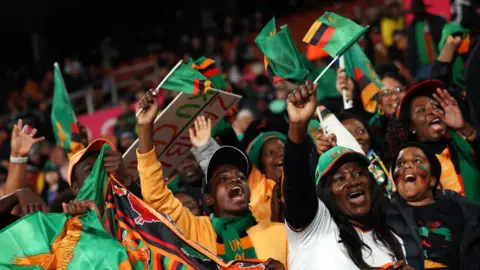 FIFA via Getty Images
Zambia's government says there is no racism in the country and that "everyone lives harmoniously"
Many point out that in these establishments, such as shops, banks and cafes, it is often black employees giving preferential service to non-black customers.
But another black Zambian told the BBC that this wasn't necessarily prejudice: "People do say that in some places being white or Indian or just lighter might get you quick service but to call it racism is extreme. Driving a nice car may get you better service, as well as speaking with a better accent."
Zambia's government spokesperson went further, saying racism "is non-existent" in the country.
"I'll challenge any citizen out there to state that racism is a problem in Zambia. If there is somebody who has said that is a problem, I think perhaps they just wanted to sensationalise. Everyone is living harmoniously," Cornelius Mweeta says.
Historian Penda believes racism does exist in Zambia but "subtly". He theorises that inequality exists in a nation founded on pro-black, pan-African principles because a deference for whiteness was hard-wired into the region, long before independence.
Penda explains that from the 17th Century onwards, various ethnic groups told the legend of Luchele, a mystical, white-looking figure who helped their ancestors set up their kingdoms.
When colonialists and missionaries began arriving in the late 19th Century, some Zambian communities, having never seen a white person before, believed they were "Luchele" and treated them like Gods.
"So from my perspective, it is not a big surprise that even up to now, we have this high esteem for white people - this racial imbalance has been passed down as from history," Penda says.
Adrian Scarlett, a white British man married to a black Zambian, says that despite having lived in Zambia for three years, he still finds it "difficult to comprehend" that there is racial inequality within a black majority country.
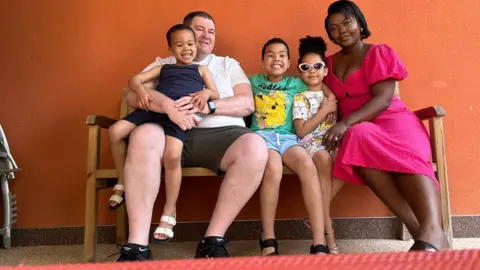 Adrian Scarlett
Adrian Scarlett lives in Livingstone with his wife, Debra, and three children
Scarlett lives in Livingstone and says "there are certain [establishments] where Zambians are just not welcome, it's just a clique of white people who gather there of an evening or weekends".
Under the alias Bye Bye Fatman, Scarlett initially set up social media pages to document his weight-loss journey. Now, much of his content, which goes out to more than 520,000 followers across Facebook and TikTok, centres on racial inequality in Zambia.
The 56-year-old says some of his white friends have distanced themselves from him as a result of his output, but adds that the response from black Zambians has been "overwhelmingly positive".
Scarlett believes the discussions he starts are necessary. Similarly, Bwalya tells the BBC that Zambians desperately need to have "honest conversations" about race.
He is "glad" people have begun to talk about the topic more and hopes this eventually leads to a reckoning - one that reawakens the ideals of their defiant, optimistic founding father.
More about Zambia from the BBC:
 Getty Images/BBC