1 hour ago
3
1 hour ago
3

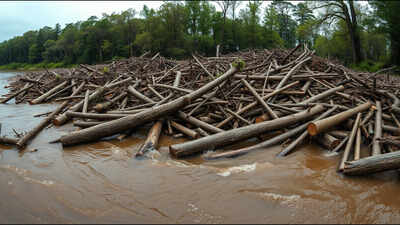
Representative Image of a massive log jam on the Chippewa River, with tangled logs forming a solid barrier across the water (AI-generated image)
In the spring of 1880, a log jam of almost unimaginable scale formed on the Chippewa River near Chippewa Falls, Wisconsin, stretching 7 miles from bank to bank and lasting 6 weeks before it finally broke apart.
Contemporary reports described a river transformed into a solid mass of tangled logs, so densely packed that a person could reportedly walk from shore to shore without ever once touching water. By some estimates, more than 200 million board feet of timber had piled up in the jam, making it the largest ever recorded on Earth at the time. The disaster grew out of the booming 19th-century lumber industry, which relied on floating felled trees downriver to sawmills, a system that occasionally produced jams when water levels dropped and logs became wedged together.
This particular jam remains a Guinness World Records title today, one many experts believe will never be broken again.
How the 19th-century lumber industry set the stage for the Chippewa log jam
When lumberjacks first arrived in the American Midwest, they found a landscape almost entirely blanketed in forest, with Wisconsin alone holding an estimated 47,000 square miles of old-growth trees, an area roughly the size of England. Logging companies set up temporary camps along the region's rivers, felling trees and rolling them into the water to be floated downstream to sawmills.
Workers known as river pigs or river drivers managed this flow using dams, booms and long hooked poles to steer logs and free them when they snagged, though variable water levels meant that occasional jams were an accepted risk of the trade.
As reported in Why the record for longest log jam will probably never be broken and how it even happened, a contemporary newspaper account from The Saint Paul Globe on 31 May 1880 described the Chippewa jam as the largest ever known, with logs piled from bottom to surface across the river's full width.
Why the log jam finally broke apart on 13 June 1880
The jam held for weeks until a stretch of heavy rain in mid-June sent water levels surging. On 13 June 1880, dams at Yellow River and Point Creek gave way one after another, releasing floods of logs that had appeared securely fastened. According to a contemporary account from The Pantagraph published on 22 June 1880, the first rush alone carried around 150 million feet of timber downstream, with logs tumbling end over end and crashing in every direction as the flood pushed through the town.
The surge of debris slammed into a covered bridge measuring 850 feet in length, tearing it from its piers and crushing it against the falls below, while townsfolk scrambled to build a temporary dam to keep the raging river from carving out an entirely new channel through Chippewa Falls.
Why the 1880 Chippewa Falls log jam record may never be broken
The scale of destruction left a lasting mark on Chippewa Falls, sweeping away large sections of the town even as it produced what remains, by volume, one of the most extreme log jams ever documented.
In today's terms, 200 million board feet works out to roughly 471,947 cubic metres of sawn timber, comparable in size to a stack of planks covering a Manhattan city block and rising to half the height of the Empire State Building.
A handful of large log jams occurred over the following decades, but none matched the scale of the Chippewa disaster, and as old-growth forests dwindled and logging shifted toward trucks, trains and mechanised methods, the conditions that produced such an event effectively disappeared. With modern forestry now focused on sustainable management rather than large-scale clear-cutting, the record set in 1880 looks set to remain unbroken for good.