50 minutes ago
1
50 minutes ago
1

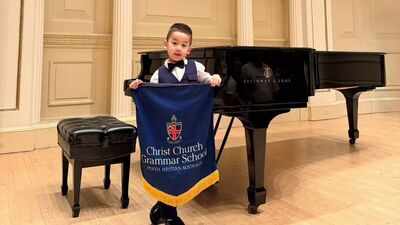
Jeremy LinPhoto credit: Christ Church Grammar School
At just six years old, Perth musician Jeremy Lin has already performed at one of the world’s most celebrated concert venues. The Christ Church Grammar School Pre-Primary student won the Gold Award and the sole First Prize in Group A at the fifth PREMIA International Young Artists Music Festival, competing against performers aged four to six.
His achievement earned him an invitation to the prizewinners concert at Weill Recital Hall at Carnegie Hall in New York, where he became the youngest musician on the programme. As reported by Christ Church Grammar School, Jeremy’s performance was judged by a 24-member international jury, turning an early childhood interest in music into an extraordinary international milestone.A remarkable beginningMost six-year-olds are still discovering what they enjoy.
Some are experimenting with sport, drawing, reading or music, while others are simply learning how to concentrate on a task for longer periods. Jeremy’s experience shows what can happen when talent, practice and opportunity come together at an early age. His journey began in Perth, where he attends Christ Church Grammar School. He has been developing his musical ability as a Pre-Primary student, participating in school life and sharing his interest with classmates.
The school says Jeremy is an excellent musician who enjoys playing both the piano and the violin. Remarkably, he plays both instruments because the two instruments require different physical skills and approaches. The piano requires co-ordination of both hands across a keyboard, while the violin requires posture, bow control and the ability to produce a clear tone without frets. Mastering one instrument can be demanding for a young performer.
Developing confidence across two suggests that Jeremy is comfortable exploring different ways of expressing himself musically.PREMIA festival competitionEarlier in 2026, Jeremy entered the fifth PREMIA International Young Artists Music Festival. He competed in Group A, which was open to performers aged four to six. Competitions at this age are not only about technical performance. Young musicians must also manage the unfamiliar experience of playing before judges and an audience.
They need to remember the music, recover if something goes wrong and remain focused despite the pressure of the setting.
Jeremy’s playing impressed a 24-member international jury. The judges awarded him the Gold Award and the sole First Prize in his category. The result meant he was not simply one of several highly commended performers. He was the only first prize winner in Group A.The award also demonstrated that his performance connected with experienced musicians from different backgrounds.
An international jury brings a broad range of expectations and listening experiences, making the recognition especially meaningful for a young performer.An invitation to Carnegie HallThe first prize came with an invitation to perform at the PREMIA International Young Artists Music Festival Prizewinners Concert. The event took place at Weill Recital Hall at Carnegie Hall in New York. Carnegie Hall has a long association with major musical performances.
The venue has welcomed musicians including The Beatles, Louis Armstrong and Elton John. For professional performers, appearing there can represent the culmination of years of work.
For Jeremy, the invitation arrived while he was still in Pre-Primary. Weill Recital Hall is one of Carnegie Hall’s performance spaces and is known for chamber music, recitals and emerging artists. Performing there placed Jeremy in a setting with a strong musical history and an audience prepared to listen closely.
The concert also brought together prizewinners from the festival. Jeremy was the youngest musician on the programme, making his appearance especially distinctive. He was not simply attending the event as a young audience member. He was performing as one of the recognised artists.What it takes to perform so youngA six-year-old musician still has a developing attention span, memory and ability to manage nerves.
Preparing for an international performance requires careful support from teachers and family members. Young children learn differently from adults. Repetition needs to be balanced with play, and practice sessions must be structured around the child’s energy and concentration. Encouragement is as important as correction, for confidence can affect the quality of a performance.
For Jeremy, the Carnegie Hall appearance would have been more than not learning notes.
He would have had to travel across the world, adapt to another environment and perform in a very prestigious setting. The experience may have been unfamiliar acoustics, a different piano and the emotional pressure of being observed by an audience. These challenges can become valuable parts of musical education. A child who learns how to prepare, travel and perform may develop skills that continue to help in future competitions and concerts.Piano and violin as creative toolsJeremy’s interest in both piano and violin gives him different ways to understand music. The piano is a clear visual layout, with notes laid out across the keyboard, and multiple pitches available at once. It can provide harmony, melody and rhythm in a single performance. The violin is more physically direct. The sound is produced by the player through the relationship of bow, strings and fingers. The pitch is determined by precise placement and the performer needs to listen continuously to adjust tone and intonation.
Learning both instruments can enhance musical awareness. A student may begin to recognise how melody moves between instruments or how different sounds can express the same musical idea. It can also encourage flexibility, as the performer learns to adapt technique to the instrument. For Jeremy, the combination appears to be part of a broader love of music rather than a narrow focus on competition. His school has described him as someone who enjoys performing and sharing creative ideas with peers.The role of school supportA young musician’s achievement is personal, but it rarely happens without a supportive network. Teachers provide guidance, families create time for practice, and schools offer encouragement and opportunities to perform. Christ Church Grammar School celebrated Jeremy’s Carnegie Hall appearance as a significant achievement for the school community. Being recognised by teachers and classmates is a way to help a young performer to see that music is not just an individual activity.
It can also be a way to connect with others. School communities offer an audience that is familiar and encouraging. Performing for classmates can help a child build confidence before appearing in a formal competition or international concert. It also allows peers to see the effort that goes into the result. Jeremy’s success may inspire other students to explore music, whether through piano, violin or another instrument.
A visible example can make performance feel more accessible and show that serious musicianship can begin during the early years of schooling.More than a trophyTo win the Gold Award and First Prize is an amazing achievement, but the real value of this journey is more than a trophy or a certificate. For Jeremy, it is a rare chance to go out on an international stage, meet other young musicians and soak up the magic of a world-famous concert hall.
Moments like this completely change a child’s view of music. Playing a piece isn’t just a classroom exercise anymore; it becomes tied to travel, history, and a much bigger, global community of artists.
Standing on the stage at Carnegie Hall is the kind of memory that stays vivid for a lifetime, no matter where his love for music takes him down the road.Beyond the spotlight, competitions teach grit. Every artist hits off-notes, and no one wins first place every single time.
Learning to take constructive feedback in stride, stick to the practice routine, and actually love the process builds character that matters way more than a shelf full of awards. At just six years old, Jeremy has endless time to explore new instruments and discover his own style. This early win is a wonderful spark, but it’s only the first chapter of his story.A milestone in a young musical lifeJeremy’s Carnegie Hall appearance is remarkable because of the combination of age, achievement and setting.
He won the sole First Prize in his age group, earned an invitation to a prizewinners concert and became the youngest performer on the programme. Yet the most human part of the story is simple. A young child who enjoys music had the opportunity to perform for a large audience in a place known around the world. His achievement reflects talent and preparation, but also the joy of discovering something he wants to share.
As Jeremy continues to work on his piano and violin skills, this performance at Carnegie Hall will be just one chapter in a longer musical journey. It could lead to more competitions, concerts or other interests altogether. Whatever comes next, the experience has already shown him his music can go far beyond his classroom in Perth.