1 hour ago
1
1 hour ago
1

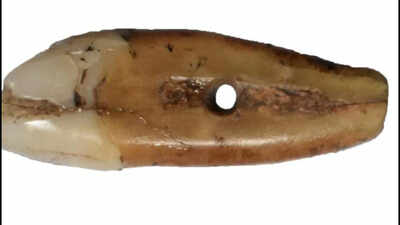
When archeologists found the tooth it was already damaged, measuring only 23 millimeters. Its crown had been split by agricultural activity into two parts. (Image Courtesy: N. Marković)
It sat on a museum shelf for nearly twenty years, unseen, mistaken for something far more common. But now a closer look at a tiny, worn tooth is giving a remarkable glimpse into how Neolithic people in the Balkans may have remembered, and perhaps even honored, the dead, states an archaeology report by Phys Org.
If we go by the report, more than 6,500 years ago, someone drilled a hole through a human canine, threaded it on a cord and probably wore it as a pendant. The bizarre artifact was unearthed at the Neolithic site of Jablanica, in Serbia, and is now regarded as the only reliably documented human tooth ornament from the Neolithic central Balkans, adds the report.
A bead that was not a bead
It is mentioned in the study that the tooth was found in field surveys at Jablanica, a settlement belonging to the Vinča culture, one of the major societies of prehistoric Europe.
Pottery, figurines and finely crafted bone tools were also found at the site, south of Belgrade, since its discovery in the late 19th century. When archeologists found the tooth it was already damaged, measuring only 23 millimeters. Its crown had been split by agricultural activity into two parts.
The pieces eventually ended up in the Museum of Mladenovac, where they were identified as parts of a bead and largely forgotten for nearly 20 years.
That was until archeologist Nemanja Marković and his colleague Ana Maričić examined the object more closely. “I was curious more than surprised at first,” Marković said in the report. But upon seeing the unmistakable shape of a human canine, “it was clear that we were looking at something far more unusual than a typical tooth bead.”
Clues in the tooth
Since the tooth had been found on the surface rather than in a secure archeological context, its age and history had to be established by detective work.
The experts used a combination of visual inspection, microscopy, and X-ray analysis. Evidence of wear on the chewing surface suggested that the tooth had belonged to a middle-aged adult. The root was also in good condition, suggesting that it had not been forcibly removed from a living person.
The tooth was likely taken from the remains of someone who had already died and whose skeleton had become sufficiently exposed or accessible for the tooth to be collected.
Dating the ornament itself was more difficult. Its drill marks were compared with those on a shell bracelet from Jablanica that is securely dated to about 4700 B.C. The researchers say that similarities in the manufacturing techniques suggest that the tooth pendant dates to roughly the same period, though they note that certainty is impossible for a surface find.
A craft of remarkable skill
According to the experts, there is a good deal of craftsmanship shown in the object as well.
Under the microscope Marković saw fastidious workmanship that indicated the pendant was no hasty improvised trinket. The drilling was skillful and the surfaces were smooth, which suggests that the object could have been worn for a long time. This is especially impressive as the ornaments seem to have been rare at Jablanica.
There have been only two other examples found there, a part of a shell bracelet and another shell pendant.
Elsewhere in Europe, human tooth ornaments are also rare. Such examples have occasionally been reported, but none has been firmly established for the Neolithic central Balkans.
Memory in a surprising form
The finding poses interesting questions about the relationship between the living and the dead in Vinča society. It was not merely a biological remnant. Someone had selected it, modified it with careful artistry, and apparently worn it for personal adornment.
What it meant, remembrance, identity, status, ancestry or something more intimate, is unknown. The discovery is also a reminder that archeology can sometimes be about asking new questions of old things.
The tiny tooth from Jablanica tells a much bigger story: that in Neolithic Europe, human remains may not have been confined to graves. It seems that at least here part of a dead person was turned into an object that could be kept close to the body, a striking expression of memory, meaning and the continuing connection between the living and the dead.