1 hour ago
1
1 hour ago
1

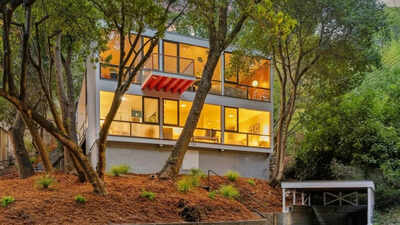
The home's architecture is closely tied to its terrain. Instead of imposing a conventional rectangular floor plan on the sloping site, Olsen organized the house across a series of split levels.
There are homes that are valued for their size, homes prized for their views, and homes that become significant because of the people who once lived within their walls. In Berkeley’s Thousand Oaks neighborhood, the Kip House belongs firmly to the third category.
Tucked into a hillside on San Diego Road, the roughly 1,900-square-foot residence has had an unusually quiet history. Built in 1952, it remained with its original owners for more than six decades and changed hands only once before returning to the market in 2026. The asking price is now $1.425 million, reports Realtor website. According to the news report, the house was designed by Donald Olsen for Arthur Frederic Kip, a UC Berkeley physics professor whose pioneering semiconductor research helped establish scientific oundations for the computer and electronics revolution that followed.
For Olsen, the commission came relatively early in his career. He had studied under Walter Gropius, founder of the Bauhaus movement, at Harvard, and the influence of that education is apparent throughout the Kip House. Rather than relying on ornament or historical references, Olsen created a home defined by geometry, transparency and a close relationship with its hillside setting. Walls of glass bring natural light into the interiors, while the clean lines give the house a distinctly modern character.
Modernism on a Berkeley Hillside
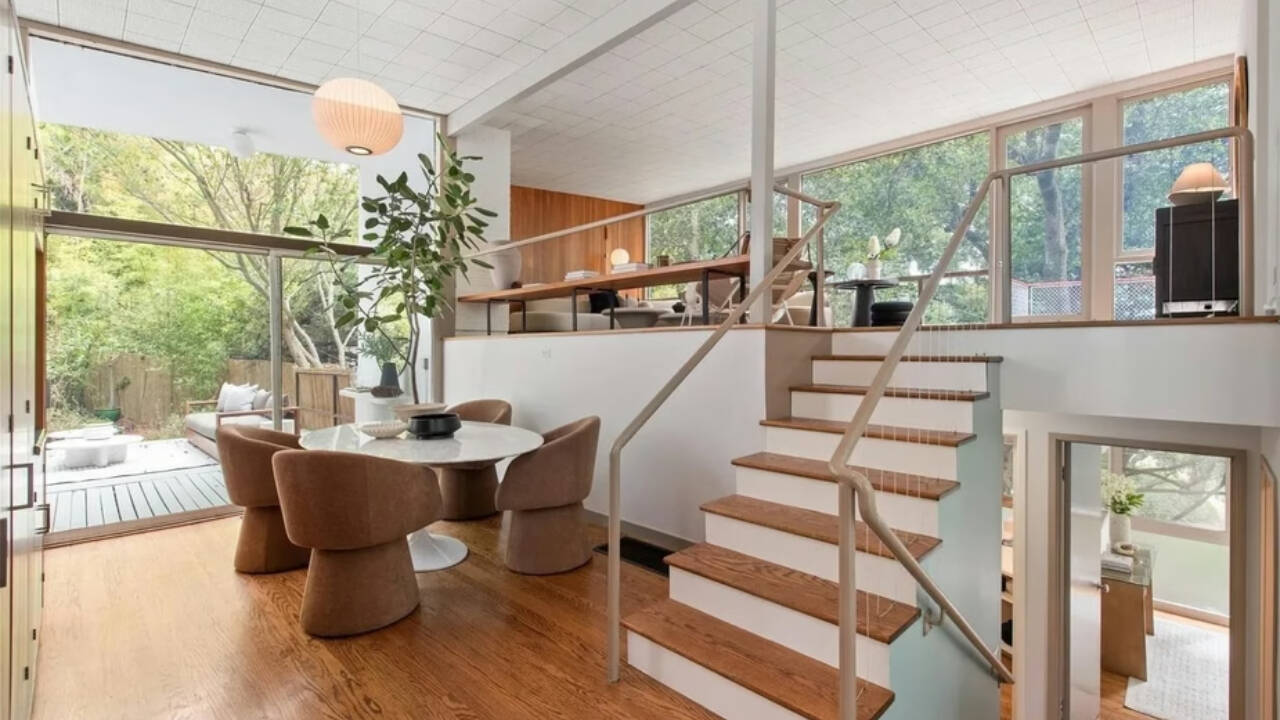
The home's architecture is closely tied to its terrain. Instead of imposing a conventional rectangular floor plan on the sloping site, Olsen organized the house across a series of split levels. Entry is made at an intermediate level, where the kitchen and dining area are located. The plan then rises toward the living room and study, while two of the three bedrooms occupy the lower level. The arrangement creates a sense of movement through the house while allowing the architecture to work with the hillside rather than against it.
It is a practical expression of midcentury modernism, where structure, landscape and everyday living were intended to function as a unified composition.
An unlikely modernist landmark
The Kip House is part of a particularly interesting stretch of San Diego Road. A few doors away stands Olsen's own residence, constructed several years later and now listed on the National Register of Historic Places. Together, the two homes form an unusual pocket of Bay Area modernism in a neighborhood otherwise better known for its 1920s and 1930s Mediterranean and Tudor-style houses.
That contrast makes the Kip House distinctive without making it feel disconnected from Thousand Oaks.
Its modernism is noticeable, but its hillside setting allows it to remain part of the neighborhood's eclectic architectural character.
73 years, two owners
Arthur Frederic Kip and his wife, Joan, owned the house from its construction in 1952 until 2013.
Perhaps the most remarkable part of the property's history is how little it has changed. Arthur Frederic Kip and his wife, Joan, owned the house from its construction in 1952 until 2013.
That year, Susie Injijian purchased the property for $1.025 million, becoming only its second owner. Since then, Injijian has concentrated on maintenance and preservation rather than transforming the interiors to suit contemporary tastes.
A main-floor bathroom was updated during asbestos abatement work in 2013, with the original linoleum tile replaced by penny travertine. A more extensive renovation of the lower-level bathroom began in 2021 and took five years to complete, with the pandemic contributing to the extended timeline.
Other work has focused on essential improvements, including electrical upgrades, roofing and asbestos abatement.
Preservation over reinvention
That philosophy of restraint may be the home's greatest asset. Rather than treating the 1952 design as something to modernize away, the owners have largely allowed Olsen's original vision to remain visible. Even the more recent bathroom work was approached with enough sensitivity to preserve the character of the house.For buyers seeking authentic midcentury architecture, that distinction can be significant. Every major renovation presents an opportunity to alter a room, add square footage or introduce features that were never part of the original design. At the Kip House, decades of ownership have produced remarkably little of that intervention. The result is a home that offers something increasingly difficult to find: a midcentury residence whose defining architectural qualities have survived largely intact.
A wider audience for a rare survivor
The listing is already attracting attention beyond Berkeley, with prospective buyers reportedly reaching out from as far away as Los Angeles. That interest reflects more than the property's price or location. Preserved midcentury homes are increasingly sought after by buyers who value architectural provenance, original design and historical continuity. The Kip House offers all three. It was designed by an important Northern California modernist at an early point in his career, built for a scientist whose work helped influence the technological age, and maintained through only two ownership eras over 73 years.
At $1.425 million, the house is being offered not simply as a piece of Berkeley real estate, but as a remarkably preserved chapter of Bay Area architectural and scientific history. In a housing market where homes are frequently remodeled, expanded and reinvented, the Kip House's greatest luxury may be what has not happened to it. More than seven decades after its construction, Olsen's design still speaks for itself.Images Courtesy: Realtor website